
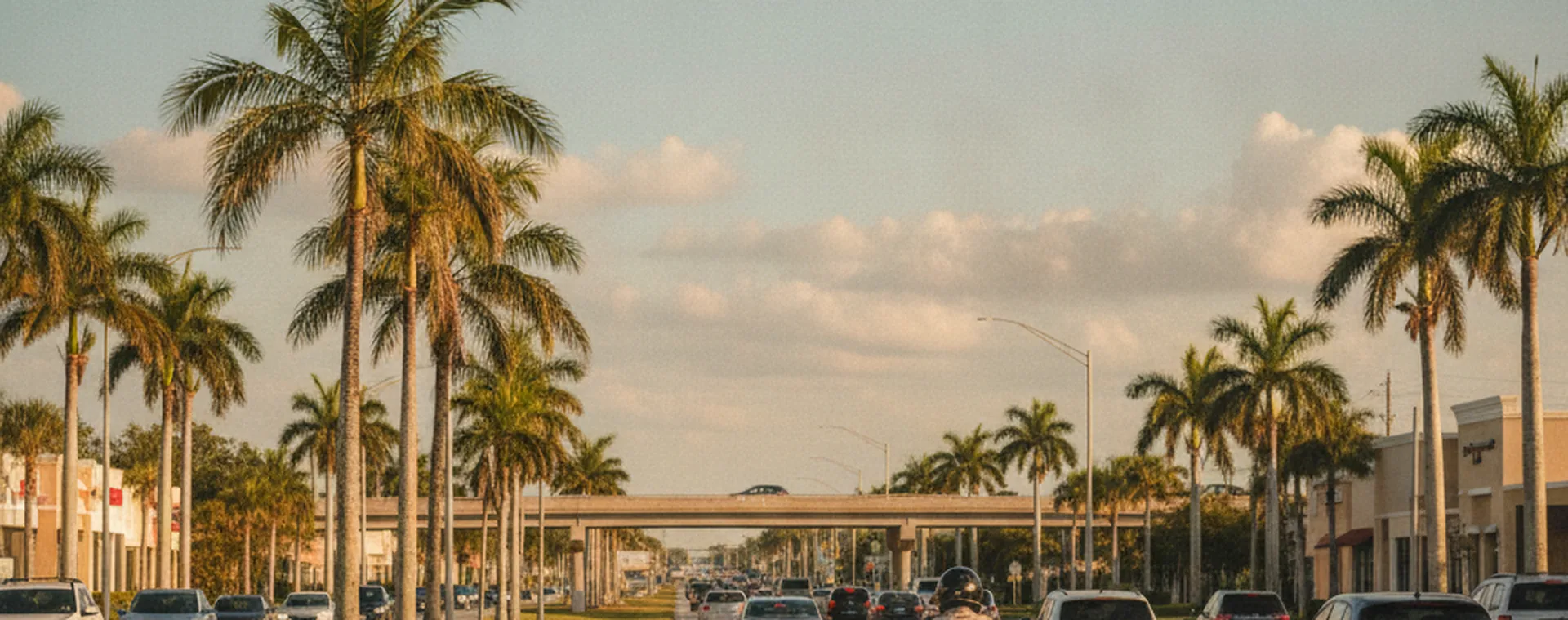
Miami motorcycle accident lawyer
Why a rider has no PIP, and where the money is instead in Miami-Dade County
Miami-Dade County recorded 60,000 traffic crashes in 2024, injuring 29,359 people and killing 272, according to the Florida Department of Highway Safety and Motor Vehicles. Florida recorded 9,347 motorcycle riders involved in crashes in 2024; 575 died and only 1,227 walked away uninjured, about one in eight. A car occupant in the same report usually walks away. The difference that decides the claim is not the injury rate though — it is that a motorcycle is not a motor vehicle for PIP under Fla. Stat. § 627.732(3), so there is no automatic first $10,000 behind a rider. The claim is filed at the Miami-Dade Circuit Court, 73 West Flagler Street, and serious injuries go to Ryder Trauma Center at Jackson Memorial, or HCA Florida Kendall for the west and south of the county. The statute, the helmet rule and the fault analysis are on the Florida motorcycle accident page. What follows is the Miami-Dade County part.
- Miami-Dade County crashes, 2024
- 60,000Florida Department of Highway Safety and Motor Vehicles
- People injured
- 29,359In Miami-Dade County alone, in one year
- People killed
- 272Down from 325 the year before
- PIP behind a rider
- NoneA motorcycle is not a motor vehicle for PIP. § 627.732(3)
Quick answers about Miami motorcycle accident claims
- Does my PIP cover a motorcycle crash?
- No. Fla. Stat. § 627.732(3) defines a motor vehicle for PIP as self-propelled with four or more wheels. A motorcycle has two, so no PIP sits behind the rider. You did not lose it — it was never there.
- Then who pays my medical bills?
- The at-fault driver’s bodily injury coverage, your own uninsured or underinsured motorist coverage, a resident relative’s policy, health insurance, or a letter of protection with a treating doctor. Finding which of those exists is the first work in the case.
- Does the 14-day treatment deadline apply to me?
- No. The 14-day rule is a PIP rule, and PIP is not in play. Get treated immediately anyway — the gap between the crash and the first record is the first thing an adjuster looks for.
- Do I have to clear the permanent injury threshold?
- Generally not. The § 627.737 threshold gates claims against an owner or operator of a vehicle covered by PIP. A rider suing a driver is not in that posture in the usual case.
- I was not wearing a helmet. Is the claim over?
- No. Florida allows riders 21 and over to ride without a helmet if they carry at least $10,000 in medical benefits coverage. It becomes a comparative fault argument about the injuries, not a bar to the claim.
- The driver said they never saw me.
- That is the most common account in these cases and it is not a defense. The questions are sight lines, lane position, lighting, whether the driver was turning left across the rider’s path, and what any nearby camera shows.
- What if the driver has no bodily injury coverage?
- Then uninsured motorist coverage is usually the claim. Florida requires PIP and property damage liability but does not require bodily injury coverage at all, which is why UM matters more to a rider than to almost anyone else.
01 The law, once
02 The roads
Where motorcycle accident claims arise in Miami-Dade County
60,000 crashes in a county of this size are not spread evenly. They concentrate on a handful of corridors, and knowing which one a crash happened on usually tells you which agency wrote the report and what kind of case it is.
- US-1 and South Dixie HighwayContinuous turning movements into commercial frontage, which is the setting for the left-turn collision that dominates these cases.
- Bird Road and Kendall DriveSix lanes with a turning conflict at every block, and the speed differential between lanes that turns a lane-change contact serious.
- The Palmetto Expressway, SR-826Heavy volume and constant lane changes, where a rider has nowhere to go when a gap closes.
- Biscayne BoulevardMulti-lane with frequent turns into and out of commercial entrances, and poor night lighting on stretches of it.
- Calle Ocho and Flagler StreetDense and slower, so the collisions are turning conflicts and door conflicts rather than high-speed impacts.
- Key Biscayne and the Rickenbacker CausewayA recreational riding route with tourist traffic, abrupt speed changes and a toll plaza transition.
- Okeechobee Road, US-27Heavy truck traffic sharing a road with riders, where the size differential compounds everything else.
- Krome Avenue, SR-997Two lanes, limited lighting, agricultural traffic and no median — the head-on exposure that is rare elsewhere in the county.
03 The coverage gap
04 Where the money is
05 The helmet question
06 How these happen here
07 Examples of situations
Situations this office sees in Miami-Dade County
The following are examples of the kinds of situations that arise in this county. They are illustrations of how the rules apply, not descriptions of past cases, and they do not predict any outcome. Every claim turns on its own facts, its own coverage and its own medical record.
A driver turns left across the rider
The most common serious collision here. Sight lines, closing speed and any nearby camera decide it, not the driver’s recollection.
A lane change on a multi-lane arterial
Mirror coverage, lane position and the speed differential between lanes, with a glancing contact producing a disproportionate injury.
A car pulls out from a commercial driveway
Sight lines obstructed by parked vehicles or landscaping, which can bring a property owner into the picture alongside the driver.
A rider goes down on a road surface defect
A repair or a drop-off a car would not notice. A road authority or contractor may be a defendant, with its own notice requirements.
The at-fault driver carries minimum coverage
Severe injuries against a small policy, which turns the case into a uninsured and underinsured motorist question from day one.
08 The evidence
Evidence that exists here and often goes uncollected
Almost every camera that saw the crash overwrites itself within days or weeks. The difference between a disputed liability case and a straightforward one is usually whether someone asked for the footage while it still existed.
The motorcycle itself
Impact direction and severity. Released to an insurer or scrapped within weeks unless preserved in writing.
The helmet, jacket and boots
Physical evidence of what happened to the rider, and of what gear was worn.
The crash report and the agency that wrote it
And a correction request if the narrative came only from the driver.
Any camera within sight of the intersection
Businesses, doorbells, buses and garages. Most overwrite within days.
Every policy in the household
Uninsured and underinsured motorist coverage reaches further than people expect.
Photographs of sight lines from the driver’s position
What the driver could actually see is the heart of a left-turn case.
Medical records from the first days
There is no PIP paying for them, so continuity has to be managed deliberately.
09 The report
10 The office
Miami motorcycle accident questions, answered
Does PIP cover a motorcycle crash in Florida?
No, and this is the fact that reorganizes the whole claim.
Fla. Stat. § 627.732(3) defines a motor vehicle for PIP purposes as self-propelled with four or more wheels. A motorcycle has two, so no PIP sits behind the rider — no automatic first $10,000, no 80 percent of medical bills regardless of fault, and no 14-day deadline.
The precise way to say it matters: a rider did not lose PIP by riding. A rider never had it.
Then who pays for my treatment while the case runs?
Whatever coverage exists, and finding it is the first work in the case.
The at-fault driver’s bodily injury coverage. Your own uninsured or underinsured motorist coverage, and often a resident relative’s. Health insurance. Or a letter of protection with a treating doctor, which defers payment until the claim resolves.
None of these starts automatically the way PIP does in a car case, which is why a motorcycle claim needs attention in the first week rather than the first month.
I was not wearing a helmet. Does that end my claim?
No. Florida allows a rider 21 or older to ride without a helmet if covered by a policy providing at least $10,000 in medical benefits for crash injuries. Riders under 21 must wear one.
Riding without a helmet is not negligence in itself and does not bar a claim. It opens a comparative fault argument under § 768.81 aimed at the injuries rather than the crash, and only at injuries a helmet would plausibly have prevented.
Eye protection is a separate requirement that applies regardless.
The driver says they never saw me. Is that a defense?
No, and it is the most common thing said in these cases.
A driver turning left owes a duty to see what is there to be seen. The questions that follow are about sight lines, lane position, lighting, closing speed and what any nearby camera recorded — not about the driver’s recollection of their own attention.
The reason it comes up so often is a genuine perception problem with narrow vehicles, which is an explanation for the crash rather than an excuse for it.
Do I have to clear the permanent injury threshold?
Generally not, and this is one place the lack of PIP works in a rider’s favor.
The threshold in Fla. Stat. § 627.737 gates claims for pain and suffering against the owner or operator of a vehicle covered by PIP. A rider suing a driver is usually not in that posture.
So the barrier that blocks many car claims for non-economic damages generally does not block a rider’s.
What if the driver has no bodily injury coverage?
Then uninsured motorist coverage is usually the claim, and it is why UM matters more to a rider than to almost anyone else on the road.
Florida requires PIP and property damage liability but does not require bodily injury liability coverage at all. The driver who pulled across your path may carry nothing that pays for your injury.
UM may come from your own policy or a resident relative’s, and in a serious motorcycle case it is frequently the only meaningful source of recovery.
They offered me the driver’s policy limits. Should I take it?
Not before checking uninsured motorist coverage, and this is the most expensive mistake available in a motorcycle case.
Accepting the at-fault driver’s limits and signing a release without first giving certified-mail notice to a UM carrier can destroy the UM claim under Fla. Stat. § 627.727(6)(a).
The UM carrier then has 30 days to authorize the settlement or to preserve its subrogation by paying the offer amount itself. Where the driver carries a minimum policy and the injuries are severe — the usual motorcycle pattern — that notice is the difference between a real recovery and a token one.
What happened to my motorcycle matters?
A great deal, and it is usually gone before anyone asks for it.
The machine shows impact direction and severity. The helmet, jacket and boots show what was worn and what happened to the rider. All of it is routinely released to an insurer, repaired or scrapped within weeks.
Photograph everything before it moves, and send a written demand that the motorcycle and the gear be preserved.
Where will I be treated if the injury is serious?
Ryder Trauma Center at Jackson Memorial, or HCA Florida Kendall for the west and south of the county.
Those first-hour records are typically what proves the injury months later, which is why where you were taken matters to the claim as well as to the treatment.
How long do I have to bring a claim?
Two years for a negligence claim accruing on or after March 24, 2023, under Fla. Stat. § 95.11.
There is no 14-day PIP clock here, but the evidence runs out long before two years: camera footage within days, and the motorcycle itself within weeks.
What does it cost?
The first conversation costs nothing and commits you to nothing.
Injury cases are handled on a contingent attorney’s fee, meaning no attorney’s fee unless there is a recovery. Case expenses are governed by the written representation agreement, including who pays them if there is no recovery.
Who will actually handle my case?
Jose A. Dapena. You deal with your attorney directly at every stage rather than through an intake department or a case manager.
He has practiced in Florida since 1998, Florida Bar number 152358, and was in-house counsel for a PIP carrier in 2002 — which is useful here precisely because the coverage question is the whole case.
11 Keep reading
- Florida motorcycle accident lawThe statutes, the deadlines and the defenses, in full
- The Miami officeEverything the office handles, and the area it covers
- Personal injury in FloridaThe whole practice, and the other 22 kinds of claim
This page is general information about Florida law, not legal advice about your case. Published by Jose A. Dapena, P.A. Last updated October 2026.
Free case review with a Miami motorcycle accident lawyer
No fee to talk and no obligation. You deal with your attorney directly, at every stage.