
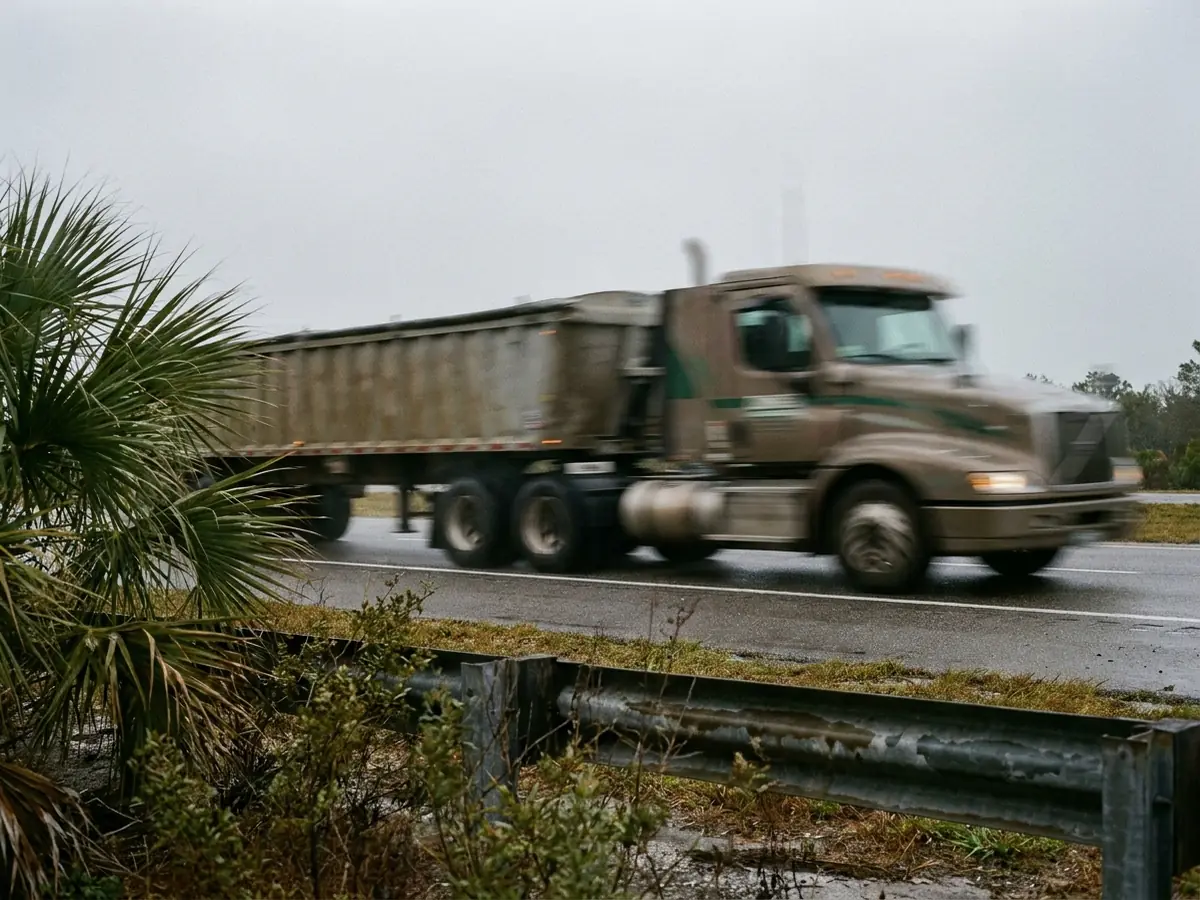
Florida truck accident lawyer
Two trucks. Same weight. Very different insurance.
The most consequential fact in a Florida truck case is usually not how the crash happened. It is whether the carrier was operating across state lines or only inside Florida — because that one difference changes the minimum liability coverage behind the truck, and it changes how many hours the driver could lawfully have been at the wheel. What it does not change is the paperwork. Florida applies the same federal safety rules to carriers that never leave the state, so the logs, the inspection records and the drug tests exist either way. They are kept for six months, and then they may lawfully be destroyed.
Quick answers about Florida truck accident claims
- Why does interstate or intrastate matter so much?
- It sets the minimum insurance. A for-hire carrier crossing state lines must carry at least $750,000 for non-hazardous freight. The same truck running only inside Florida may carry $300,000.
- How long do the driver’s logs exist?
- Six months. Federal rule requires carriers to keep records of duty status and ELD data for that long, and no longer.
- Is a truck claim just a bigger car claim?
- No. Florida PIP and the injury threshold still apply to you, but the defendant is a regulated business with federal record-keeping duties and usually several layers of insurance.
- Who else can be responsible besides the driver?
- The motor carrier, and sometimes a freight broker, the shipper who loaded the trailer, or a maintenance contractor. Each may carry separate coverage.
- What should be done first?
- A written preservation demand to the carrier, before the six-month clock runs on the logs and before the vehicle is repaired or released.
- Can the case be handled in Spanish?
- Yes. The attorney and the staff speak Spanish, so the matter runs in Spanish from the first call.
- Interstate minimum
- $750,000For-hire, non-hazardous freight. 49 CFR 387.9
- Florida intrastate minimum
- $300,000For a vehicle of 44,000 lbs or more. Fla. Stat. § 627.7415
- Driver log retention
- 6 monthsRecords of duty status and ELD data. 49 CFR 395.8(k)(1)
- Deadline to sue
- 2 yearsFla. Stat. § 95.11, for crashes on or after 24 March 2023
01 The question that sets the ceiling
02 The rulebook applies either way
03 Two different ceilings
04 The gap below 26,001 pounds
05 A contract that cannot shift the blame
06 The six-month clock
07 Who answers
08 What still applies to you
09 Where these cases come from
Miami-Dade
Miami-Dade freight moves through the Port of Miami and the warehouse corridors off the Palmetto and NW 12th Street, feeding I-95 and the Turnpike. Container and drayage traffic brings defendants a car case never has — terminal operators and chassis providers, easy to miss and hard to add late.
Hillsborough
Hillsborough is a distribution county. The I-275 and I-4 interchange north of downtown carries the heaviest truck traffic in the area, Port Tampa Bay moves fuel and aggregate, and the warehouse corridors along the interstate run commercial traffic at all hours.
10 The law
Florida laws that decide a truck accident case
-
Federal minimum financial responsibility
At least $750,000 for a for-hire carrier moving non-hazardous property in interstate commerce. Higher for hazardous materials — $1,000,000 or $5,000,000 by category.
-
Florida commercial vehicle coverage
For intrastate commercial vehicles: $50,000 per occurrence at 26,000 to under 35,000 lbs, $100,000 from 35,000 to under 44,000, and $300,000 at 44,000 and above. Vehicles subject to the federal rules must meet those instead.
-
Record retention
Carriers must keep records of duty status and supporting documents for six months. ELD data, including the back-up copy, carries the same requirement.
-
Hours of service
11 hours driving after 10 off; no driving past the 14th consecutive hour on duty; a 30-minute break once 8 cumulative driving hours have passed; 60 hours in 7 days or 70 in 8, restarting after 34 consecutive hours off.
-
PIP and the fourteen-day rule
Treatment must begin within fourteen days of the crash or PIP pays nothing. PIP then pays 80% of medical bills to its limit, regardless of fault.
-
The injury threshold
Noneconomic damages require significant and permanent loss of an important bodily function, permanent injury within a reasonable degree of medical probability, significant and permanent scarring or disfigurement, or death.
-
Comparative fault
A party found greater than 50% at fault for their own harm recovers nothing. The bar does not apply to medical negligence claims under chapter 766.
-
Deadline to sue
Two years for most negligence claims arising on or after 24 March 2023. Four years before that date.
11 Step by step
What to do after a truck accident in Florida
- 01
Photograph the door and the trailer
The company name and the USDOT number on the cab door identify the carrier, and the USDOT number is what reveals whether its authority is interstate or intrastate. Photograph the trailer number too — it is often a different company.
- 02
Begin treatment within fourteen days
The PIP deadline applies in a truck case exactly as it does in any other. Miss it and the first layer of medical funding is gone whoever caused the crash.
- 03
Get a preservation demand out
In writing, to the carrier, naming the logs, ELD data, engine control module, dispatch records, driver qualification file and maintenance history. The six-month retention clock is already running.
- 04
Do not let the vehicle be released
The engine control module records speed, braking and throttle in the seconds before impact. Once the truck is repaired or sold, that data goes with it.
- 05
Check the carrier’s FMCSA record
Operating authority, insurance filings and inspection history are public. They establish which minimum applies and often reveal a pattern.
- 06
Say nothing recorded to the carrier
Many carriers have a rapid-response protocol that puts an investigator at the scene the same day. Their reconstructionist may be working before you have seen a doctor.
12 What proves it
- Records of duty status and ELD data — six months, then the duty ends.
- The engine control module, which lives only as long as the truck does.
- The driver qualification file: licensing, medical certification, training, prior violations.
- Maintenance and inspection records for the tractor and the trailer separately.
- Dispatch messages and the load paperwork, which show the schedule the driver was held to.
- The carrier’s FMCSA record — authority, insurance filings and inspection history, all public.
- Any forward-facing or in-cab camera footage, which is retained at the carrier’s discretion.
13 What damages a claim
- Waiting months, by which time the logging data is lawfully gone.
- Letting the truck be repaired or released before the engine control module is downloaded.
- Treating it as a claim against the driver alone.
- Assuming the minimum coverage is the only coverage, without checking for excess layers.
- Giving a recorded statement to a carrier that already has a reconstructionist on the file.
Frequently asked questions about Florida truck accidents
Does a truck that never leaves Florida still have to keep driver logs?
Yes. Fla. Stat. § 316.302(1)(b) adopts 49 C.F.R. parts 382–386 and 390–397 for intrastate commercial vehicles, which is the same body of rules an interstate carrier follows. Records of duty status, driver qualification files, inspection and maintenance records and drug and alcohol testing are all required either way.
The intrastate version is frozen as those rules stood on 31 December 2023, which can matter on fine points, but the core record-keeping duties are the same. The difference between interstate and intrastate is the insurance minimum and the hours limits — not whether the paperwork exists.
How many hours is a truck driver allowed to drive in Florida?
It depends on the carrier’s authority. An interstate driver may drive up to 11 hours, only after 10 consecutive hours off duty, and not at all after 14 consecutive hours on duty — 49 C.F.R. § 395.3(a).
A Florida intrastate driver may drive up to 12 hours after 10 hours off, with no driving after the sixteenth hour on duty, and a weekly cap of 70 hours in 7 days or 80 in 8 — Fla. Stat. § 316.302(2)(b).
So the same hours behind the wheel can be a violation for one carrier and lawful for another. Establishing which ceiling applied is one of the first things worth pinning down in a fatigue case.
What if it was a box truck or a van rather than a semi?
An intrastate vehicle under 26,001 pounds — by gross vehicle weight, weight rating and combination rating — and not placarded for hazardous materials falls outside most of the adopted federal rules under § 316.302(2)(f).
It still has to comply with the drug and alcohol rules in part 382, the driving rules in part 392, the equipment rules in part 393, and the inspection duties at 396.3(a)(1) and 396.9.
The practical difference is insurance. These vehicles are often behind an ordinary commercial auto policy with no federal filing, which makes finding every other available policy — the employer’s, the owner’s, your own uninsured motorist coverage — more important, not less.
How do I find out whether the carrier was interstate or intrastate?
The USDOT number on the cab door is the key. FMCSA publishes each carrier’s operating authority and insurance filings, so the answer is a public record rather than something the carrier has to volunteer.
It matters because it sets the minimum coverage — $750,000 for interstate for-hire non-hazardous freight, against as little as $300,000 for a comparable intrastate vehicle under Florida law.
The trucking company offered to pay my medical bills. Should I take it?
An early offer usually arrives before anyone knows the extent of the injury, and it is normally conditioned on a release that ends every claim against every defendant.
It also tends to arrive while the records that would prove a larger case are still inside their six-month retention window.
Does it matter that the driver was an owner-operator?
It changes who answers, not whether anyone does. Lease agreements, placarding and how much control the carrier exercised all bear on whether the carrier is responsible for the driver.
It is one reason the paperwork between driver, carrier and broker can matter as much as the crash report.
What if the truck was carrying hazardous materials?
The required coverage rises substantially — $1,000,000 or $5,000,000 depending on the category of material, under the same federal rule.
Hazmat loads also bring additional record-keeping and placarding requirements, which create more documentary evidence than an ordinary freight case.
Is my own PIP still involved?
Yes. PIP is no-fault and pays first regardless of who caused the crash, so the fourteen-day treatment deadline applies exactly as in a car case.
It pays 80% of medical bills to its limit. In a serious truck case that limit is reached quickly, and the claim against the carrier is what covers the rest.
How long will a truck case take?
Longer than a car case, generally. There are more parties, more documents and usually more disputed expert opinion about how the crash happened.
The medical treatment still sets the pace: a claim cannot be valued properly until the treating doctors can say what is permanent.
Does my immigration status affect the claim?
No. An injured person in Florida may bring a claim regardless of immigration status.
It is worth saying plainly, because the fear of raising it is a common reason a legitimate claim is never brought.
What does it cost?
A percentage of the settlement or judgment, owed only if there is one. The fee is payable only if there is a recovery; case expenses are governed by the written agreement, which sets out who is responsible for them if there is not. The percentage is in the retainer agreement and explained before anything is signed.
Case costs — records, expert reports, investigation, filing fees — are advanced by the firm and repaid out of a recovery. Who is responsible for them if there is no recovery is set out in the written agreement. They run higher in a truck case because the expert work is heavier.
14 Sources
Official Florida resources
- FMCSA company snapshotLook up a carrier by USDOT number: authority, insurance filings, inspection history
- 49 CFR Part 395 — hours of serviceThe driving limits and the record retention rule
- 49 CFR Part 387 — financial responsibilityThe federal minimum coverage figures
- Fla. Stat. § 627.7415Florida’s intrastate commercial vehicle minimums, by weight
- FLHSMV crash portalWhere the Florida crash report is requested
This page is general information about Florida law, not legal advice about your case. Published by Jose A. Dapena, P.A. Last updated October 2026.
Tell Jose what happened
A free review of your truck accidents case, with no obligation, and no fee and no costs unless there is a recovery. English or Spanish, whichever you would rather use. You speak with Jose A. Dapena directly at every stage, not with an intake department — and if there is no claim worth bringing, he will tell you that.