
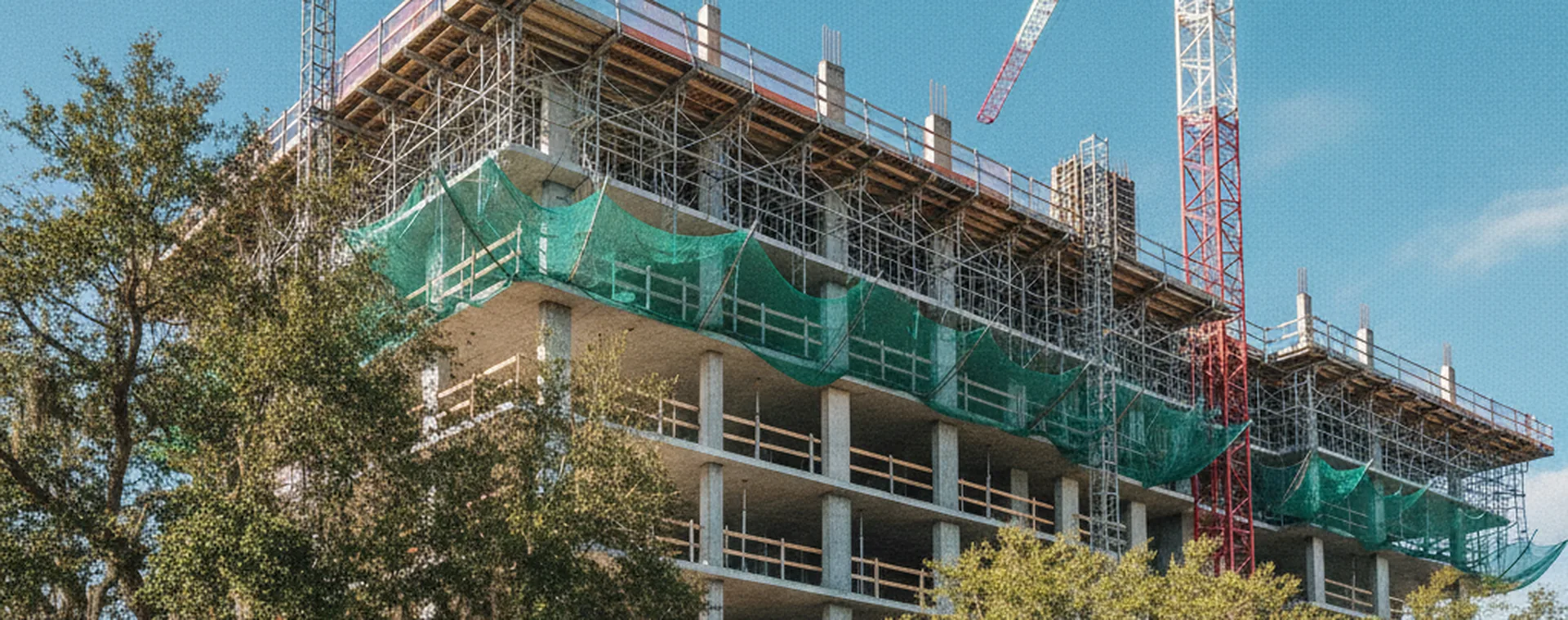
Tampa construction accident lawyer
The claim against everyone on the site who is not your employer
Workers’ compensation is the exclusive remedy against your employer under Fla. Stat. § 440.11, and this firm does not handle comp claims. What it handles is the third-party claim — against the general contractor who is not your employer, another trade on the site, an equipment manufacturer, a property owner or a driver — and that claim runs alongside a comp claim rather than replacing it. The sentence that opens most of these cases is § 440.10(1)(e): a subcontractor loses its protection from suit where its own gross negligence was the major contributing cause of the injury. Federal OSHA covers Florida, and Hillsborough falls under the Tampa Area Office. The chapter 440 framework is explained in full on the Florida construction accident page. What follows is the Hillsborough County part.
- Hillsborough County crashes, 2024
- 26,269Florida Department of Highway Safety and Motor Vehicles
- People injured
- 17,359In Hillsborough County alone, in one year
- People killed
- 180Down from 230 the year before
- Third-party claims only
- Not compThis firm handles the claim against everyone who is not your employer.
Quick answers about Tampa construction accident claims
- Do you handle workers’ compensation?
- No. Comp is the claim against your own employer and it is not part of this practice. The third-party claim — against the other companies on the site — is, and the two run alongside each other.
- Can I sue if I am already getting comp benefits?
- A third-party claim is a different case against a different party, and receiving comp does not bar it. The comp carrier will normally assert a lien against any recovery, which is worked out as part of the case.
- Can I sue another subcontractor on the site?
- Sometimes, and § 440.10(1)(e) is where it turns: that sub is protected only if comp was secured and its own gross negligence was not the major contributing cause of the injury.
- Can I ever sue my own employer?
- Only in two narrow situations under § 440.11(1): where the employer failed to secure compensation at all, or where it committed an intentional tort — which must be proved by clear and convincing evidence.
- Does an OSHA citation prove my case?
- No, but it is evidence and it is public. OSHA inspection and citation history is searchable by establishment, and a citation on the same hazard before the injury is worth a great deal.
- Who investigates a serious Tampa site injury?
- Federal OSHA, which covers Florida. Hillsborough County is covered by the Tampa Area Office, at 4012 Gunn Hwy, Suite 200, Tampa, (813) 626-1177.
- How long do I have?
- Two years for a negligence claim accruing on or after March 24, 2023. The comp claim has its own separate deadlines, which is one reason the two are handled in parallel from the start.
01 The law, once
02 Who else was on the site
Where construction accident claims arise in Hillsborough County
A Tampa job site has a dozen companies on it and only one of them is your employer. The question that decides a construction case is who the others were, and what each of them controlled.
- Your employerComp only, under § 440.11, except where coverage was never secured or an intentional tort is proved.
- The general contractorWhere it is not your employer, chapter 440 does not shield it from an ordinary negligence claim.
- Another subcontractorProtected only if comp was secured AND its own gross negligence was not the major contributing cause. § 440.10(1)(e)
- The equipment manufacturerA product claim, entirely outside chapter 440.
- The property ownerAvailable — but § 440.11(3) shields an owner acting as a safety consultant, with a motor vehicle exception.
- Water Street and the downtown buildsHigh-rise concrete work, where falls, hoists and falling material drive the claims.
- Brandon, Riverview and the I-75 corridorFast residential and distribution building with heavy equipment and constant truck movement.
- Road work on I-275, I-4 and the SelmonWork-zone claims against drivers, which are ordinary motor vehicle cases alongside comp.
03 The two claims
04 The gross negligence door
05 Suing an employer
06 The record
07 Examples of situations
Situations this office sees in Hillsborough County
The following are examples of the kinds of situations that arise in this county. They are illustrations of how the rules apply, not descriptions of past cases, and they do not predict any outcome. Every claim turns on its own facts, its own coverage and its own medical record.
A fall from a scaffold another trade erected
Section 440.10(1)(e) is the question: was comp secured, and was it gross negligence that was the major contributing cause?
A machine that failed
A product claim against the manufacturer, which chapter 440 does not touch at all.
Struck by a vehicle in a work zone
An ordinary motor vehicle claim against the driver, alongside comp.
An employer with no comp coverage
Section 440.11(1)(a) lets the worker sue, and strips the usual defenses.
A hazard cited by OSHA months earlier
Public, searchable, and evidence of notice before the injury.
A crane or hoist operated by another company
A separate contractor with separate insurance and separate exposure.
08 The evidence
Evidence that exists here and often goes uncollected
Almost every camera that saw the crash overwrites itself within days or weeks. The difference between a disputed liability case and a straightforward one is usually whether someone asked for the footage while it still existed.
Every company name on the site
Trucks, hard hats, signage, the gate log. This list is the case.
The OSHA inspection and citation history
Public and searchable by establishment, and strongest when it predates the injury.
Subcontracts and certificates of insurance
They establish who insured whom, which decides who can be sued.
The site safety plan and daily reports
Who was responsible for the condition, and who was on site that day.
Equipment inspection and maintenance records
Where a machine or a lift failed, this is where notice lives.
Photographs before the condition is corrected
On an active site that window is hours, not days.
Names of the crew working near you
Crews rotate off a job and become very hard to find.
The written injury report to your employer
It starts the comp claim and fixes the date.
09 The report
10 The office
Tampa construction accident questions, answered
Do you handle workers’ compensation claims?
No. Workers’ compensation is the claim against your own employer, and it is not part of this practice.
What is handled here is the third-party claim — the case against the other companies on the site whose conduct caused the injury. The two run alongside each other rather than one instead of the other.
If what you need is a comp lawyer, you will be told that on the first call rather than signed up and sorted out later.
I am already receiving comp benefits. Can I still bring a claim?
Yes. A third-party claim is a different case against a different party, and receiving workers’ compensation does not bar it.
Comp covers medical care and a portion of lost wages and pays nothing for pain and suffering. The third-party claim is where the full range of damages exists.
Where comp has paid benefits the carrier will normally assert a lien against any third-party recovery. That is routine, it is resolved within the case, and it is not a reason to avoid bringing one.
Can I sue another subcontractor on the job?
Sometimes, and the whole question sits in one sentence of § 440.10(1)(e).
A subcontractor working alongside the contractor on the same project is protected from an action by another sub’s employee — provided that workers’ compensation was secured, and provided that the subcontractor’s own gross negligence was not the major contributing cause of the injury.
Both conditions have to hold. So two things get established in every case of this kind: whether coverage was actually secured for that sub’s workers, and whether that sub’s conduct was gross negligence that was the major contributing cause.
Can I ever sue my own employer?
Only in two narrow situations, both in § 440.11(1).
First, where the employer failed to secure compensation as the chapter requires. The worker may then elect to claim compensation or bring an action at law — and in that action the employer may not plead fellow-employee negligence, assumption of risk, or the employee’s comparative negligence.
Second, an intentional tort, which must be proved by clear and convincing evidence: either that the employer deliberately intended to injure, or that it engaged in conduct it knew — from prior similar accidents or explicit warnings identifying a known danger — was virtually certain to cause injury or death, where the danger was not apparent and the employer deliberately concealed or misrepresented it.
That second standard is deliberately hard to meet, and an honest assessment of it is better given early than late.
What about a supervisor or a co-worker?
Generally immune, but not absolutely.
Fellow-employee immunity under § 440.11 does not apply to someone who acts with willful and wanton disregard, unprovoked physical aggression, or gross negligence. Nor does it apply between employees of the same employer who are assigned primarily to unrelated works.
Supervisors and officers acting in a managerial or policymaking capacity have their own immunity, which does not extend to conduct that violated a law carrying more than 60 days’ imprisonment.
Does an OSHA citation prove the case?
No, but it is useful, and it is public.
OSHA’s establishment search returns inspections, citations and penalties by company name, free and without discovery. A citation issued to the same contractor on the same hazard before the injury is evidence of the standard and of notice.
It does not establish civil liability by itself, and a defendant will say so. It still changes what they are willing to argue.
Who would investigate a serious injury on a Tampa site?
Federal OSHA. Florida has no state plan covering private employers, so these sites fall to the federal agency.
OSHA’s own county listing places Hillsborough County under the Tampa Area Office, at 4012 Gunn Hwy, Suite 200, Tampa, FL 33618, (813) 626-1177.
Whatever that inspection produces becomes part of a public record. OSHA’s establishment search returns inspections, citations and penalties by company name, which means a contractor’s history can be checked before anyone files anything.
The Tampa Police Department or the Hillsborough County Sheriff’s Office may also work a scene where a vehicle or a death is involved, depending on which side of the city line it happened.
What should I do in the first days?
Report the injury to your employer in writing and get medical care. That starts the comp claim, which is what pays for treatment while everything else is sorted out.
Then preserve the third-party case: photograph the scene and the equipment before anything is corrected, and write down every company name on the site — on trucks, hard hats, signage and the gate log.
Get the names of the people working near you. Crews rotate off a job within weeks and become very difficult to find afterward.
How long do I have?
Two years for a negligence claim accruing on or after March 24, 2023, under Fla. Stat. § 95.11.
The workers’ compensation claim has its own separate deadlines and its own notice requirements, which is one reason the two are handled in parallel from the beginning rather than in sequence.
Where would the case be filed?
At the George E. Edgecomb Courthouse, 800 East Twiggs Street.
What does it cost?
The first conversation costs nothing and commits you to nothing.
Injury cases are handled on a contingent attorney’s fee, meaning no attorney’s fee unless there is a recovery. Case expenses are governed by the written representation agreement, including who pays them if there is no recovery.
Who will actually handle my case?
Jose A. Dapena. You deal with your attorney directly at every stage rather than through an intake department or a case manager.
He has practiced in Florida since 1998, Florida Bar number 152358. The early work on a site injury is identifying every company that was there and what each of them controlled, and that is done before anyone argues about liability.
11 Keep reading
- Florida construction accident lawThe statutes, the deadlines and the defenses, in full
- The Tampa officeEverything the office handles, and the area it covers
- Personal injury in FloridaThe whole practice, and the other 22 kinds of claim
This page is general information about Florida law, not legal advice about your case. Published by Jose A. Dapena, P.A. Last updated October 2026.
Free case review with a Tampa construction accident lawyer
No fee to talk and no obligation. You deal with your attorney directly, at every stage.