
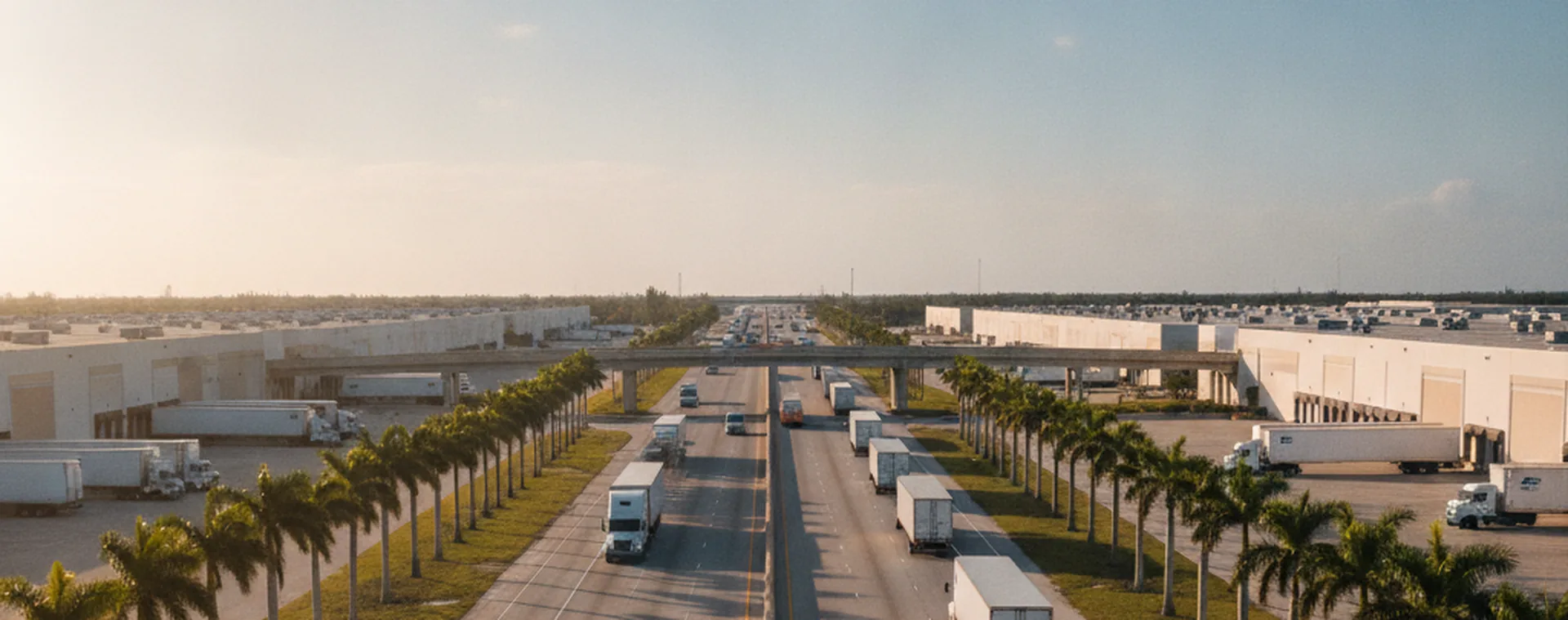
Miami truck accident lawyer
What a commercial truck crash in Miami-Dade involves, and who else is on the hook
Miami-Dade County recorded 60,000 traffic crashes in 2024, injuring 29,359 people and killing 272, according to the Florida Department of Highway Safety and Motor Vehicles. The share involving commercial trucks is small and the share of the serious injuries is not, because a loaded tractor-trailer can weigh twenty times what a car weighs. A Miami-Dade truck claim is filed at the Circuit Court on West Flagler Street, or in the US District Court for the Southern District of Florida where an interstate carrier is involved and the parties are from different states. The serious injuries go to Ryder Trauma Center at Jackson Memorial or to HCA Florida Kendall. The law that governs these claims — the federal carrier regulations, the logbook and electronic logging rules, and who besides the driver can be liable — is set out on the Florida truck accident page. What follows is the Miami-Dade part: the corridors the freight moves on, the companies behind it, and where the records are held.
- Miami-Dade County crashes, 2024
- 60,000Florida Department of Highway Safety and Motor Vehicles
- People injured
- 29,359In Miami-Dade County alone, in one year
- People killed
- 272Down from 325 the year before
- To start treatment
- 14 daysOr Florida PIP pays nothing at all
Quick answers about Miami truck accident claims
- Who can be responsible besides the driver?
- The motor carrier, the company whose freight it was, a broker, the trailer owner where it is a separate company, a maintenance contractor, and in some cases the shipper who loaded it. In Miami-Dade those are frequently five different companies with five different insurers.
- Where is a Miami-Dade truck case filed?
- The Miami-Dade Circuit Court at 73 West Flagler Street, or the South Dade Justice Center for the far south of the county. Where an interstate carrier is involved and the parties are from different states, it may be brought in the US District Court for the Southern District of Florida at 400 North Miami Avenue.
- How fast does the evidence disappear?
- Faster than in a car case. Electronic logging data, the engine control module, dash and dispatch records and the trailer itself are all controlled by the carrier, and much of it cycles out on a schedule. A written preservation letter in the first days is what holds it.
- Why is a carrier investigator at the scene so quickly?
- Because a serious crash triggers it. Large carriers run rapid response teams, and it is normal for one to be documenting the scene before the vehicles are moved. Nothing improper about it — but it means one side starts collecting evidence on day one.
- Does the trucking company have more insurance than a car driver?
- Usually, substantially more. That is why identifying the carrier and every other company connected to the load matters more here than anywhere else in injury work.
- What if the driver was an owner-operator?
- That label rarely ends the inquiry. Whose authority the truck was running under, whose placard was on the door, who dispatched the load and who controlled the schedule are the questions, and the answers are in paperwork rather than in what anyone says at the scene.
01 The law, once
02 The roads
Where truck accident claims arise in Miami-Dade County
60,000 crashes in a county of this size are not spread evenly. They concentrate on a handful of corridors, and knowing which one a crash happened on usually tells you which agency wrote the report and what kind of case it is.
- Okeechobee Road, US-27The county’s freight spine. Medley and Hialeah warehousing feeds onto it all day, which puts heavy trucks and ordinary commuters on the same road at the same speed.
- The Palmetto Expressway, SR-826Among the most heavily traveled roads in Florida, with constant lane changes and a speed differential that turns a sideswipe by a trailer into a serious injury.
- I-95The long-haul corridor. Higher speeds, more fatigue, and the crashes that most often involve a carrier based in another state.
- The Dolphin Expressway, SR-836The route between downtown, Doral and the airport cargo area, with short merges and persistent construction.
- Port Boulevard and the Port TunnelContainer traffic to and from PortMiami, moving between Dodge Island and the mainland on roads shared with downtown traffic.
- NW 36th Street and the airport cargo areaAir freight moving between the airport and the Doral and Medley warehouse districts, mostly in straight trucks and tractor-trailers on surface streets.
- The Homestead Extension of Florida’s TurnpikeThe north-south freight alternative, and the route agricultural loads from the south of the county take toward the rest of the state.
- Krome Avenue, SR-997Two lanes through the agricultural west, carrying farm and construction trucks with limited lighting and head-on exposure.
03 Who else is liable
04 The evidence has a clock
05 Where the freight actually moves
06 Where it is heard
07 Examples of situations
Situations this office sees in Miami-Dade County
The following are examples of the kinds of situations that arise in this county. They are illustrations of how the rules apply, not descriptions of past cases, and they do not predict any outcome. Every claim turns on its own facts, its own coverage and its own medical record.
A trailer changes lanes on the Palmetto
A driver in the next lane is pushed into the barrier. The question is what the mirrors and any camera showed, and whether the carrier’s own footage still exists.
A truck turning into a Medley warehouse yard
A car traveling straight on Okeechobee has nowhere to go. Sight lines, the yard’s entrance design and whether a spotter was used all come into it.
A container truck leaving the port tunnel
A low-speed impact downtown that is nonetheless severe because of the weight involved, with a carrier, a shipper and a port operation all potentially in the picture.
A long-haul carrier on I-95 at night
Hours-of-service and fatigue become central, and the electronic logging data is the evidence that answers it — if it is preserved in time.
An owner-operator hauling for a broker
Four entities and four possible policies, and the lease and dispatch records rather than the roadside conversation decide which ones respond.
08 The evidence
Evidence that exists here and often goes uncollected
Almost every camera that saw the crash overwrites itself within days or weeks. The difference between a disputed liability case and a straightforward one is usually whether someone asked for the footage while it still existed.
The carrier’s USDOT number
Usually on the door. It leads to the safety record, inspection history and insurance filings.
Electronic logging device data
Hours of service and vehicle movement, held by the carrier and cycled out on a schedule.
The engine control module
Speed, braking and throttle in the seconds before impact — lost once the tractor is repaired.
Dash and inward-facing camera footage
Overwritten within days on many fleets unless preserved in writing.
Maintenance and inspection records
For the tractor and the trailer separately, since they are frequently owned by different companies.
The bill of lading and dispatch records
Who the freight belonged to, who arranged it, and who set the schedule.
Driver qualification and testing files
Licensing, medical certification and the carrier’s own hiring and testing history.
09 The report
10 The office
Miami truck accident questions, answered
Who can be sued after a truck crash in Miami?
The driver is rarely the only defendant, and frequently not the most important one.
The motor carrier whose authority the truck ran under, the company whose freight it was, a broker who arranged the load, the trailer owner where that is a separate company, and a maintenance contractor where equipment failed can all be in the case.
In Miami-Dade that list is usually longer than average, because so much of the work is short-haul port, airport and warehouse hauling run through layered arrangements between separate companies.
Why does a truck case need to move faster than a car case?
Because the evidence belongs to the other side and cycles out on a schedule.
Electronic logging data, engine control module data, dispatch records, camera footage and maintenance history are all held by the carrier. Much of it is overwritten or purged in the normal course, and the trailer itself may be back in service within days.
A written preservation letter naming the tractor, the trailer, the date and each category of record is the step that stops the clock, and it is far more effective sent in the first week than the first month.
Where will my Miami-Dade truck case be filed?
Usually the Miami-Dade Circuit Court at 73 West Flagler Street, or the South Dade Justice Center in Cutler Bay for crashes in the far south of the county.
Truck cases are the common exception. Where an interstate carrier is involved and the parties are citizens of different states, the case can be brought in or removed to the US District Court for the Southern District of Florida at 400 North Miami Avenue.
That decision is often the defendant’s rather than yours, and it changes the procedure, the timetable and the jury pool.
An investigator from the trucking company was already at the scene. Is that allowed?
Yes, and it is routine for a serious crash. Large carriers operate rapid response programs precisely so that someone is documenting the scene before the vehicles are moved.
There is nothing improper about it. What it means practically is that one side began building its record within hours, which is the reason to get the other side’s preservation demand out quickly.
The driver said he is an owner-operator. Does that limit my claim?
Usually not, and the label is one of the most misleading things said at a roadside.
What matters is whose operating authority the truck was running under, whose name and USDOT number were on the door, who dispatched the load, and who controlled the schedule and the route. Those are answered by the lease, the dispatch records and the bill of lading.
Federal regulation of motor carriers is built around exactly this arrangement, which is why the answer is usually that the carrier remains in the case.
Does commercial insurance pay more than a car policy?
Generally yes, and by a wide margin.
Florida does not require private drivers to carry bodily injury liability coverage at all, which is why so many car cases turn into uninsured motorist claims. Commercial carriers operate under federal financial responsibility requirements instead.
In a catastrophic injury that difference frequently decides what can actually be recovered, as opposed to what is owed on paper — which is another reason to identify every company connected to the load.
Where will I be treated if the injury is serious?
Miami-Dade has two Level I trauma centers: Ryder Trauma Center at Jackson Memorial, and HCA Florida Kendall for the west and south of the county.
A child is usually taken to Nicklaus Children’s rather than an adult trauma center.
Those first-hour records are typically what proves the injury months later, which is why the hospital you were taken to matters to the claim as well as to the treatment.
How do I get the crash report, and how long does it take?
Through the FLHSMV crash portal. Under Fla. Stat. § 316.066(2)(a) a report revealing personal information is confidential for 60 days after filing — but § 316.066(2)(b) lets the parties involved and their legal representatives obtain it immediately.
Which agency wrote it depends on the road: the Florida Highway Patrol on the expressways, the Miami-Dade Sheriff’s Office in unincorporated areas, and the municipal department inside each city.
In a truck case the report usually names the carrier and its USDOT number, which is the thread to everything else.
How long do I have to bring a truck claim in Florida?
Two years for a negligence claim accruing on or after March 24, 2023, under Fla. Stat. § 95.11.
That is far longer than the evidence survives, which is the practical point. The legal deadline is rarely what decides a truck case; the preservation of the carrier’s records usually is.
What does it cost to bring a truck accident claim?
The first conversation costs nothing and commits you to nothing.
Injury cases are handled on a contingent attorney’s fee, meaning no attorney’s fee unless there is a recovery. Case expenses are governed by the written representation agreement, including who pays them if there is no recovery, and that is explained before anything is signed.
Do I have to come to the South Miami office?
No. A first conversation happens by phone or video and documents are handled electronically.
The office on Sunset Drive is there when meeting in person is better, and home and hospital visits are available when someone cannot travel. For people in the south of the county the Homestead office on Krome Avenue is usually closer.
Who will actually handle my case?
Jose A. Dapena. You deal with your attorney directly at every stage rather than through an intake department or a case manager.
He has practiced in Florida since 1998, Florida Bar number 152358, and is admitted in all three Florida federal districts — which matters in truck cases, because that is where an interstate carrier often wants the case heard.
11 Keep reading
- Florida truck accident lawThe statutes, the deadlines and the defenses, in full
- The Miami officeEverything the office handles, and the area it covers
- Personal injury in FloridaThe whole practice, and the other 22 kinds of claim
This page is general information about Florida law, not legal advice about your case. Published by Jose A. Dapena, P.A. Last updated October 2026.
Free case review with a Miami truck accident lawyer
No fee to talk and no obligation. You deal with your attorney directly, at every stage.