
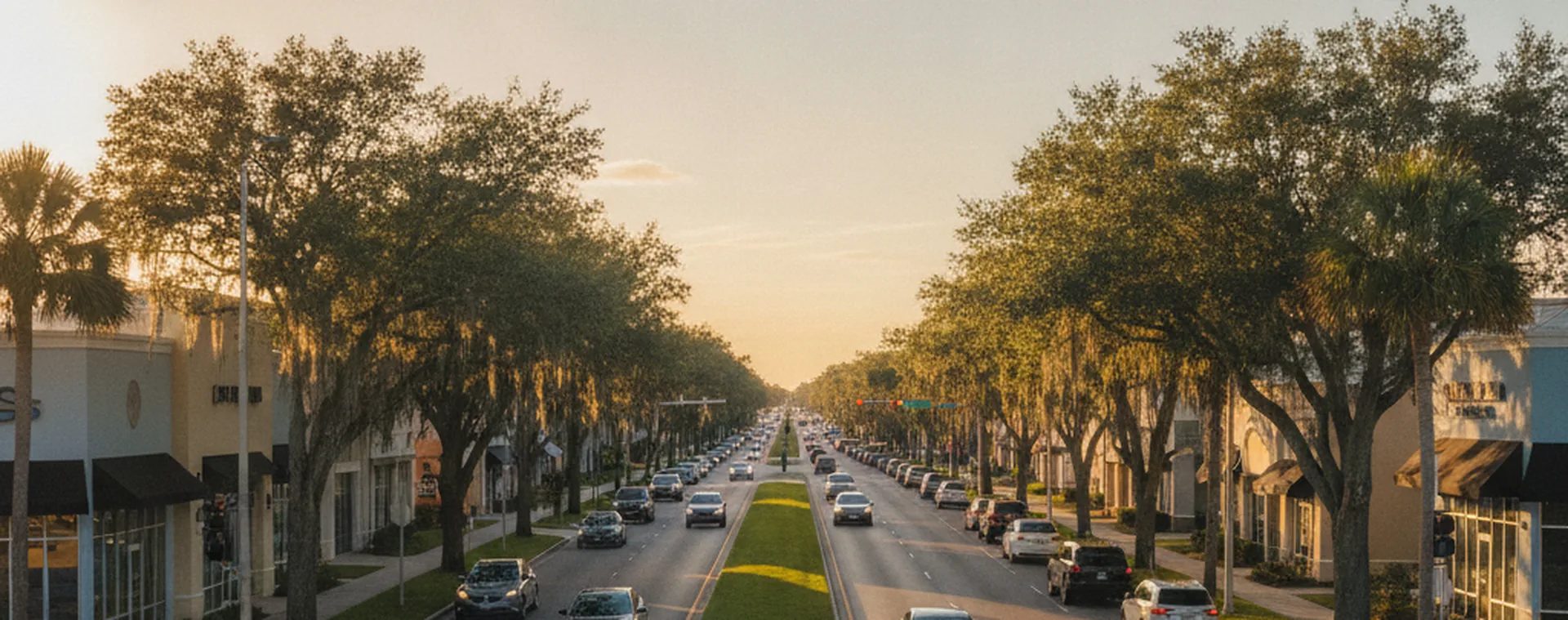
Tampa pedestrian accident lawyer
Who pays when you were on foot in Hillsborough County, and what the crossing has to do with it
Hillsborough County recorded 26,269 traffic crashes in 2024, injuring 17,359 people and killing 180, according to the Florida Department of Highway Safety and Motor Vehicles. A person on foot has no vehicle around them, so a pedestrian claim here is almost always a serious injury claim. The first question is not fault — it is coverage: a pedestrian with no car of their own can frequently reach PIP through a resident relative’s policy, and the 14-day treatment deadline applies either way. The claim is filed at the George E. Edgecomb Courthouse at 800 East Twiggs Street, and serious injuries go to Tampa General on Davis Islands, the region’s Level I trauma center. The duties a driver owes and the fault rules that apply are on the Florida pedestrian accident page. What follows is the Hillsborough part.
- Hillsborough County crashes, 2024
- 26,269Florida Department of Highway Safety and Motor Vehicles
- People injured
- 17,359In Hillsborough County alone, in one year
- People killed
- 180Down from 230 the year before
- To start treatment
- 14 daysPIP, reached through a household policy. § 627.736
Quick answers about Tampa pedestrian accident claims
- I do not own a car. Does any insurance pay for my treatment?
- Often yes. A pedestrian struck by a vehicle can frequently reach PIP through a resident relative’s auto policy. That is the first coverage question in a Hillsborough pedestrian case rather than the last.
- Does the 14-day PIP deadline apply to me?
- Yes. Treatment has to begin within 14 days of the crash for PIP to pay anything, whether the coverage is your own or a household member’s.
- I was crossing outside a crosswalk. Is the claim over?
- No. It changes the fault conversation, not the existence of the claim. A driver owes due care regardless, and under Fla. Stat. § 768.81 a share of fault reduces the recovery proportionally rather than erasing it — until it passes 50 percent.
- The driver left. What then?
- Uninsured motorist coverage, through your own policy or a resident relative’s. A hit-and-run is one of the situations UM exists for, and the police report carries more weight here than in any other kind of claim.
- Which agency wrote the report?
- On I-275, I-4, I-75 and the Selmon it is usually the Florida Highway Patrol. Inside the city it is the Tampa Police Department, in unincorporated Hillsborough it is the Sheriff’s Office, and Temple Terrace and Plant City have their own.
- Is there video?
- More often than people assume. Buses, storefronts, doorbell cameras and parking garages all record the street, and all of them overwrite — some within days. The request has to be in writing and immediate.
- Where will I be taken?
- Tampa General on Davis Islands, the region’s Level I trauma center. Serious injuries anywhere in Hillsborough are routed there.
01 The law, once
02 The roads
Where pedestrian accident claims arise in Hillsborough County
26,269 crashes in a county of this size are not spread evenly. They concentrate on a handful of corridors, and knowing which one a crash happened on usually tells you which agency wrote the report and what kind of case it is.
- Hillsborough AvenueSix lanes through Town ’n’ Country with a persistent pedestrian toll and signalized crossings a long way apart.
- Nebraska Avenue and Florida AvenueStraight, fast north-south arterials through dense neighborhoods, with a recurring night-time toll.
- Dale Mabry HighwayMile after mile of commercial frontage, turning conflicts at every entrance, and crossings spaced far apart.
- Fletcher AvenueThe corridor beside the university, where student foot and bicycle traffic mixes with commuter volume.
- Busch BoulevardWide, commercial, and heavily walked between bus stops and businesses on both sides.
- US-301 and US-41 southRiverview, Gibsonton, Ruskin and Wimauma, where the road narrows, the lighting thins and agricultural traffic shares it.
- Kennedy Boulevard and Columbus DriveThrough-routes close to downtown, with pedestrian volume from both sides and frequent turning movements.
- Bayshore BoulevardThe city’s best-known waterfront route, used constantly by runners and walkers alongside through traffic.
03 Coverage before fault
04 The crossing is evidence
05 If the driver left
06 Where it happens here
07 Examples of situations
Situations this office sees in Hillsborough County
The following are examples of the kinds of situations that arise in this county. They are illustrations of how the rules apply, not descriptions of past cases, and they do not predict any outcome. Every claim turns on its own facts, its own coverage and its own medical record.
Struck crossing six lanes between lights
The distance to the nearest marked crossing, the signal timing and the lighting decide how fault is apportioned, and all three are documentable conditions of the road.
A driver turning across a crosswalk on a walk signal
The dispute is about who had the signal, and the answer is often in a nearby camera rather than in either account.
Hit crossing to or from a bus stop
Where the stop sits relative to the nearest crossing is itself a fact about the road, and it is frequently the whole argument.
A hit-and-run on an arterial at night
UM through a household policy becomes the claim, and the prompt report plus any surviving camera footage become the proof.
A student struck near the university
Fletcher and the surrounding streets carry heavy foot and bicycle traffic against commuter volume, and campus or business cameras are often the only independent account.
08 The evidence
Evidence that exists here and often goes uncollected
Almost every camera that saw the crash overwrites itself within days or weeks. The difference between a disputed liability case and a straightforward one is usually whether someone asked for the footage while it still existed.
Photographs of the crossing, not just the injuries
Signal, lane count, distance to the nearest marked crossing, and the lighting as it was.
Any camera within sight of the spot
Buses, storefronts, doorbell cameras, garages. All overwrite, some within days.
The crash report and the agency that wrote it
And a correction request if the narrative is wrong, before an insurer adopts it.
Whether anyone in the household has auto insurance
It decides whether PIP responds at all, and it is the first thing to establish.
Medical records from the first 14 days
The PIP deadline is a hard cut-off and the record is what proves it was met.
Signal timing and lighting records
Held by the city or the county, and recoverable by request while they still reflect that night.
Witness names and phone numbers
Taken at the scene. People on an arterial disperse immediately and are not traceable later.
09 The report
10 The office
Tampa pedestrian accident questions, answered
I do not own a car. Can I still get PIP for a pedestrian injury?
Often yes, and it surprises people who assume PIP follows the vehicle alone.
A pedestrian struck by a motor vehicle can frequently reach PIP benefits through a resident relative’s auto policy under Fla. Stat. § 627.736, and the 14-day deadline to begin treatment applies whether the coverage is yours or a household member’s.
So the first coverage question is not who was at fault. It is who in the household has an auto policy.
I was crossing outside a crosswalk. Does that end my claim?
No. It changes the fault conversation rather than the existence of the claim.
A driver owes due care to a pedestrian regardless, and the questions that follow are about the road: how far the nearest marked crossing was, how long the signal gave, whether a sidewalk existed, and whether the lighting worked.
Under Fla. Stat. § 768.81 a share of fault reduces the recovery proportionally and bars it entirely above 50 percent, which is why the conditions of the crossing are worked on early.
The driver did not stop. What claim is there?
Usually a claim against uninsured motorist coverage, from your own policy or a resident relative’s.
The police report carries more weight here than in any other kind of claim, because a UM carrier will test whether the incident was reported promptly and described consistently from the start.
Camera footage matters for the same reason, and it is the piece with a deadline on it.
Is there likely to be video?
More often than people assume on a Hillsborough arterial.
Buses, storefronts, doorbell cameras and parking garages all record the street. The problem is not whether it exists but how long it lasts — much of it overwrites within days.
A written preservation request naming the location, date and time window, sent immediately, is the only thing that reliably holds any of it.
The report blames me. Can that be changed?
A correction request is possible, and it is worth making rather than leaving.
Pedestrian narratives are written quickly and frequently from the driver’s account, because the person on foot is often being treated and not available to give one.
A wrong narrative left unchallenged becomes the version the insurer works from, and it is much harder to displace later than to correct early.
Which agency wrote my report?
It depends on where it happened.
The Florida Highway Patrol works I-275, I-4, I-75 and the Selmon. Inside the city it is Tampa Police; in unincorporated Hillsborough it is the Sheriff’s Office; Temple Terrace and Plant City have their own departments.
That determines where a copy ultimately comes from and how long it takes.
Where will I be taken if the injury is serious?
Tampa General on Davis Islands is the region’s Level I trauma center, and serious injuries anywhere in Hillsborough are routed there.
Those first-hour records are typically what proves the injury months later, which is why where you were taken matters to the claim as well as to the treatment.
They offered me the driver’s policy limits. Should I take it?
Not before checking uninsured motorist coverage.
Accepting the at-fault driver’s limits and signing a release without first giving certified-mail notice to a UM carrier can destroy the UM claim under Fla. Stat. § 627.727(6)(a).
The UM carrier then has 30 days to authorize the settlement or to preserve its subrogation by paying the offer itself. In a pedestrian case, where injuries are frequently severe and the driver’s limits frequently low, this is not a technicality.
I was walking for work when it happened. Does that change anything?
It adds a claim rather than removing one.
Workers’ compensation covers authorized treatment and part of the wage loss regardless of fault, and runs through the Office of the Judges of Compensation Claims rather than a court. The claim against the driver is separate and is where pain and suffering and the full wage loss live.
Under Fla. Stat. § 440.39 the compensation carrier asserts a lien on what that claim recovers, so the two are run with each other in view.
How long do I have to bring a claim?
Two years for a negligence claim accruing on or after March 24, 2023, under Fla. Stat. § 95.11.
The shorter deadline is the one that actually bites: treatment has to begin within 14 days for PIP to pay anything, and camera footage is usually gone long before either.
What does it cost?
The first conversation costs nothing and commits you to nothing.
Injury cases are handled on a contingent attorney’s fee, meaning no attorney’s fee unless there is a recovery. Case expenses are governed by the written representation agreement, including who pays them if there is no recovery.
Who will actually handle my case?
Jose A. Dapena. You deal with your attorney directly at every stage rather than through an intake department or a case manager.
He has practiced in Florida since 1998, Florida Bar number 152358, and was in-house counsel for a PIP carrier in 2002 — which is the coverage question a pedestrian case usually turns on.
11 Keep reading
- Florida pedestrian accident lawThe statutes, the deadlines and the defenses, in full
- The Tampa officeEverything the office handles, and the area it covers
- Personal injury in FloridaThe whole practice, and the other 22 kinds of claim
This page is general information about Florida law, not legal advice about your case. Published by Jose A. Dapena, P.A. Last updated October 2026.
Free case review with a Tampa pedestrian accident lawyer
No fee to talk and no obligation. You deal with your attorney directly, at every stage.