
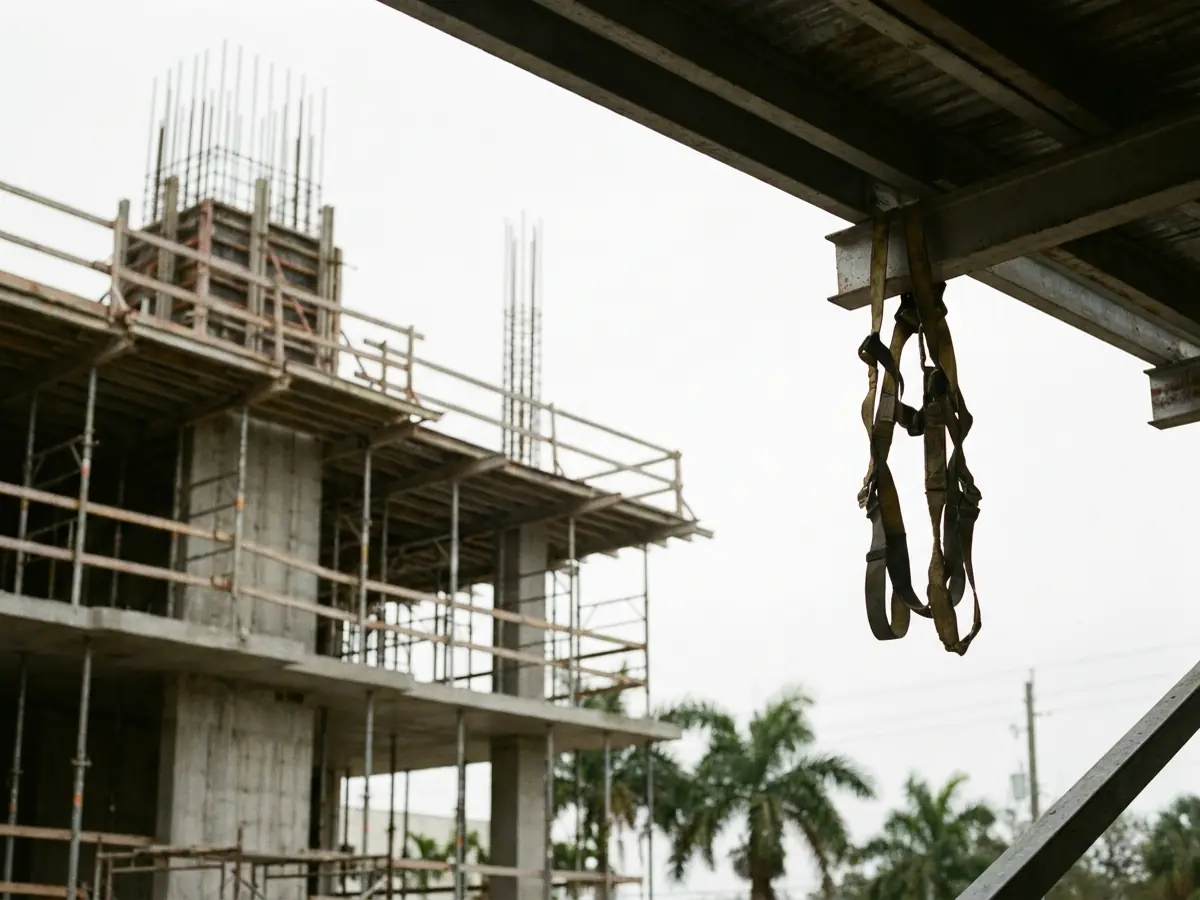
Florida construction accident lawyer
Everyone on the site is not the same defendant.
A construction injury almost always produces a workers’ compensation claim. The harder and more valuable question is who else can be held responsible — and on a Florida site that question is governed by two statutes that extend immunity well beyond your direct employer, with an exception that matters enormously. This firm does not handle workers’ compensation claims. It handles the third-party injury claim that runs alongside one. DAPENALAW works from offices in Miami, Homestead and Tampa. The review is free, and there is no attorney’s fee unless there is a recovery; case expenses are separate and governed by the written agreement.
Why bring your construction accident claim to Jose A. Dapena
There is no shortage of injury lawyers in Florida. These are the specific things that separate this firm, and every one of them can be checked.
-
He worked the other side of the file
Before he opened his firm in 1998, Jose A. Dapena worked for insurance companies — reviewing claims on the insurer’s behalf and deciding how the company would answer them. He knows how the other side builds its position because he used to build it.
-
28 years admitted in Florida
Florida Bar number 152358, admitted October 8, 1998, with federal practice in all three Florida districts. The bar number is checkable in The Florida Bar’s own directory.
-
You speak with your attorney, not an intake department
At many large firms a client deals with an intake team and then a case manager. Here you deal with your attorney directly at every stage. It is a question of access.
-
Home and hospital visits when travel is not realistic
A serious injury does not make it easy to get to a law office. Where that is the situation, the meeting happens where you are rather than being postponed until you can travel.
-
Three Florida offices, including Homestead
South Miami, Homestead and Tampa. Almost no injury firm keeps an office in Homestead, and for the south of the county that means not driving to downtown Miami to speak to a lawyer.
-
Free review, and the fee depends on a recovery
The fee is a percentage of the settlement or judgment, owed only if there is one. Case costs are a separate thing: the firm advances them and they are repaid out of a recovery, and who is responsible for them if there is none is set out in writing before you sign.
If you were hurt, the first call is free and commits you to nothing.
What happens when you call
The first call commits you to nothing and costs nothing. This is what happens in it, and in the days after.
- 01
You say what happened
In No forms first, and no intake questionnaire.
- 02
You are told whether there is a claim, including when there is not
If what you describe does not support a claim worth bringing, you hear that on the call rather than having a file opened.
- 03
The evidence that is expiring gets identified
Video, inspection logs, the report, a truck’s electronic logs. Almost all of it is held by the other side and almost all of it has a retention schedule.
- 04
A preservation demand goes out in writing
A phone call creates no obligation to keep anything. A written demand does, and it goes out in the first days rather than the second month.
- 05
Your own coverage gets checked
PIP, uninsured motorist, health coverage. A great many people have coverage they do not know they have.
- 06
You concentrate on treatment
Adjuster calls come through the firm. You do not give a recorded statement unprepared.
What it costs, and who pays your medical bills in the meantime
Workers’ compensation pays the medical bills for a work injury, with no deductible and no co-pay, and it pays them whoever was at fault. What it does not pay is anything for pain and suffering, and it limits wage benefits to a portion of what you earned.
This firm does not handle workers’ compensation claims. What it handles is the separate claim against a third party — a property owner, a general contractor, a subcontractor, an equipment manufacturer, a driver — where someone other than your employer caused the injury. The two run alongside each other.
That third-party claim is where pain and suffering, full wage loss and future care are recovered. Where it succeeds, the compensation carrier generally has a right to be repaid out of it, and that is worked out as part of resolving the case.
Quick answers about Florida construction accident claims
- Can I sue the general contractor?
- Often not. Under Fla. Stat. § 440.10(1)(b) a contractor who sublets work must secure compensation for the subcontractors’ employees, and having done so it generally takes the exclusivity protection of § 440.11 with it.
- Can I sue another subcontractor on the site?
- Sometimes, and this is the key exception. Under § 440.10(1)(e) a subcontractor is protected from suit by another sub’s employees only if compensation was secured AND its own gross negligence was not the major contributing cause of the injury.
- What is gross negligence here?
- Conduct well beyond ordinary carelessness. Where a subcontractor’s gross negligence was the major contributing cause, the statutory protection does not apply and the claim is open.
- Who is never protected?
- Anyone outside the compensation chain: equipment and tool manufacturers, the property owner where it is not the employer, design professionals, crane and rigging companies, suppliers, and at-fault motorists.
- Does this firm handle workers’ compensation?
- No. Jose Dapena brings the third-party claim, against someone other than your employer. Compensation against your employer is a separate system and a different kind of lawyer.
- Does an OSHA citation prove the case?
- No, but it is evidence. There is no private right of action under the federal statute; the value is in the citation against a third party and in the underlying investigation file.
- What if the site is a public project?
- Then Fla. Stat. § 768.28 governs claims against the public entity: written notice within three years, suit within four, and recovery capped at $200,000 per person.
- How long do I have?
- For the third-party claim, two years from the injury for most negligence claims arising on or after March 24, 2023. Fla. Stat. § 95.11.
- They gave me a 1099. Am I outside workers’ compensation?
- On a construction site, usually not. Fla. Stat. § 440.02(18)(c) counts an independent contractor working or performing services in the construction industry as an employee. The label on the paperwork does not settle it.
- Who else is on a job site that I might have a claim against?
- The companies the immunity does not reach: an equipment lessor, a crane or rigging company under its own contract, a delivery or trucking company, the manufacturer of a failed tool or component, a design professional, and in some circumstances the property owner.
- Does a compensation lien come out of what I recover?
- Yes. Under Fla. Stat. § 440.39 the benefits paid become a lien on the third-party recovery, apportioned by the court. It is worked out as part of the settlement, not after it.
- What are the most common ways people are seriously hurt in construction?
- Falls from height, being struck by an object or vehicle, being caught in or between equipment or materials, and electrocution. Each one points at a different set of records and usually a different company.
- Equipment failed and hurt me. Who is responsible?
- Possibly the manufacturer, the company that leased it, and whoever was responsible for inspecting and maintaining it on site. Those are separate claims against separate insurers, and they all depend on the equipment itself being preserved.
- How fast does the evidence disappear on a job site?
- Faster than anywhere else. The scaffold is struck, the trench is backfilled, the floor opening is covered and the crew moves to the next scope. A written preservation demand in the first days is the only thing that reliably holds any of it.
- I fell from a scaffold or a ladder. Does that change the analysis?
- It focuses it. Who erected and inspected it, who owned or rented it, whether fall protection was provided and whether anyone was required to tie off are each answered by a different company and a different document.
- Can I bring the compensation claim and the injury claim at the same time?
- Yes, and they belong together. Compensation keeps treatment running; the third-party claim reaches the pain and suffering and the full wage loss that compensation never pays.
- The contractor
- Usually immuneWhere it secured compensation. §§ 440.10(1)(b), 440.11
- Another sub
- DependsProtected unless its gross negligence was the major cause. § 440.10(1)(e)
- Outside the chain
- OpenManufacturers, owners, designers, suppliers, motorists
- Deadline (third party)
- 2 yearsInjuries on or after March 24, 2023. § 95.11
01 Why the site is not one defendant
02 The exception that matters
03 Outside the chain entirely
04 What OSHA is for
05 What disappears from a site
06 The clock
07 The paperwork does not decide it
08 The list of possible defendants
09 What OSHA is for
10 How people are hurt here
11 The site is gone by Monday
12 Where these cases come from
Miami-Dade
Miami-Dade construction runs on high-rise concrete, large mixed-use projects and a dense subcontractor market, which means a single injury frequently involves four or five separate entities and as many insurance policies. Serious injuries go to Ryder Trauma at Jackson Memorial.
Construction accidents in Miami · The Miami office · Homestead
Hillsborough
Hillsborough construction spans downtown and Water Street development, distribution and industrial building along the interstate, and residential growth across the county, with the same layered contractor structure. Serious injuries are routed to Tampa General.
What Jose Dapena can do about a Florida construction injury
The first call is about who else was on that site, who owned the equipment, and who secured compensation for whom — because that is what decides which claims exist. If the only responsible party is your employer, you are told that, and pointed toward the compensation lawyer you need.
Before opening his firm in 1998, Jose Dapena worked for insurance companies, reading injury claims from the side of the file that decides what they are worth. On a construction site several insurers are investigating from the first day, and the site itself is being rebuilt while they do it.
You deal with him directly, at every stage. The consultation is free and there is no attorney’s fee unless there is a recovery.
The consultation is free and there is no obligation.
13 The law
Florida laws that decide a construction accident case
-
Horizontal immunity between subs
A subcontractor is immune from a suit by another subcontractor’s employee where both are working on the same contract and the first has secured compensation — unless the injury was caused by its own gross negligence.
-
The 1099 that changes nothing
An independent contractor working or performing services in the construction industry counts as an employee for compensation purposes.
-
The exclusive remedy
Compensation replaces other liability to the employer, and the immunity reaches supervisors and managers within their duties.
-
Why OSHA is evidence and not the claim
The Act does not enlarge, diminish or otherwise affect the common law or statutory rights, duties or liabilities of employers and employees.
-
What compensation takes back
Benefits paid become a lien on the third-party recovery, apportioned by the court.
-
When the project is public
Written notice first, and statutory limits on recovery against a government body.
14 Step by step
What to do after a construction accident in Florida
- 01
Report it to your own employer the same day
That is what opens the compensation claim and the authorized medical care. The third-party claim is built on top of it, not instead of it.
- 02
Photograph the scene before the next shift
A job site is rearranged daily. The scaffold comes down, the trench is filled, the hole is covered. What you photograph today may not exist tomorrow.
- 03
Write down every company on the site
Not just yours. The logos on the trucks, the names on the hard hats, the crane company, the delivery driver. That list is the list of possible defendants.
- 04
Find out who owned or rented the equipment
A leased lift, a rented scaffold or a hired crane brings in a separate company with separate insurance and separate maintenance records.
- 05
Keep the hard hat, harness, boots and tools
If equipment failed, the equipment is the case. Do not let anyone take it to be inspected, repaired or replaced.
- 06
Get the names of witnesses and their phone numbers
Crews move to the next job and subcontractors finish their scope and leave. A coworker who is easy to reach this week may be unreachable in a month.
- 07
Send a written preservation demand
Daily reports, toolbox talk sign-ins, the job hazard analysis, inspection records and any site video. None of it is kept indefinitely once a project closes out.
15 Where injuries are treated
Trauma centers in Miami-Dade and Hillsborough
The records a trauma center generates in the first hour are usually what proves the injury later. Levels below are from the Florida Department of Health trauma center list.
- Ryder Trauma Center, Jackson MemorialMiami-DadeThe county Level I trauma center. Falls, crush injuries and electrocutions go here.
- Kendall Regional Medical CenterMiami-DadeLevel I trauma, serving the western and southern construction corridors.
- Tampa General HospitalHillsboroughThe Level I trauma center on Davis Islands.
- HCA Florida South Tampa HospitalHillsboroughReceives from the South Tampa and Westshore build-out.
16 What a claim is actually made of
Medical expenses
Past and future, including what compensation did not authorize and the care that follows a permanent injury.
Lost income and earning capacity
The gap between compensation wage benefits and the full wage loss, and the trade a worker can no longer do.
Pain and suffering
Not payable in compensation at all. This is the main reason the third-party claim exists.
Household and family losses
Services the injured person can no longer perform, and a spouse’s separate loss of consortium.
17 What damages a claim
- Assuming workers’ compensation is the only claim available after a site injury.
- Suing the general contractor without checking whether it secured compensation and took § 440.11 immunity with it.
- Missing the § 440.10(1)(e) gross negligence exception, which is what opens a claim against another subcontractor.
- Letting the equipment be repaired, returned to the lessor or scrapped before anyone inspects it.
- Waiting for the compensation claim to finish, by which time the site has changed completely.
- Not requesting the OSHA investigation file early, since it takes time to obtain.
- Letting the scaffold, lift, trench or tool be dismantled, repaired or returned before anyone inspects it.
- Writing down only your own employer and not the other companies working that day.
- Settling the third-party case without first resolving the compensation lien.
- Assuming a 1099 means there is no compensation claim on a construction site.
Frequently asked questions about Florida construction accidents
Can I sue the general contractor for my construction injury?
Usually not. Under § 440.10(1)(b), a contractor who sublets part of its work must secure compensation for the subcontractors’ employees, and all of them are deemed employed in one and the same business.
Having secured that compensation, the contractor generally carries the exclusivity protection of § 440.11. The claim worth investigating is against parties outside that chain, or against a subcontractor that lost the protection.
Can I sue a different subcontractor whose crew caused it?
Potentially, and this is the most important exception on a construction site. Section 440.10(1)(e) protects a subcontractor from suit by another sub’s employees only where compensation was secured and that subcontractor’s own gross negligence was not the major contributing cause of the injury.
Where the conduct was gross negligence and it was the major contributing cause, the protection does not apply. Establishing that is a factual investigation and it has to start before the site changes.
Who can I definitely claim against?
Anyone outside the compensation chain. Equipment and tool manufacturers in a product liability claim, the property owner where it is not your employer, architects and engineers, crane and rigging companies, equipment lessors, suppliers and delivery drivers, and at-fault motorists.
On a catastrophic file the product claim against a manufacturer is frequently the largest available recovery.
What does gross negligence mean in this context?
Conduct substantially beyond ordinary carelessness. Ordinary negligence by another subcontractor does not defeat the § 440.10(1)(e) protection; gross negligence that was the major contributing cause does.
That is why the investigation matters more than the obvious fact that somebody made a mistake. The standard is specific and the evidence has to meet it.
Does an OSHA citation win my case?
No. There is no private right of action under the federal statute and a citation does not create a claim.
It is evidence — a documented federal finding that a standard was violated by a particular entity at that site. The investigation file behind it, with statements and photographs taken within days, is frequently more valuable than the citation itself.
The job was a public school project. Does that change anything?
For the claim against the public entity, substantially. Fla. Stat. § 768.28 requires written presentation of the claim within three years and suit within four, and caps recovery at $200,000 per person and $300,000 for all claims from one incident.
The private contractors and manufacturers on the same project are not subject to that cap, which makes identifying them a priority rather than an afterthought.
Does this firm handle the workers’ compensation side?
No. Compensation is a separate system with its own procedure and its own practitioners, and it should be opened promptly with a lawyer who does that work.
What this firm reviews is whether anyone outside your employer contributed to the injury, because that claim is not barred and it is the one most commonly missed.
They gave me a 1099. Am I outside workers’ compensation?
On a construction site, usually not, and this surprises people on both sides of it.
Fla. Stat. § 440.02(18)(c) counts an independent contractor working or performing services in the construction industry as an employee for compensation purposes. Outside construction, § 440.02(18)(d)1 excludes independent contractors — but construction is carved out of that exclusion.
So on a job site the 1099 generally does not remove the compensation coverage, and it does not remove the employer immunity that comes with it either. What matters for the claim that is actually worth money is the same as it was before: which other company on that site caused the injury.
Which companies on a job site can actually be claimed against?
The ones the compensation immunity does not reach. On a site with a dozen companies, that list is usually longer than people expect.
An equipment lessor, where a rented lift, scaffold or tool failed or was not maintained. A crane, rigging or hoisting company working under its own contract. A trucking or delivery company bringing materials in. The manufacturer of a defective tool, component or safety device. An engineer or architect, where the failure is in the design or in a specified method. And in some circumstances the property owner.
The point of the exercise is that each one is a separate company with separate insurance. That is why writing down every logo on the site in the first days matters more here than in almost any other kind of injury claim.
Does an OSHA citation prove my case?
No. It is evidence in the case, and often good evidence, but it is not the claim.
29 U.S.C. § 653(b)(4) provides that the Act does not enlarge, diminish or in any other manner affect the common law or statutory rights, duties or liabilities of employers and employees with respect to work-related injuries. So a citation does not create civil liability by itself.
What it does supply is a documented account of what the standard required, what an inspector found, and sometimes that the condition had been raised before. In a negligence claim built on the ordinary elements, that is useful material rather than a shortcut.
The reverse is also true: the absence of a citation does not mean there was no negligence. OSHA inspects a fraction of sites and cites against its own standards, not against the duty owed in a civil case.
What are the most common serious construction injuries, and what does each one turn on?
Four mechanisms account for most of them, and each points at a different company and a different document.
A fall from height — scaffold, ladder, roof edge or an unguarded floor opening. The questions are who erected and inspected the surface, who owned or rented it, and whether fall protection was provided and required.
Struck by an object or vehicle — falling material, swinging loads, backing equipment, a delivery truck. That usually brings in the crane or rigging company, or a trucking company with commercial coverage.
Caught in or between — trench collapse, machinery, material handling. The trench protection, the inspection record and the equipment maintenance file are the case.
Electrocution — energized lines, temporary power, a tool with a failed ground. The questions are lockout and tagout, who controlled the power, and whether the equipment was defective.
Equipment failed and injured me. Who is responsible for that?
Potentially three different companies, and they are not alternatives — they can be claimed against together.
The manufacturer, where the tool, lift, component or safety device was defectively designed or made. The lessor, where it was rented and supplied in an unsafe condition. And whoever was responsible for inspecting and maintaining it on that site.
All three depend on one thing: the equipment itself has to survive. Once a lift is returned to the rental yard, a harness is thrown out or a tool is repaired, the case against the manufacturer is usually over before it started. Keep it, and say in writing that it must be preserved.
How quickly does the evidence disappear on a construction site?
Faster than on any other kind of scene, because a job site is supposed to change. It is not a crash scene that stays put until someone photographs it.
The scaffold is struck and returned. The trench is backfilled the same day. The floor opening is covered and finished over. The subcontractor completes its scope and leaves the state. By the time a claim is being investigated in the normal course, the physical scene is gone.
What can be preserved is documentary: daily reports, toolbox talk sign-in sheets, the job hazard analysis, equipment inspection records, delivery tickets, the subcontract and its insurance requirements, certificates of insurance, and any site camera footage. A written preservation demand in the first days is what holds it.
Does the compensation carrier get repaid out of my construction case?
Yes. Fla. Stat. § 440.39 makes the benefits paid a lien on the third-party recovery, apportioned by the court.
By default the carrier recovers what it paid and will pay, reduced by the share of the recovery that went to costs and fees. If the injured person demonstrates that the recovery was less than the full value of the damages, the carrier’s share drops to the ratio of net recovery to full value — and the burden of showing that sits on the worker.
The Florida work injury page covers the compensation side in more detail, across every industry.
I fell from a scaffold. What is the claim actually about?
Four questions, each answered by a different company and a different record.
Who erected it, and were they a separate subcontractor working under their own contract. Who inspected it, and is there a record of that inspection. Who owned or rented it, and in what condition was it supplied. And whether fall protection was provided, required and actually usable at that location.
A fall is also the mechanism where the injury is most often catastrophic and the available coverage most often decides what can be recovered — which is why identifying every company on the site early matters as much as the liability question.
18 Sources
Official Florida resources
- Fla. Stat. § 440.10Contractor liability and the immunity between subcontractors
- Fla. Stat. § 440.02Who counts as an employee, including in construction
- Fla. Stat. § 440.39The compensation lien on a third-party recovery
- 29 U.S.C. § 653What the OSH Act does and does not do to civil liability
- Fla. Stat. § 768.28Claims involving a government body on a public project
This page is general information about Florida law, not legal advice about your case. Published by Jose A. Dapena, P.A. Last updated October 2026.
19 Related matters
- Premises liability The hazard is only half of it. Who controlled the place is the rest.
- Workplace accidents Comp is not the only claim. It is only the one against your employer.
- Catastrophic injury The case is worth what it is worth. Recovering it is a different question.
The full list is on the personal injury page.
Tell Jose what happened
A free review of your construction accidents case, with no obligation, and no fee and no costs unless there is a recovery. You speak with Jose A. Dapena directly at every stage, not with an intake department — and if there is no claim worth bringing, he will tell you that.