
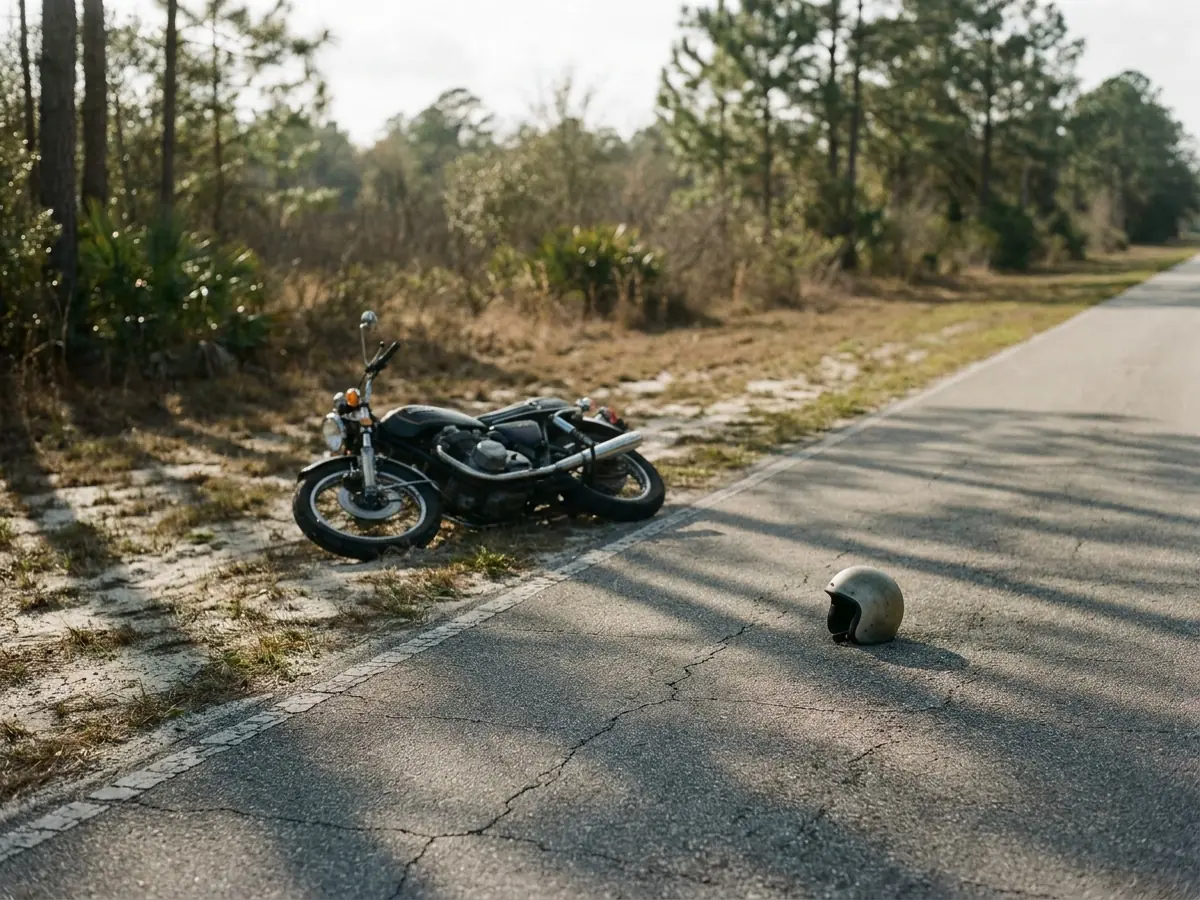
Florida motorcycle accident lawyer
A rider has no PIP. And no cushion either.
In 2024 Florida recorded 9,347 motorcycle riders involved in crashes. 575 died and only 1,227 walked away uninjured — about one in eight. A car occupant in the same report usually walks away; a rider usually does not, and unlike that car occupant a rider has no Personal Injury Protection behind them. There is no automatic first $10,000, which means the first question in almost every Florida motorcycle claim is not who was at fault but where the money is going to come from. DAPENALAW handles these claims from offices in Miami, Homestead and Tampa. Before opening his firm in 1998, Jose Dapena worked for insurance companies, reading these claims from the side of the file that decides what they are worth, and you deal with him directly at every stage. The review is free, and there is no attorney’s fee unless there is a recovery.
Why bring your motorcycle accident claim to Jose A. Dapena
There is no shortage of injury lawyers in Florida. These are the specific things that separate this firm, and every one of them can be checked.
-
He worked the other side of the file
Before he opened his firm in 1998, Jose A. Dapena worked for insurance companies — reviewing claims on the insurer’s behalf and deciding how the company would answer them. He knows how the other side builds its position because he used to build it.
-
28 years admitted in Florida
Florida Bar number 152358, admitted October 8, 1998, with federal practice in all three Florida districts. The bar number is checkable in The Florida Bar’s own directory.
-
You speak with your attorney, not an intake department
At many large firms a client deals with an intake team and then a case manager. Here you deal with your attorney directly at every stage. It is a question of access.
-
Home and hospital visits when travel is not realistic
A serious injury does not make it easy to get to a law office. Where that is the situation, the meeting happens where you are rather than being postponed until you can travel.
-
Three Florida offices, including Homestead
South Miami, Homestead and Tampa. Almost no injury firm keeps an office in Homestead, and for the south of the county that means not driving to downtown Miami to speak to a lawyer.
-
Free review, and the fee depends on a recovery
The fee is a percentage of the settlement or judgment, owed only if there is one. Case costs are a separate thing: the firm advances them and they are repaid out of a recovery, and who is responsible for them if there is none is set out in writing before you sign.
If you were hurt, the first call is free and commits you to nothing.
What happens when you call
The first call commits you to nothing and costs nothing. This is what happens in it, and in the days after.
- 01
You say what happened
In No forms first, and no intake questionnaire.
- 02
You are told whether there is a claim, including when there is not
If what you describe does not support a claim worth bringing, you hear that on the call rather than having a file opened.
- 03
The evidence that is expiring gets identified
Video, inspection logs, the report, a truck’s electronic logs. Almost all of it is held by the other side and almost all of it has a retention schedule.
- 04
A preservation demand goes out in writing
A phone call creates no obligation to keep anything. A written demand does, and it goes out in the first days rather than the second month.
- 05
Your own coverage gets checked
PIP, uninsured motorist, health coverage. A great many people have coverage they do not know they have.
- 06
You concentrate on treatment
Adjuster calls come through the firm. You do not give a recorded statement unprepared.
What it costs, and who pays your medical bills in the meantime
A motorcycle is not covered by PIP, and this surprises almost everyone. Fla. Stat. § 627.732(3) defines a motor vehicle for these purposes as a self-propelled vehicle with four or more wheels. Two wheels falls outside the definition, so the $10,000 that would answer a car crash is simply not there.
That means medical bills are paid from health insurance, from medical payments coverage if the rider bought it, from a letter of protection with a treating doctor, or from the liability claim at the end. It also means the 14-day rule that traps so many car claims does not apply in the same way.
The practical consequence is that the liability and uninsured motorist coverages carry more weight here than in any other kind of crash, because there is no no-fault layer underneath to absorb the first bills.
Quick answers about Florida motorcycle accident claims
- Does PIP cover me on a motorcycle?
- No. Fla. Stat. § 627.732(3) defines a motor vehicle for PIP as having four or more wheels, so a motorcycle is outside no-fault entirely. There is no automatic $10,000.
- Then who pays my medical bills?
- Your health insurance, MedPay if you bought it, your own uninsured motorist coverage, and the at-fault driver at the end of the case. Letters of protection are sometimes used where there is no other source.
- Do I have to wear a helmet in Florida?
- Not if you are over 21 and carry at least $10,000 in medical benefits coverage for motorcycle crash injuries. Under 21, a helmet meeting FMVSS 218 is required. Fla. Stat. § 316.211.
- Is eye protection also optional over 21?
- No, and this is the part riders miss. The $10,000 exemption in § 316.211(3)(b) covers the helmet only. Subsection (2) still requires an approved eye-protective device, with no age exemption.
- I was not wearing a helmet. Does that end my claim?
- No. Not wearing a helmet does not cause a crash, and it cannot make a driver who turned across you any less responsible. It is an argument about the injuries, not about fault.
- Am I entitled to the whole lane?
- Yes. Fla. Stat. § 316.209(1) gives a motorcycle full use of a lane and forbids another vehicle from being driven so as to deprive it of that. Riders are rarely told this is a right they hold.
- Is lane splitting legal in Florida?
- No. Section 316.209(3) prohibits operating a motorcycle between lanes of traffic or between adjacent rows of vehicles. It is a noncriminal moving violation.
- Why does uninsured motorist coverage matter so much to a rider?
- Because Florida does not require drivers to carry bodily injury liability at all. With no PIP under you and possibly no liability policy in front of you, your own UM coverage is often the entire claim.
- The driver said he never saw me. Is that a defense?
- No, it is an admission of failing to look. The duty to see what is there does not switch off because a motorcycle is smaller than a car.
- They offered the policy limits. Can I accept?
- Not before giving your own UM carrier written notice under Fla. Stat. § 627.727(6)(a). It then has 30 days, and signing a release without that notice can end the UM claim.
- What if I was partly at fault?
- Your recovery is reduced by your share, and above 50% Fla. Stat. § 768.81 bars it entirely. That cliff is why the fault argument in a rider case is fought so hard.
- How long do I have to sue?
- Two years from the crash for most negligence claims arising on or after March 24, 2023. Fla. Stat. § 95.11.
- Riders uninjured
- 13%1,227 of 9,347 involved in 2024 Florida crashes. FLHSMV
- PIP on a motorcycle
- NonePIP needs four or more wheels. § 627.732(3)
- Helmet exemption
- Over 21 + $10,000Medical benefits coverage. § 316.211(3)(b)
- Deadline to sue
- 2 yearsCrashes on or after March 24, 2023. § 95.11
01 What the numbers say
02 The coverage gap
03 Where the money comes from
04 The lane is yours
05 The helmet rule, exactly
06 The helmet argument
07 Why UM is the case
08 The first days
09 Where these happen here
10 Situations we are asked about
11 What it is worth
12 Where these cases come from
Miami-Dade
Miami-Dade recorded 60,000 crashes in 2024 with 29,359 people injured, according to FLHSMV. Rider conflicts concentrate on the long surface arterials — US-1 through the South Miami corridor where this office sits, Bird Road and Kendall Drive — and on the Palmetto Expressway. Serious injuries reach the Ryder Trauma Center at Jackson Memorial or HCA Florida Kendall, the county’s two Level I trauma centers, and those first-hour records usually become the backbone of the claim. Suit is filed at the Circuit Court on West Flagler Street, or the South Dade branch for cases from the far south of the county.
Motorcycle accidents in Miami · The Miami office · Homestead
Hillsborough
Hillsborough rider crashes concentrate on Dale Mabry Highway, with its long commercial stretches and constant turning conflicts, on Hillsborough Avenue through Town ’n’ Country, and on US-301 and SR-674 serving Riverview, Ruskin and Wimauma. Serious crashes are routed to Tampa General, the region’s Level I trauma center. Suit is filed at the Circuit Court on East Twiggs Street.
What Jose Dapena can do about a Florida motorcycle claim
The first call is about coverage, because on a rider case that is what decides whether there is a claim worth bringing. Yours, a relative’s, the driver’s, and whether a UM rejection form actually exists. If there is nothing there, you are told so in that conversation.
Before opening his firm in 1998, Jose Dapena worked for insurance companies, reading these claims from the side of the file that decides what they are worth. On a rider case the insurer’s first moves are predictable: speed, the helmet, and what you were wearing. None of those answers who turned across you.
You deal with him directly, at every stage. Home and hospital visits are available where travel is not realistic. The consultation is free and there is no attorney’s fee unless there is a recovery.
The consultation is free and there is no obligation.
13 What damages a claim
- Assuming PIP covers you because you carry motorcycle insurance. It needs four wheels under § 627.732(3).
- Not checking your own and a resident relative’s uninsured motorist coverage, which on a rider case is usually the whole claim.
- Accepting a declarations page that shows no UM without asking the carrier to produce the signed rejection form.
- Letting the motorcycle be repaired or disposed of before the damage pattern is documented.
- Throwing away a damaged helmet, which is physical evidence of what it absorbed.
- Giving the other driver’s insurer a recorded statement, where the questions aim at speed and at what you were wearing.
- Accepting the at-fault driver’s limits without the § 627.727(6)(a) notice to your own UM carrier.
- Signing a letter of protection without advice, when § 768.0427 governs what a jury may later hear about that cost.
Frequently asked questions about Florida motorcycle accidents
Why does Florida PIP not cover a motorcycle?
Because of how PIP defines a motor vehicle. Fla. Stat. § 627.732(3) requires a self-propelled vehicle with four or more wheels, designed and required to be licensed for use on Florida highways.
A motorcycle has two wheels, so no PIP attaches and there is no automatic first $10,000 of medical coverage.
One consequence runs in your favor: because PIP does not apply, the § 627.737 permanent injury threshold does not stand between a rider and a pain and suffering claim the way it does for a car occupant.
So who pays my medical bills?
Health insurance, medical payments coverage if you bought it on the motorcycle policy, your own uninsured motorist coverage, a resident relative’s policy, and the at-fault driver at the end of the case.
Health insurers and public programs generally assert a right to be reimbursed from any settlement. Negotiating those liens down at the end is frequently worth as much as the last increment of settlement.
Where none of that is enough, a letter of protection is sometimes used — but § 768.0427 governs what a jury may later hear about the cost of that care, so it is a decision to take advice on.
Do I have to wear a helmet in Florida?
Section 316.211(1) requires properly fastened headgear meeting Federal Motorcycle Vehicle Safety Standard 218. The exemption in subsection (3)(b) applies to a person over 21 covered by an insurance policy providing at least $10,000 in medical benefits for injuries from a motorcycle crash.
Under 21 there is no exemption.
And the exemption covers the helmet only. Subsection (2) separately requires an approved eye-protective device with no age exemption at all, which is the part riders most often have wrong.
I was not wearing a helmet. Does that end my claim?
No. If you were over 21 and carried the required $10,000 in medical benefits coverage, you were complying with Florida law, which is a materially different posture from a violation.
Even where it is raised, it cannot establish fault. Not wearing a helmet does not cause a collision and does not make the driver who turned across you less responsible for turning across you.
It supports a comparative fault argument under § 768.81 directed at a portion of the damages. Where the injuries are not to the head — a leg, a shoulder, a spine — it has very little to attach to.
Am I entitled to the full lane, and is lane splitting legal?
Yes to the first and no to the second, and both are in the same statute. Fla. Stat. § 316.209(1) entitles all motorcycles to full use of a lane and forbids any motor vehicle being driven so as to deprive a motorcycle of that use.
That protection does not apply where motorcycles are operated two abreast in a single lane, which subsection (4) permits but caps at two.
Subsection (3) prohibits operating between lanes of traffic or between adjacent rows of vehicles, so lane splitting is not lawful here. Police officers and firefighters on duty are the only exception, and a violation is a noncriminal moving violation.
The driver says he never saw me. Does that help him?
No. It is an admission of failing to look rather than an explanation that excuses anything.
The duty to see what is plainly there does not relax because a motorcycle presents a smaller profile than a car, and it is frequently the most useful sentence in the whole crash report.
In a left-turn case it sits alongside § 316.122, which puts the duty on the turning driver to yield to oncoming traffic close enough to be an immediate hazard.
The other driver had no insurance. What now?
Your own uninsured motorist coverage steps into their place, and it matters more to a rider than to anyone else because there is no PIP underneath you either.
Check every declarations page in the household. UM generally follows the person rather than the vehicle, so a resident relative’s policy may respond.
If a declarations page shows no UM, ask the carrier to produce the signed rejection form. Section 627.727 requires the coverage unless it was rejected in writing on an approved form, and where no such form exists the coverage may be there regardless.
They offered the policy limits. Should I take it?
Not before telling your own UM carrier. Under § 627.727(6)(a), where the settlement will not fully satisfy your claim, written notice must go by certified or registered mail to every underinsured motorist insurer before you accept.
It then has 30 days to authorize the settlement, or to refuse and preserve its subrogation rights by paying you the amount of that offer itself. If it authorizes or does not respond, you may sign a full release and keep the UM claim.
On a rider case the UM claim is usually the larger half, because the injuries are serious and the at-fault driver’s limits are often low.
I went down avoiding a car that never touched me. Is there a claim?
Possibly, and it is worth being precise about where the rule comes from. Section 627.727 says nothing at all about unidentified vehicles or physical contact — those words do not appear in it.
Whether a no-contact claim is covered therefore turns on your own policy’s definition of an uninsured motor vehicle, and those definitions commonly require the claim to be corroborated by something other than your own testimony.
That makes the police report, the 911 recording, independent witnesses and any camera footage decisive, and all of them perish quickly.
I crashed on a pothole or loose gravel. Can I claim?
Possibly, against whoever owned or maintained that stretch of roadway. Photograph the defect with something for scale before it is repaired.
Where the responsible body is a government entity, Fla. Stat. § 768.28 governs: a written claim must be presented first, recovery is capped at $200,000 per person and $300,000 per incident, and the notice requirement is a condition precedent.
That notice has its own timetable, which is why a roadway claim needs to be identified early rather than discovered late.
What is a motorcycle claim worth?
Nobody can answer that before reading the file, and a guarantee is a reason for caution.
It turns on the injury and its permanence, past and future medical cost under § 768.0427, lost earnings and earning capacity, the coverage actually available, and your share of fault under § 768.81.
Rider injuries skew toward the catastrophic, and permanent disfigurement from road rash is a distinct element of damages rather than an aspect of pain and suffering. A claim still cannot be valued until a doctor says you have reached maximum medical improvement.
What does it cost to hire a motorcycle accident lawyer?
The first consultation is free and there is no attorney’s fee unless there is a recovery.
Case expenses are separate and governed by the written representation agreement, which sets out who is responsible for them if there is no recovery.
14 Related matters
- Car accidents What a Florida car accident claim actually depends on.
- Uninsured motorist Florida does not require the coverage that pays you.
- Catastrophic injury The case is worth what it is worth. Recovering it is a different question.
The full list is on the personal injury page.
Tell Jose what happened
A free review of your motorcycle accidents case, with no obligation, and no fee and no costs unless there is a recovery. You speak with Jose A. Dapena directly at every stage, not with an intake department — and if there is no claim worth bringing, he will tell you that.