
Tampa negligent security lawyer
Why the first question is what kind of property you were on
A negligent security claim does not accuse the owner of the crime. It says the crime was foreseeable and the owner did not take reasonable measures against it. Since 2023, Fla. Stat. § 768.0706 gives owners of multifamily residential property of five or more units a presumption against liability — but the owner must first prove it substantially implemented nine specific measures, and most have not. Every other kind of property in Hillsborough County — garages, hotels, stores, bars, office parks — carries no presumption at all. Foreseeability is proved from the address’s own call history, and in Hillsborough County that history is held by whichever agency patrols that address. The claim is filed at the George E. Edgecomb Courthouse, 800 East Twiggs Street. The statute is explained in full on the Florida negligent security page. What follows is the Hillsborough County part.
- Hillsborough County crashes, 2024
- 26,269Florida Department of Highway Safety and Motor Vehicles
- People injured
- 17,359In Hillsborough County alone, in one year
- People killed
- 180Down from 230 the year before
- Where the statute applies
- 5+ unitsThe 2023 presumption covers multifamily residential only. § 768.0706(1)(b)
Quick answers about Tampa negligent security claims
- Does the 2023 statute end my claim?
- Not by itself. The owner has to prove it substantially implemented all nine measures before it gets the presumption at all, and in practice very few properties have done every one of them.
- Does the statute apply where I was hurt?
- Only if it was multifamily residential with at least five dwelling units on the parcel. A garage, hotel, store, bar or office park is ordinary premises liability, with no presumption and no checklist.
- What makes a crime foreseeable?
- Chiefly what happened at that address before. Prior crimes on the property, calls for service to it, and conditions the owner knew about — a broken gate, dead lighting, cameras that were not recording.
- How do I get the call history for the address?
- The Tampa Police Department offers an address search for calls for service — a search of a specific address — through the city’s records portal. It only covers addresses inside the city limits; the Hillsborough County Sheriff’s Office handles everything outside them, and states plainly that its patrol units do not respond within the city.
- The lighting looked dim. Does that matter?
- It is measurable, which makes it one of the strongest facts available. The statute requires an average of 1.8 foot-candles per square foot measured 18 inches above the surface — but only while conditions are unchanged, so it has to be measured before the owner relamps.
- Can I sue the security company too?
- Often yes. The owner, a management company and a contracted security firm can each have had control over a different part of the problem, and leaving one out can leave a share of fault unassigned.
- How long do I have?
- Two years for a negligence claim accruing on or after March 24, 2023. Camera footage is the real deadline — thirty days is the statutory retention floor for covered properties, and many systems overwrite sooner.
01 The law, once
02 The places
Where negligent security claims arise in Hillsborough County
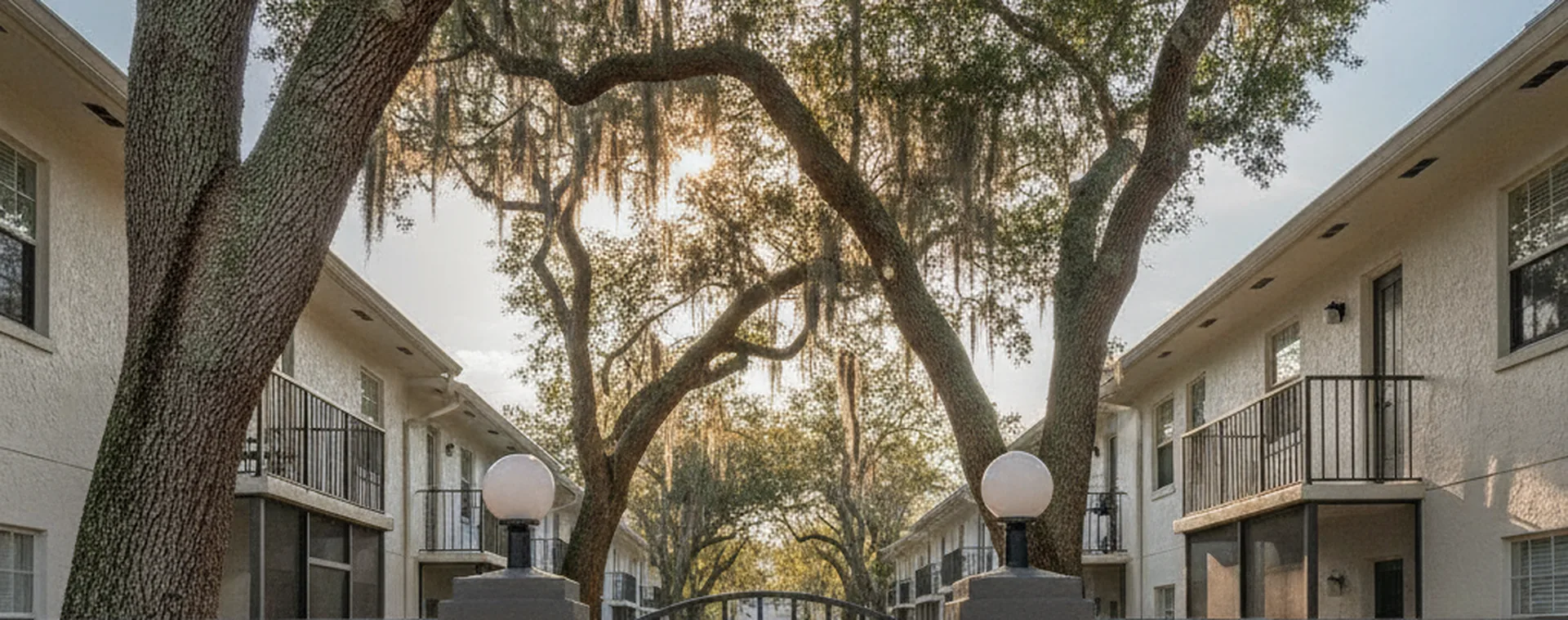
These claims do not come from roads. They come from buildings, and which kind of building you were on decides whether the 2023 statute applies at all — which is the first question in the case, not a detail.
- Apartment complexes of five or more unitsThe only setting the 2023 statute reaches, and the only one where an owner can claim the presumption.
- The university area off FletcherDense student housing with high turnover, where access control and who actually has a key are recurring questions.
- Town ’n’ Country and the northwestLarge garden-style complexes with surface lots, perimeter gates and long walkways between buildings.
- Brandon and RiverviewNewer multifamily built fast along the I-75 corridor, where gates and cameras are sold as amenities and not always maintained as ones.
- Downtown and Channelside garagesNot multifamily residential. No presumption, and the claim is ordinary premises liability.
- Ybor City and the Seventh Avenue venuesBars and clubs sit outside the statute entirely, and the duty is analyzed on ordinary premises principles.
- Westshore hotels and office parksAlso outside the statute, with the call history for the lot usually carrying the argument.
- Gas stations and convenience stores on the arterialsA recurring setting for late-night robberies, and squarely ordinary premises law.
03 Which statute applies
04 The nine things
05 Proving foreseeability
06 What to preserve
07 Examples of situations
Situations this office sees in Hillsborough County
The following are examples of the kinds of situations that arise in this county. They are illustrations of how the rules apply, not descriptions of past cases, and they do not predict any outcome. Every claim turns on its own facts, its own coverage and its own medical record.
Attacked in an apartment complex parking lot
The 2023 statute is in play, and the case turns on whether the owner can prove all nine measures.
A gate that had been broken for months
A work order predating the incident is often worth more than any expert opinion.
Assaulted in a parking garage
Not multifamily residential, so no presumption at all — ordinary premises liability.
A hotel or short-term rental
Also outside the statute, and the duty is analyzed as an ordinary premises claim.
Cameras that turned out not to be recording
A camera that records nothing is not a security camera system under § 768.0706(2)(a).
A complex with a history of violent crime
The call history is the case, and it is a public record.
08 The evidence
Evidence that exists here and often goes uncollected
Almost every camera that saw the crash overwrites itself within days or weeks. The difference between a disputed liability case and a straightforward one is usually whether someone asked for the footage while it still existed.
The call history for the address
Several years back, from the agency that actually patrols it.
A written demand to preserve footage
Date, time window and cameras named. Thirty days is the floor, not a promise.
A foot-candle reading, before relamping
Measured 18 inches above the surface, as the statute specifies.
Photographs of the gate, locks and lighting
Taken before anything is repaired.
The CPTED assessment, if one exists
Required to be under three years old. Often there is none.
Employee training records
The second administrative requirement, and frequently missing.
Work orders and tenant complaints
Notice the owner had and did not act on.
The lease and the management agreement
They identify who controlled what, and who else belongs in the claim.
09 The report
10 The office
Tampa negligent security questions, answered
Does the 2023 statute mean I cannot bring a claim?
No. It gives certain owners a presumption against liability, and the owner has to earn it first.
Under § 768.0706(3) the owner carries the burden of proving it substantially implemented the measures in subsection (2). There are nine of them, including a CPTED assessment under three years old and documented employee training, and in practice very few properties have done all nine.
It also only applies to multifamily residential property of five or more dwelling units. On any other kind of property there is no presumption at all.
Which properties does § 768.0706 actually cover?
Multifamily residential property: a residential building or group of buildings with at least five dwelling units on a single parcel, as the property appraiser has assigned that parcel number.
So apartment complexes, townhouse communities and condominiums can qualify. A duplex or a fourplex does not.
Garages, hotels, motels, stores, restaurants, bars, gas stations, office parks and shopping centers are not multifamily residential property and are governed by ordinary premises liability.
What are the nine measures an owner has to prove?
Seven physical ones: cameras at entry and exit with footage retrievable for at least 30 days; parking lot lighting averaging at least 1.8 foot-candles per square foot measured 18 inches above the surface, dusk to dawn or on a photocell; lighting in walkways, laundry rooms, common areas and porches on the same schedule; a deadbolt of at least one inch on each unit door; locking devices on windows, exterior sliding doors and other exterior non-community doors; locked gates with key or fob access along pool fence areas; and a peephole or door viewer on each unit door without an adjacent window.
Then two administrative ones: a crime prevention through environmental design assessment no more than three years old, and crime deterrence and safety training for employees.
Every one of them is documentary or measurable, which is what makes the owner’s burden a real one.
How is foreseeability proved?
Mainly from the history of that specific address. Prior crimes on the property, calls for service to it, and the character of those incidents.
Conditions the owner knew about matter just as much: a gate that had been broken for months, lighting that had been out, cameras that were not recording, complaints from other residents.
A single prior incident is rarely enough on its own. A pattern, or a known and unrepaired condition, is the substance of the argument.
How do I get the call history for a Tampa address?
Through whichever agency patrols it, and in Hillsborough that is decided by the city boundary.
The Tampa Police Department lists "Address Search / Calls for Service" as a request type — a search of a specific address — submitted through the city’s online records portal. Its own instruction is to check the boundary map first and confirm the address is within the limits of the City of Tampa.
Outside the city limits it is the Hillsborough County Sheriff’s Office, through its records request center. HCSO states that its patrol units do not respond to activity within the city, which is the same line drawn from the other side. Temple Terrace and Plant City run their own departments.
Ask the property for its own records at the same time: incident logs, tenant complaints and work orders, none of which reach a police database at all.
Nobody was ever arrested. Does that end the case?
No. A negligent security claim is against the property owner, not the attacker, and it does not require anyone to be identified, arrested or convicted.
The question is whether the crime was foreseeable and whether the owner’s security measures were reasonable. An unsolved crime still answers both.
One caution: since 2023 fault can be apportioned among those responsible under § 768.81, so how the defense frames the attacker’s share is something to expect rather than be surprised by.
The lighting was dim. Can that be proved now?
Only while conditions are unchanged, which is why it is urgent.
The statute sets a measurable standard — an average of at least 1.8 foot-candles per square foot, measured 18 inches above the surface, from dusk until dawn or on a photocell. That can be measured with a meter.
But a reading taken after the owner has replaced the lamps proves nothing about the night in question. Photographs taken that night, and a measured reading as early as possible, are what preserve it.
Who can be held responsible besides the owner?
Frequently more than one party. The property owner, the management company and a contracted security firm can each have controlled a different piece of what went wrong.
A management company may have handled the work orders. A security contractor may have set the patrol schedule. The owner may have decided the budget for lighting and cameras.
Identifying all of them early matters, because under § 768.81 fault is apportioned, and a party left out of the case is a share of fault that cannot be recovered from anyone.
How quickly does the evidence disappear?
Faster than almost any other kind of injury case, and most of it is held by the other side.
Thirty days is the retention floor the statute sets for a covered property, and many systems overwrite sooner. Lighting is relamped. Broken gates are repaired once a claim appears.
A written preservation demand naming the date, the time window and the cameras is the first substantive step, and it also establishes whether the system was working at all.
Where will these cases be heard?
At the George E. Edgecomb Courthouse, 800 East Twiggs Street.
Serious injuries from Tampa are treated at Tampa General on Davis Islands, the region’s Level I trauma center, and those first-hour records are typically what proves the injury months later.
How long do I have to bring a claim?
Two years for a negligence claim accruing on or after March 24, 2023, under Fla. Stat. § 95.11.
The deadlines that bite first are much shorter: camera footage measured in days or weeks, and physical conditions that change as soon as a claim is known about.
What does it cost?
The first conversation costs nothing and commits you to nothing.
Injury cases are handled on a contingent attorney’s fee, meaning no attorney’s fee unless there is a recovery. Case expenses are governed by the written representation agreement, including who pays them if there is no recovery.
Who will actually handle my case?
Jose A. Dapena. You deal with your attorney directly at every stage rather than through an intake department or a case manager.
He has practiced in Florida since 1998, Florida Bar number 152358. A negligent security case is a records case before it is anything else, and the early decisions about what to demand and from whom are the ones that decide it.
11 Keep reading
- Florida negligent security lawThe statutes, the deadlines and the defenses, in full
- The Tampa officeEverything the office handles, and the area it covers
- Personal injury in FloridaThe whole practice, and the other 22 kinds of claim
This page is general information about Florida law, not legal advice about your case. Published by Jose A. Dapena, P.A. Last updated October 2026.
Free case review with a Tampa negligent security lawyer
No fee to talk and no obligation. You deal with your attorney directly, at every stage.