
Immigration
My TPS ended. What do I do now?
Find out what you are eligible for before a charging document arrives. That is the whole of the useful advice, and this is what it means in practice.
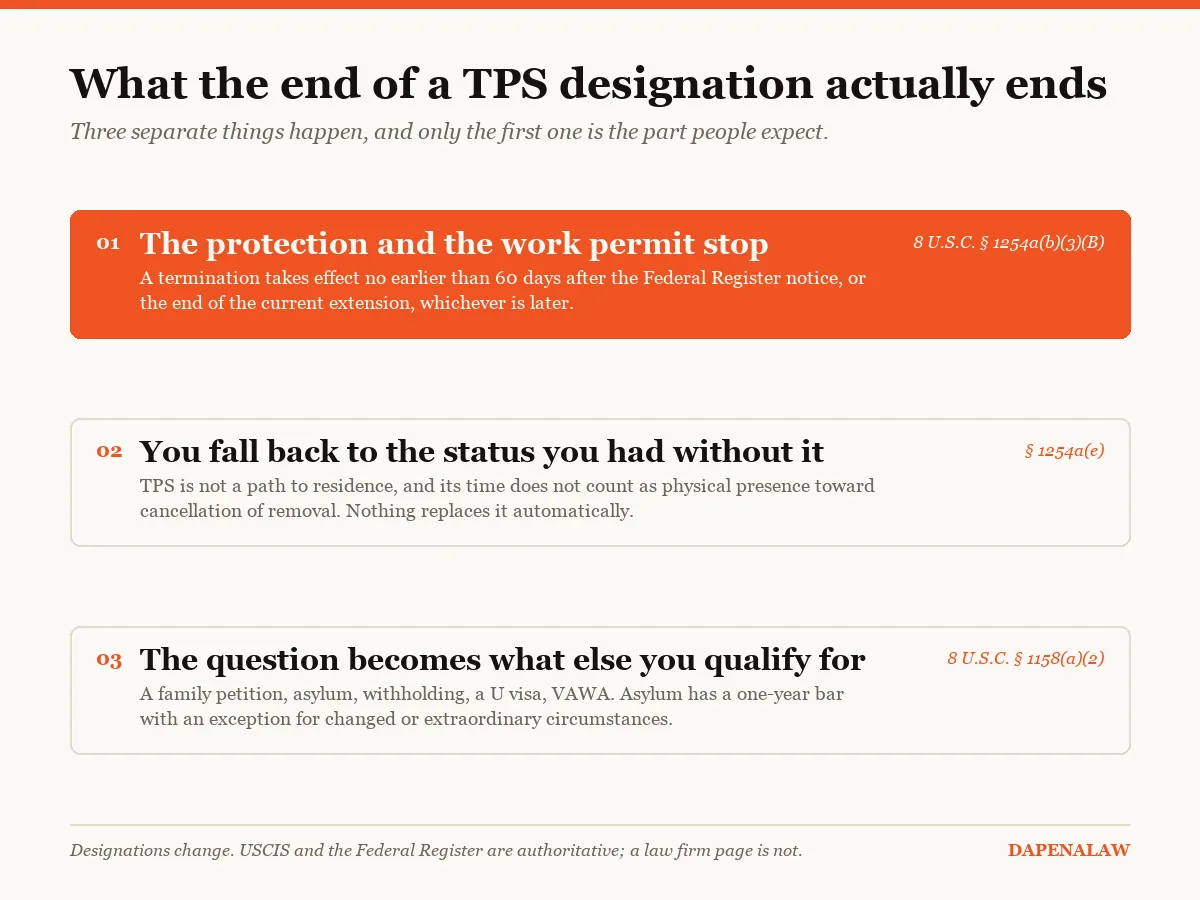
Three things happen, and only the first is the one people brace for. The work permit and the protection from removal stop. You do not move into another status — you fall back to whatever status you had without TPS, which for many people is none. And the real question becomes what else you qualify for: a family petition, asylum, withholding of removal, a U visa, VAWA, something tied to a child or a spouse. That question has an answer far more often than people expect, and it is much easier to act on before a charging document arrives than after.
01 What a termination actually does
The dates are in the Federal Register notice, not in the news
TPS is granted by country, not by person. The Secretary designates a country, nationals already here register, and they can remain and work while the designation is in force (8 U.S.C. § 1254a). Review happens at least 60 days before each period ends, and the outcome — extension or termination — is published in the Federal Register.
A termination has a floor on when it can bite. It cannot take effect earlier than 60 days after the notice is published, or the end of the most recent extension, whichever is later (§ 1254a(b)(3)(B)). Those dates are the ones that matter, and they are in the notice rather than in a headline.
The work authorization follows the status. A termination applies to documentation issued or renewed after the effective date, and the agency can allow a transition period (§ 1254a(d)(3)). Working past the expiration of an employment authorization document has consequences of its own, which is why the date on the card is worth checking against the notice rather than assumed.
And none of it is reviewable in court. Designation, extension and termination decisions are expressly not subject to judicial review (§ 1254a(b)(5)(A)). There is no appeal of the decision itself. What there is, is everything else you may be eligible for.
There is no appeal of a termination. What there is, is everything else you may be eligible for.
02 What people get wrong
Two beliefs that cost the most time
That TPS was building toward something. It was not. TPS is not a path to permanent residence, and its time does not count as physical presence toward cancellation of removal under § 1229b(a) — the statute says so directly (§ 1254a(e)). Ten years on TPS does not become ten years of anything else. It is a hard thing to hear after a decade of renewals, and it is better heard now.
That something will replace it automatically. Nothing does. When the designation ends you are in whatever status you held independently of TPS, and for most people that is none. The absence of a notice in the mail is not a status.
One thing does carry over, and it matters. For adjustment of status under § 1255 and change of status under § 1258, a person granted TPS is treated as maintaining lawful nonimmigrant status (§ 1254a(f)(4)). Whether that helps in a particular case depends on the rest of the history, and it is one of the first things worth having someone look at.
03 What to look at now
The categories worth checking, and the deadline inside one of them
A family petition. A spouse, parent or adult child who is a citizen or a permanent resident. Many people in this position have a qualifying relative and have never had the question asked properly, because TPS worked and there was no reason to.
Asylum, and the deadline that sits on it. An asylum application must generally be filed within one year of arrival, and the applicant must show that by clear and convincing evidence (8 U.S.C. § 1158(a)(2)(B)). Past that, the application can still be considered on a showing of changed circumstances materially affecting eligibility, or extraordinary circumstances explaining the delay (§ 1158(a)(2)(D)). Whether a terminated designation and conditions in the country support that showing is an argument to be made on the facts, not a result anyone should promise.
Withholding of removal, where the one-year bar does not apply in the same way but the standard of proof is higher.
A U visa or a VAWA self-petition, where someone has been the victim of a qualifying crime or of abuse by a citizen or resident relative. These are routinely missed because nobody asks.
Cancellation of removal, which requires long continuous physical presence and a hardship standard that is deliberately difficult, and which TPS time does not help build.
04 What not to do
The four that make it worse
Do not wait for a notice to appear. Filing something before a charging document exists is a different posture from filing after one arrives, and the difference is substantial.
Do not keep working on an expired document. Check the card against the notice rather than assuming either way.
Do not travel on an assumption. Travel while TPS is in force requires prior consent, and travel once a designation has ended is a separate question with serious consequences.
Do not pay a notario. A filing prepared badly is worse than no filing: it creates a record, it can foreclose an argument, and it is frequently what has to be undone first.
05 Where the information is authoritative
Check the government source, including against this page
Designations change, and they change on the government’s schedule rather than on anybody else’s. The USCIS Temporary Protected Status page and the Federal Register notice for a specific country are the authority for what is designated and from when. A law firm page, this one included, is not.
What does not change is the structure — how a termination takes effect, what TPS never built toward, and the categories worth checking when it ends. That is what this is written around, and it is why there is no country list here.
06 An example
A petition that had been available for six years
Someone has held TPS for eleven years, renewing each time without incident, working, raising two children born in Florida. The designation is terminated. The assumption in the household is that eleven years of lawful work must count for something, and that the children must count for something.
Neither assumption is how the statute works. But their spouse became a permanent resident six years earlier, and nobody had ever asked the question, because TPS was working and there was no reason to look. That relationship, not the eleven years, is where the available route turns out to be.
This is an illustration rather than a case, and the point of it is narrow: the thing that helps is frequently already true and nobody has asked. The answer to "what do I do now" starts with an inventory, not with a filing.
A constructed example, written to show how the rule works. It is not a case this firm handled and it is not a promised result.
07 What to do now
- Find the Federal Register notice for your countryNot a news article about it. The notice carries the effective date and any transition period, and those are the dates everything else is measured from.
- Check your employment authorization document against itThe expiration on the card and the effective date in the notice are two different things, and whether either has been extended is a question with a documented answer.
- Write down every relative and their statusSpouse, parents, children, their ages, whether anyone is a citizen or a permanent resident and since when. This is the inventory that most often produces the route nobody had looked for.
- Write down your own datesWhen you last entered and how, every period you have been here without a break, and when anything was ever filed for you. More immigration outcomes turn on dates than on anything else.
- Gather every prior filing, including denialsReceipt notices, approval notices, denials, anything a notario prepared. A denial is not a reason to leave it out — it is a reason to bring it.
- Ask before anything is filedThe order in which things are filed, and what is said in them, changes outcomes. A filing made to feel like progress can foreclose the argument that would have worked.
08 What an attorney would look into
- The exact effective date of the termination and any transition period in the notice, rather than the date in the news
- Whether the employment authorization document has been extended by notice, and what the card itself says
- Whether any qualifying family relationship exists, and when the relative obtained their status
- Whether an asylum application is still within the one year, and if not, what supports a changed or extraordinary circumstances showing
- Whether anything in the history supports a U visa or a VAWA self-petition, which are routinely missed
- What § 1254a(f)(4) means for this particular history, since TPS is treated as maintaining lawful nonimmigrant status for adjustment and change of status
- Whether there is any criminal record at all, in any state, because it changes which routes remain open
09 The sources
- 8 U.S.C. § 1254a Temporary Protected StatusDesignation by country, the review and termination mechanism, the sixty-day floor on when a termination can take effect, and the rule that TPS time does not count toward cancellation of removal.
- 8 U.S.C. § 1158(a)(2) Asylum deadlinesThe one-year filing deadline, proved by clear and convincing evidence, and the exception for changed or extraordinary circumstances.
- 8 U.S.C. § 1229b Cancellation of removalThe continuous physical presence requirement and hardship standard, which TPS time does not help satisfy.
- USCIS, Temporary Protected Status The government sourceThe authoritative list of designated countries and their dates. Confirm against this before acting on anything.
More questions
Can the termination be appealed?
Not the decision itself. Designation, extension and termination are expressly not subject to judicial review, so there is no appeal of the determination that a country no longer qualifies.
What can be done is everything on the other side of it: establishing what else you are eligible for, and acting on it before a charging document exists.
I had TPS for ten years. Does that count toward a green card?
No, and this is the hardest part to hear. TPS is not a path to permanent residence, and the statute says directly that TPS time does not count as physical presence toward cancellation of removal.
One thing does carry: for adjustment of status and change of status, a TPS holder is treated as having maintained lawful nonimmigrant status. Whether that helps depends on the rest of the history, and it is worth having looked at.
Can I keep working?
Only while the authorization is valid. The card’s expiration date and the termination’s effective date are not the same thing, and the agency sometimes extends documents by notice.
Check the card against the notice. Working past the authorization has consequences separate from the status question.
What happens if I do nothing?
The protection from removal ends and the work authorization ends, and you are in whatever status you held independently of TPS — for many people, none.
Doing nothing also means any filing you eventually make happens after a charging document rather than before, which is a materially worse position.
Is it too late for asylum?
Not necessarily. The general rule is one year from arrival, proved by clear and convincing evidence, but an application can still be considered on a showing of changed circumstances that materially affect eligibility, or extraordinary circumstances explaining the delay.
Whether a terminated designation and conditions in the country support that showing is an argument made on the specific facts. Nobody should promise the outcome of it, and anybody who does is worth walking away from.
What does it cost to find out what I qualify for?
The consultation is with the attorney who would appear. Immigration matters are billed hourly, which is different from how the injury side of this office works, and government filing fees are separate and paid to the agency. Payment plans are available and the rate is stated before anything is signed.
Bring the notice, the card, the dates, and everything ever filed. That is usually enough for a real answer in one sitting.
Find out what you qualify for before a charging document arrives
The inventory takes one conversation: the relatives, the dates, and everything ever filed. Acting before a case is opened is a different position from acting after one is.