
Homestead truck accident lawyer
Agricultural freight, long rural stretches, and evidence that starts disappearing immediately
A truck case in South Dade is a different case from a car case, and the difference is the evidence. There is a company behind the driver, a USDOT number on the door, maintenance records, hours-of-service logs and frequently an electronic logging device — and none of it is kept forever. The claim is still a Miami-Dade claim heard through the South Dade Justice Center, the fourteen-day treatment deadline still runs, and the law is explained in full on the Florida truck accident page. What follows is the South Dade part: which roads this freight is on, who writes the report, and what has to be requested before the ordinary retention period runs out.
- Miami-Dade County crashes, 2024
- 60,000Florida Department of Highway Safety and Motor Vehicles
- People injured
- 29,359In Miami-Dade County alone, in one year
- People killed
- 272Down from 325 the year before
- To start treatment
- 14 daysOr Florida PIP pays nothing at all
Quick answers about Homestead truck accident claims
- What makes a truck case different?
- A company, a commercial policy with far higher limits than a private car, and records that exist for a while and then do not — logs, maintenance, inspection reports, and whatever the vehicle itself recorded.
- What do I need from the scene?
- The company name on the door, the USDOT number, the plate and the trailer number if there is one. That thread leads to everything else.
- Who writes the report?
- Homestead Police inside the city, Florida City Police in Florida City, the Miami-Dade Sheriff’s Office in the unincorporated areas, and the Florida Highway Patrol on the Turnpike and the open stretches of US-1.
- How fast does the evidence go?
- Faster than people expect. Logs and inspection records are kept for defined periods and then lawfully destroyed, which is why a preservation request goes out early rather than after the medical picture is clear.
- Is the deadline different?
- No. Fourteen days for initial care or PIP pays nothing, and two years to file suit for most negligence claims. The difference is how much has to happen inside those two years.
- The truck was agricultural. Does that change it?
- Sometimes. Some farm vehicles and some short-haul agricultural operations sit under different federal rules than long-haul freight, and which rules applied is part of what gets established rather than assumed.
- Will my case be heard downtown?
- Usually not. Most South Dade matters go to the South Dade Justice Center at 10710 SW 211th Street, and most injury claims resolve without a lawsuit at all.
01 The law, once
02 The roads
Where truck accident claims arise in Miami-Dade County
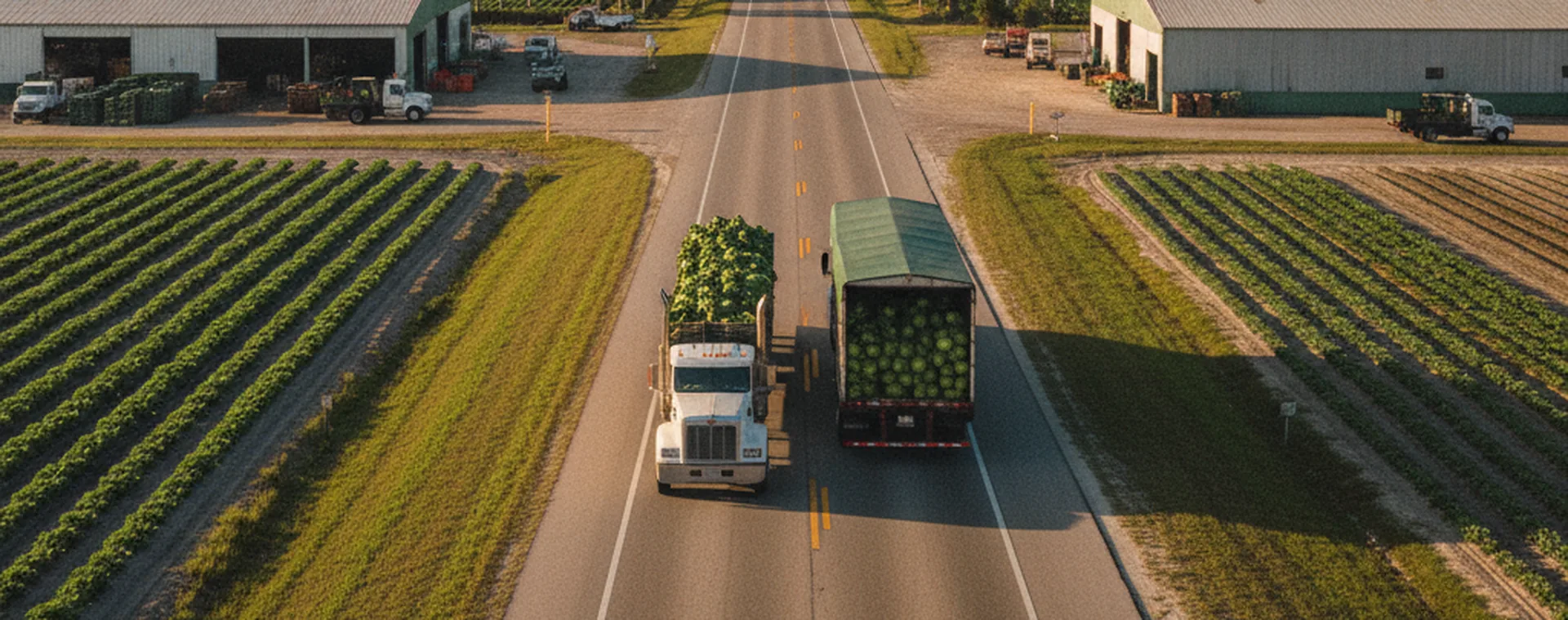
The freight here is not the freight on a city expressway. It is produce moving out of the packing houses, nursery stock going north, and equipment crossing between fields on roads that were not built for it.
- US-1, South Dixie HighwayThe main freight route north and the only highway south to the Keys. Produce trucks and through traffic in the same lanes.
- Krome Avenue, SR-997The agricultural artery. Packing trucks, equipment between fields, and vehicles entering from unpaved field roads.
- Florida’s Turnpike, Homestead ExtensionHigh speed and high closing rates, which is what turns a truck collision into a catastrophic one.
- Campbell Drive, SW 312th StreetThe east-west that carries Turnpike and US-1 freight across town.
- Palm Drive, SW 344th StreetFlorida City’s crossing and the Turnpike terminus, where freight and Keys traffic meet.
- SW 137th AvenueThe north-south toward Kendall, used when US-1 is backed up.
- Packing house and nursery drivewaysTurning movements out of private property onto a highway, which is where a great many of these happen.
- Card Sound Road, SR-905ATwo lanes, unlit, and the alternate when US-1 is congested.
03 The evidence
04 The freight here
05 The injuries
06 What not to do
07 Examples of situations
Situations this office sees in Miami-Dade County
The following are examples of the kinds of situations that arise in this county. They are illustrations of how the rules apply, not descriptions of past cases, and they do not predict any outcome. Every claim turns on its own facts, its own coverage and its own medical record.
Turning out of a packing house
A loaded truck pulls onto a highway from a private driveway and a car at speed has nowhere to go. The question is sight lines and how long the turn took, and it is answered with the physical evidence rather than the two accounts.
Dusk on Krome
A slow agricultural vehicle and a car at highway speed on an unlit stretch. The dispute is visibility, and photographs taken at the scene of what could actually be seen are worth more than anything reconstructed later.
A load that shifted
Cargo moves in transit and the trailer behaves differently than the driver expected. Who loaded it and how it was secured becomes the question, and that is a records question involving somebody who was never at the scene.
The Turnpike at speed
A high-speed collision on the extension, serious injuries, and a transfer to Ryder. The commercial policy behind the truck is frequently the only coverage large enough to matter.
08 The evidence
Evidence that exists here and often goes uncollected
Almost every camera that saw the crash overwrites itself within days or weeks. The difference between a disputed liability case and a straightforward one is usually whether someone asked for the footage while it still existed.
The company name and USDOT number
From the door of the truck, before it leaves. That number leads to the carrier, its insurer, its inspection history and its safety record.
Photographs of both vehicles and the scene
Positions, debris, skid or scuff marks, the lighting, and the driveway or intersection the truck came out of. Before anything is moved.
A preservation request, early
Logs, maintenance records, dispatch records and any electronic data. Retention periods are defined and they run whether or not a claim has been made.
Your own vehicle, uninspected
Do not authorize repair or disposal until somebody has looked at it. The damage profile is evidence of force and direction.
Both sets of medical records
Homestead Hospital for the emergency department and Jackson for anything transferred. A claim built on one of them is incomplete.
The names at the scene
On US-1 here a witness may be from another county or another state and genuinely unreachable a week later.
09 The report
10 The office
Homestead truck accident questions, answered
Do I need a lawyer for a truck accident?
More often than for a car crash, and the reason is practical rather than legal. The company has a claims process that starts within hours, and the records that decide the case are in their possession and on a retention clock.
Where nobody is hurt and the damage is straightforward, people handle it themselves and should.
The company already called me. Should I talk to them?
You are not required to give a recorded statement to the other side’s insurer. Their adjusters are competent and the questions are designed to produce useful answers about how you feel today and what you were doing before.
Get the claim number and the adjuster’s details, and say you will respond once you have a complete picture.
How much insurance does a truck carry?
Generally far more than a private car, and in an area where many drivers carry no bodily injury coverage at all, that is frequently the difference between a serious injury being recoverable and not.
The limits are confirmed in writing rather than described on a call.
What if the truck was a farm vehicle?
Some short-haul and agricultural operations sit under different federal rules than long-haul freight, which changes what records had to exist. Which rules applied is established from the operation rather than assumed from the look of the vehicle.
The negligence claim itself runs on the same Florida law either way.
My case was on the Turnpike. Is that different?
Only in who wrote the report — the Florida Highway Patrol — and in the speeds, which tend to make the injuries worse. The claim runs on the same rules and is still a Miami-Dade case.
What does it cost to ask?
The consultation is free and the representation is on a contingency fee, generally payable only on recovery. Case expenses are governed by the written agreement.
The conversation is with Jose A. Dapena, not an intake department.
11 Keep reading
- Florida truck accident lawThe statutes, the deadlines and the defenses, in full
- The Homestead officeEverything the office handles, and the area it covers
- Personal injury in FloridaThe whole practice, and the other 22 kinds of claim
This page is general information about Florida law, not legal advice about your case. Published by Jose A. Dapena, P.A. Last updated October 2026.
Free case review with a Homestead truck accident lawyer
No fee to talk and no obligation. You deal with your attorney directly, at every stage.