
Personal injury
The insurance company offered me money. Should I take it?
Sometimes yes. But not before you know three things, and an early offer is designed to arrive before you do.
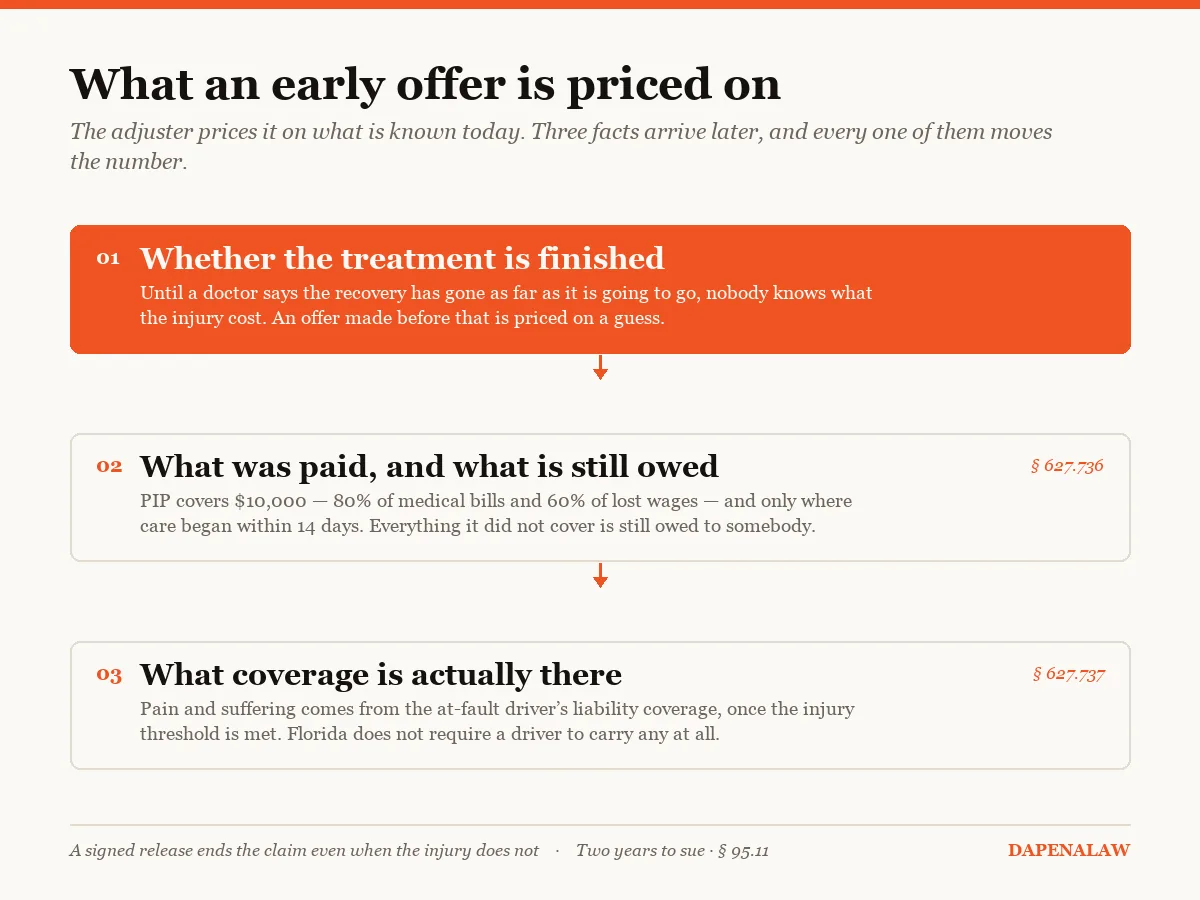
Not yet — not until you know whether you have finished treating, whether anyone has seen the full medical picture, and what insurance is actually available. An early offer is not a trick, but it is priced on what the adjuster knows today, and that is always less than what you will know in three months. Once you sign the release, the claim is over even if the injury is not.
01 Why it came so fast
An early offer is a pricing decision, not a favor
An adjuster who calls within days is doing something rational. The file is cheapest to close before anyone knows what is in it. Right now there is an emergency room record and a police report. There is no MRI, no specialist opinion, no record of what happens when you try to go back to work, and no way to know whether the pain settles in three weeks or does not settle at all.
Closing now transfers that uncertainty from the insurer to you, at a price set by the insurer. That is not misconduct — it is the job. But it means the number reflects risk the company is avoiding, not the value of what happened to you.
The release is the part that matters. Taking the money means signing a release, and a release is final. It covers the injuries nobody has diagnosed yet, the surgery nobody has recommended yet, and the months of work you have not yet missed. There is no mechanism to reopen it because the injury turned out to be worse.
So the question is never really "is this a good number." It is "do I know enough yet for any number to be a good one."
The file is cheapest to close before anyone knows what is in it. That is what an early offer is pricing.
02 What changes the answer
Three things to know before any number means anything
Whether you have finished treating. Until a doctor says you have reached maximum medical improvement, nobody knows what the injury cost. Settling before that point prices a guess. Settling after it prices a fact.
What the medical record actually says. Not what you remember telling the doctor — what is written down. Gaps in treatment, a missed follow-up, a note that says "patient reports feeling better" on a day you felt better: those are read closely and they move the number. So does a pre-existing condition that was asymptomatic until the crash, which is compensable but has to be documented as an aggravation rather than left to look like the real cause.
How much insurance exists. This is the one that decides most cases and almost nobody asks about it first. Florida requires PIP and property damage liability, but it does not require bodily injury liability coverage at all. A driver can be legally insured in this state and have nothing that pays for your injuries. Where that is the case the real question is not the offer, it is whether your own uninsured or underinsured motorist coverage applies and whether it stacks.
Florida’s own rules sit underneath all of it. PIP pays 80% of medical bills up to $10,000 regardless of fault, but only if treatment begins within fourteen days (§ 627.736). To recover pain and suffering from the at-fault driver at all, the injury has to clear the threshold in § 627.737. And under § 768.81, being found more than 50% at fault means recovering nothing — so how fault is apportioned is not a detail.
03 When yes is the right answer
Taking it is sometimes correct, and here is when
This is the part most firms leave out, and leaving it out is why people distrust the advice. There are cases where the early offer is a good offer.
When you have genuinely recovered. A minor collision, treatment that finished, no ongoing symptoms, and an offer that covers the bills and something for the disruption. There is nothing left to discover, so there is nothing lost by closing.
When the policy limit is the ceiling and the offer is at it. If the at-fault driver carries a small bodily injury policy, the offer is the full limit, and there is no other coverage and no other defendant, then no amount of litigation produces more money. A lawyer who takes that case and makes the same recovery has cost you a fee for nothing. An honest answer is to say so.
What makes the difference is that in both of those situations somebody has actually checked — the treatment is finished, the policy limits are confirmed in writing, and the search for other coverage came back empty. The problem with an early offer is not the amount. It is that it is usually accepted before any of that is known.
04 What not to do
The four things that make it worse
Do not give a recorded statement before you understand the claim. You are not required to give one to the other driver’s insurer. The questions are competent and they are designed to produce useful answers — about how you feel today, about what you were doing in the seconds before, about whether you have had back trouble before.
Do not minimize. "I’m fine, just sore" is the most natural thing to say at a scene and it is quoted back for the next two years. Describe symptoms accurately rather than politely.
Do not stop treating because you feel better. A gap in the record reads as recovery whether or not that is what happened, and it is the single most common reason a legitimate claim loses value.
Do not sign anything that looks administrative. A medical authorization that opens your entire history rather than the records from this crash is not the same document as a release, but it causes its own damage.
05 An example
An offer that looked generous for about six weeks
Someone is rear-ended on US-1 and goes to the emergency room the same evening with neck and shoulder pain. X-rays are clear, they are discharged with anti-inflammatories, and the bill is around $4,000. Eleven days later the adjuster calls and offers $9,000 to close it.
It reads as more than double the bills. What nobody has yet is an MRI. Six weeks on, the pain has not settled, an orthopedist orders imaging, and it shows a disc herniation that will need injections and may need surgery. The medical cost alone passes the offer, before anything for the months of work missed or the permanence the injury may leave behind.
Nothing improper happened. The adjuster priced the file with the information available on day eleven, and the information available on day eleven was an emergency room visit with clear X-rays. The offer was not unfair for what was known. It was simply made before anything was known.
A constructed example, written to show how the rule works. It is not a case this firm handled and it is not a promised result.
06 What to do now
- Do not accept, and do not refuse rudelyThere is no deadline forcing a decision this week. Tell the adjuster you are still treating and will respond when you have a complete picture. Nothing is lost by saying that.
- Get the treatment finishedFollow through on referrals and attend the appointments. The medical record is the claim, and the strongest evidence is consistent treatment rather than a persuasive account of pain.
- Find out what coverage existsThe at-fault driver’s bodily injury limits, your own PIP, and critically your uninsured and underinsured motorist coverage. Request your own policy declarations page — most people have never read theirs.
- Gather the documentsThe police report or exchange of information, every medical record and bill, photographs of the vehicles and of any visible injury, the names of anyone who saw it, and anything your employer has about missed work.
- Write down what the offer actually wasThe amount, the date, who made it, and what they said it covered. Early offers are frequently verbal, and the terms change between the call and the paperwork.
- Have the number checked before the release, not afterA consultation about an open offer is a short conversation. A consultation about a signed release is usually a conversation about what cannot be done.
07 What an attorney would look into
- Whether the policy limits you were told about are the real limits, confirmed in writing rather than described on a call
- Whether any other coverage exists — your own UM or UIM, a resident relative’s policy, an employer’s vehicle, a commercial policy behind the other driver
- Whether the medical record documents an aggravation of a pre-existing condition rather than leaving it to look like the cause
- Whether treatment began within fourteen days, and what the record shows if it did not
- Whether the fault apportionment in the report is supported by the physical evidence, because above 50% the claim recovers nothing
- Whether anything has already been signed — a recorded statement, a medical authorization, or a release
- Whether a lien or a letter of protection is attached to any of the medical bills, because that changes what reaches you
08 The sources
- Fla. Stat. § 627.736 Personal Injury Protection80% of medical bills to $10,000 regardless of fault, and the fourteen-day treatment deadline.
- Fla. Stat. § 627.737 The injury thresholdWhat an injury has to meet before pain and suffering can be claimed from the at-fault driver.
- Fla. Stat. § 768.81 Comparative faultMore than 50% at fault and the claim recovers nothing, which is why apportionment matters.
- Fla. Stat. § 95.11 Time limitsTwo years for most negligence claims accruing on or after March 24, 2023.
More questions
Will the offer be withdrawn if I do not accept now?
Almost never, and an offer that is genuinely presented as expiring this week is worth asking questions about rather than accepting. The claim does not disappear because an offer lapses, and the deadline that actually matters is the statute of limitations, which is two years for most negligence claims.
What does change is leverage. An offer made before treatment is finished is the insurer’s cheapest moment, not yours.
How much more could I get?
Nobody can tell you honestly before the treatment is finished and the coverage is confirmed, and a firm that gives you a number on a first call is guessing in order to get the case.
What can be said early is what the number will depend on: the medical record, whether the injury clears the statutory threshold, how fault is apportioned, and how much insurance exists. The last one sets the ceiling and is often the whole answer.
They said I do not need a lawyer for this.
Sometimes that is true, and it is worth saying plainly: where you have fully recovered, or where the offer is the policy limit and no other coverage exists, a lawyer may add nothing but a fee.
What is not true is that the adjuster is the right person to tell you which situation you are in. That assessment takes an hour and it is the part that should happen before the release, not after.
I already gave a recorded statement.
It is not fatal. It is a document that now exists and has to be worked with — what was said about how you felt that day, about prior injuries, about what you were doing before the impact.
Get a copy of it. The sooner someone reads it against the medical record, the easier it is to address what is in it.
What if the other driver has no insurance?
Then the question moves to your own policy. Florida does not require bodily injury liability coverage, so a legally insured driver can have nothing that pays for injuries — uninsured and underinsured motorist coverage on your own policy is what responds, and whether it stacks across vehicles can change the available amount substantially.
Pull your declarations page before deciding anything.
Does it cost anything to have the offer looked at?
The consultation on an injury matter is free, and the representation is on a contingency fee, generally payable only on recovery. Case expenses are governed by the written agreement. If the honest answer is that the offer is as good as it gets, that is what you will be told.
Have the offer read before you sign the release
It is a short conversation, it is free, and it is the one that has to happen before rather than after. If the offer is fair, you will be told that.