
Property insurance
They denied my claim. Which kind of denial is it?
Three different problems arrive in the same envelope. The first useful step is telling them apart.
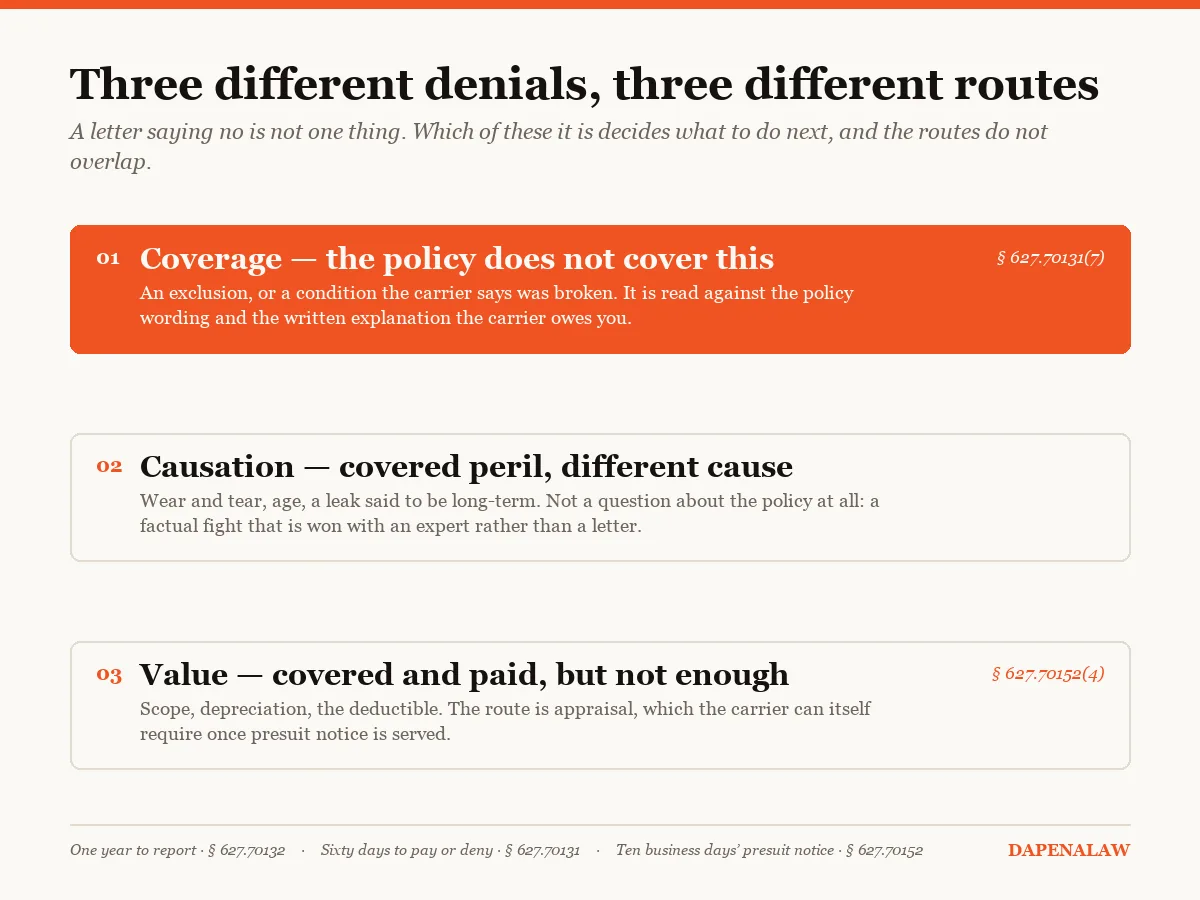
Read the letter for which of three things it actually says. A coverage denial: the policy does not cover this at all, because of an exclusion or a condition the carrier says you broke. A causation denial: the peril is covered, but this particular damage came from something else — age, wear, a leak they call long-term. A value dispute: they accepted the claim and paid, and the payment does not come close to the repair. Each one is answered differently, and the answer to one is useless against the others.
01 Why it matters which
Three problems that arrive in the same envelope
Most advice about denied property claims treats "denied" as a single event, and it is not. A carrier can refuse to pay for reasons that have nothing in common, and the letter usually contains more than one of them stated as though they were one.
A coverage denial is a document question. It is decided by the policy wording, the endorsements, and whether the condition they are relying on was actually breached. An expert cannot help with it and an estimate will not move it.
A causation denial is a factual fight. Nobody disputes the policy covers a roof leak; they dispute that this leak came from the storm. That one is won or lost on evidence — an engineer, a roofer, dated photographs, weather data — and no amount of reading the policy changes it.
A value dispute is not a denial at all. They accepted the claim and paid something. The argument is about scope, depreciation and the deductible, and it has its own route, which is usually appraisal rather than a lawsuit.
Spending three weeks building the wrong answer is the common way this goes wrong, and the deadlines are not generous enough to absorb it.
An expert cannot help with a coverage denial, and reading the policy will not move a causation denial. Telling them apart comes first.
02 What the carrier already owes you
Documents you may already be entitled to and have not asked for
A reasonable explanation in writing. Florida requires the insurer to pay or deny a claim, or a portion of it, within 60 days of receiving notice of the claim — and to give a written explanation for a denial, a partial denial, or a payment (§ 627.70131(7)(a)). Where the payment is less than a detailed estimate, the difference has to be explained in writing too.
A copy of the estimate. The carrier must send the policyholder a copy of any detailed estimate of the loss within 7 days after the adjuster generates it (§ 627.70131(3)(e)). Most policyholders never receive one because they never ask, and it is the single most useful document in the file — it shows what the carrier thinks the work costs and what it has left out.
And the adjuster’s name and license number, which the assigned adjuster must give you in writing (§ 627.70131(3)(b)).
Ask for all three in one email. Nothing about that is aggressive, it is a statutory entitlement, and the answer tells you which of the three denials you are actually dealing with better than the denial letter does.
03 The deadlines
Three clocks, and the first one is shorter than people expect
One year to report the claim. Notice of a claim must be given within one year of the date of loss — notice, not proof of loss and not a finished estimate (§ 627.70132). This is what catches damage that only becomes visible later as a stain on a ceiling.
Eighteen months for a supplemental claim, measured from the same date of loss rather than from the first payment. It runs while informal back-and-forth is still going on, which is exactly how it gets missed.
Ten business days of presuit notice before filing suit. A notice of intent to litigate on the department’s form is a condition precedent to suing a residential or commercial property carrier, and it cannot be served before the insurer has made a coverage determination (§ 627.70152(3)). A suit filed without it must be dismissed without prejudice.
What goes in that notice depends on which denial it is. Where it follows a denial of coverage, it states an estimate of damages if known. Where it follows anything else, it must carry a presuit settlement demand itemizing damages, fees and costs, and the disputed amount — which is the gap between that demand and the carrier’s offer.
04 What happens next
What the carrier is allowed to do once you serve notice
The carrier has 10 business days to respond in writing. After a coverage denial it must do one of three things: accept coverage, continue denying, or assert a right to reinspect the property. Asserting that right gives it 14 more business days, with the limitation periods tolled, after which it must accept or keep denying. If it keeps denying, suit may be filed with no further notice (§ 627.70152(4)(a)).
After anything other than a denial, the options are different. It must make a settlement offer, or require appraisal or another form of alternative dispute resolution. Limitation periods are tolled while that runs. If it has not concluded within 90 days after the notice period expires, suit may be filed immediately (§ 627.70152(4)(b)).
That is why the value dispute usually ends in appraisal. It is not a concession and it is frequently the faster route: two appraisers and an umpire deciding the amount of loss, without the two years a lawsuit can take. It settles the number, not whether the policy covers it — which is the reason it is wrong for a coverage denial.
Neither the notice nor the response is admissible later, and serving one does not relieve any other notice obligation in the policy (§ 627.70152(6)).
05 What not to do
The four that cost the most
Do not start repairs beyond what stops the damage spreading. Mitigation is required by the policy. A finished repair before the carrier has inspected destroys the evidence of what the damage was, and that is read against the person who did it.
Do not let the file go quiet. The 60-day clock runs from the carrier’s receipt of notice of the claim, and a file that nobody has written to in four months is a file where nothing is tolled and nothing is documented.
Do not sign a release to get a partial payment released. Carriers do issue partial payments, and they should not require giving up the rest. Read what is attached to the check.
Do not assume the denial letter states all the reasons. It frequently states one and leaves others in the file, which is what the detailed estimate and the adjuster’s own notes are for.
06 An example
A letter that was two denials in one paragraph
A Miami-Dade homeowner reports a roof leak after a storm. Four months later a letter arrives saying the claim is denied: the damage is consistent with wear and deterioration over time, and in any event the policy excludes damage resulting from faulty workmanship in a prior repair.
That is two different problems in one paragraph. The first is causation and it is answered with an engineer who dates the damage against the storm. The second is coverage and it is answered by reading the exclusion against what was actually done in that prior repair, and against the rest of the policy — anti-concurrent causation wording decides a great deal here and it is in the endorsements rather than the letter.
Answering the engineering question alone would have left the exclusion standing. Answering the exclusion alone would have left the carrier’s version of the cause unchallenged. Both had to be dealt with, and the detailed estimate the carrier had already generated — requested, not volunteered — showed which of the two it was really relying on.
A constructed example, written to show how the rule works. It is not a case this firm handled and it is not a promised result.
07 What to do now
- Read the letter for the word that decides itExcluded, or not covered, is a coverage denial. Caused by, consistent with, or resulting from is causation. A payment with an estimate attached is a value dispute. A letter can be more than one.
- Ask in writing for the three documentsThe written explanation, the detailed estimate the adjuster generated, and the adjuster’s name and license number. One email, no argument, statutory entitlements.
- Photograph everything again, with datesThe damage as it is now, the interior, the exterior, and anything that has got worse since. Keep the originals with their metadata rather than screenshots.
- Find the policy, including the endorsementsThe declarations page is not the policy. The exclusions and the anti-concurrent causation wording live in the form and the endorsements, and they decide more coverage denials than anything in the letter.
- Put the dates on one pageDate of loss, date reported, every inspection, every payment, every letter. The one-year, eighteen-month and sixty-day clocks all run from different events and that page is how they stop being missed.
- Get it read before the presuit notice is draftedWhat that notice must contain is not the same for a coverage denial as for anything else, and it cannot be served before the carrier has made a coverage determination. It is the step most worth getting right the first time.
08 What an attorney would look into
- Which of the three denials the letter is actually making, and whether it is making more than one
- Whether the carrier met the 60-day deadline to pay or deny, counted from notice of the claim rather than proof of loss
- Whether a detailed estimate was generated and whether it was ever sent, as the statute requires within 7 days
- What the endorsements say, particularly any anti-concurrent causation wording, rather than what the declarations page says
- Whether the condition the carrier relies on — late notice, failure to mitigate, a missed examination under oath — was actually breached
- Whether the date of loss is the date the carrier is using, which matters because the deadlines were shortened by statute in recent years
- Whether anything has been signed, including anything attached to a partial payment
09 The sources
- Fla. Stat. § 627.70131 Insurer duties on a property claimSeven days to acknowledge, thirty to inspect, sixty to pay or deny from notice of the claim, a written explanation for a denial or short payment, and a copy of the adjuster’s detailed estimate within seven days.
- Fla. Stat. § 627.70132 Notice deadlinesOne year to give notice of a claim and eighteen months for a supplemental claim, both from the date of loss.
- Fla. Stat. § 627.70152 Presuit noticeA condition precedent to suing a property carrier: ten business days’ notice on the department’s form, what it must contain, and what the carrier may do in response.
More questions
Can I just appeal the denial?
There is no appeal as such. What exists is a response: new information, a written request for the documents the carrier owes you, and if that does not resolve it, the presuit notice that precedes a lawsuit.
The useful version of an appeal is answering the specific reason given, which is why identifying which of the three denials it is comes first.
What is appraisal, and should I agree to it?
It is a process in the policy for deciding the amount of a loss: each side appoints an appraiser, the two select an umpire, and the amount is determined without a lawsuit. It is often faster and it is frequently the right route for a pure value dispute.
It is the wrong route where the argument is about whether the policy covers the loss at all, because appraisal decides the number rather than coverage. Agreeing to it on a coverage denial can cost time that the deadlines do not have.
They paid something, but not nearly enough. Is that a denial?
Legally it is a partial payment rather than a denial, and that distinction changes what the presuit notice must contain — a settlement demand itemizing damages, fees and costs, and the disputed amount, which is the gap between the demand and what was offered.
Ask for the detailed estimate behind the payment first. The difference between their scope and the actual repair is usually visible in it.
The damage only showed up months later. Is it too late?
Not necessarily. Notice of the claim is due within one year of the date of loss, not within a year of noticing the damage, so the date the carrier assigns as the date of loss matters a great deal.
A supplemental claim gets eighteen months from the same date of loss. Both are shorter than they used to be, so this is worth checking against the policy and the date rather than assuming.
Do I have to use a public adjuster?
No. A public adjuster can be useful, particularly on scope and estimating, and is a different role from a lawyer — they cannot advise on whether an exclusion applies or serve a presuit notice.
Which one a claim needs depends on which denial it is, which is the point of reading the letter properly first.
What does it cost to have the denial looked at?
The initial review of a property insurance denial costs nothing. Property insurance matters are handled on terms set out in writing before anything is signed, and they are not the contingency terms that apply to injury work.
Bring the denial letter, the policy and the dates. That is usually enough for a first answer.
Bring the letter, the policy and the dates
Which of the three denials you have decides everything that follows, and it is usually readable in twenty minutes. The first review costs nothing.