
Family law
We agree on everything. Do we still both need lawyers?
Not necessarily two. But not one between you either, and the reason is a conflict rule rather than a sales pitch.
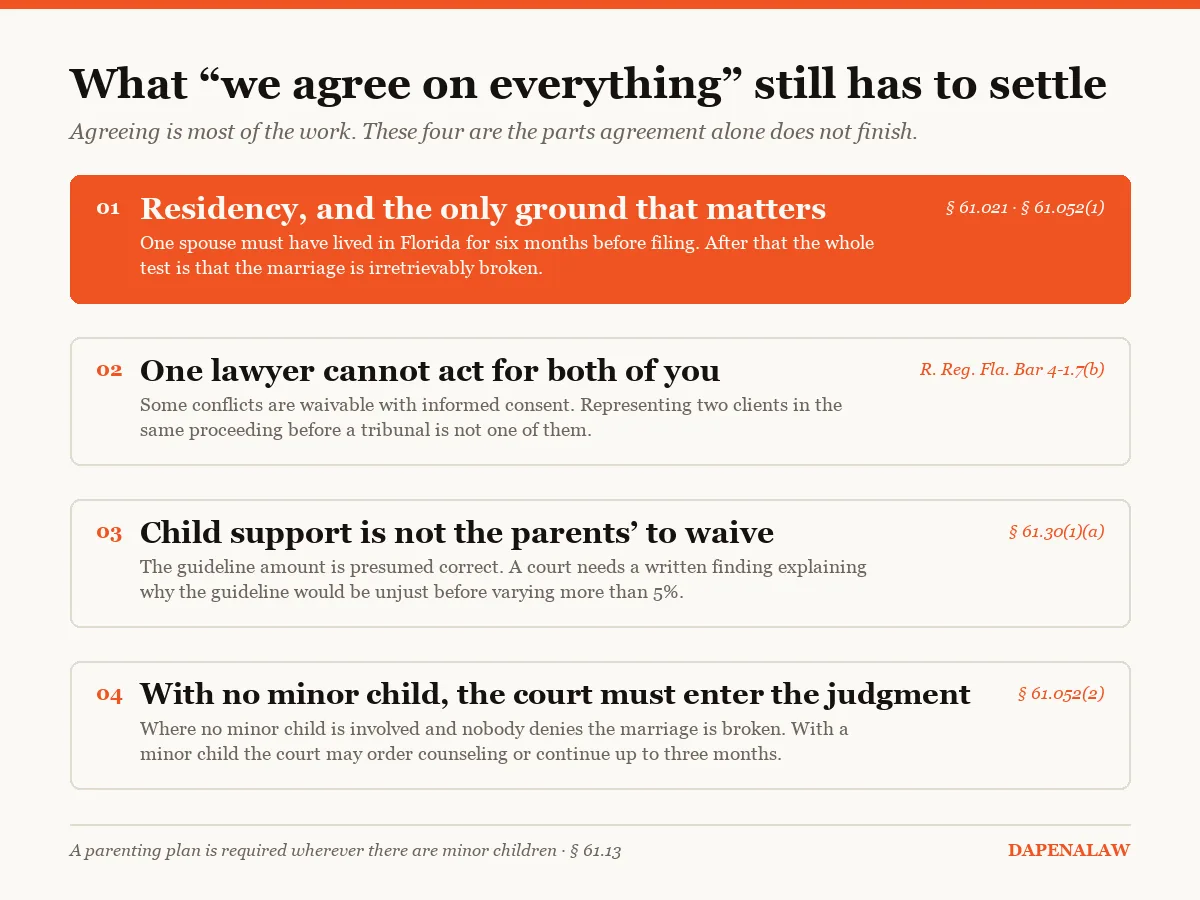
You do not necessarily need two lawyers, but you cannot share one. A lawyer may represent one of you and prepare the agreement and the filings; the other should have it independently reviewed before signing. That is not an upsell — Florida’s conflict rule does not permit one lawyer to act for two clients on opposite sides of the same proceeding, and a divorce is exactly that. What agreement genuinely saves you is the contested part, which is most of the cost. What it does not settle is whether the agreement does what you both think it does.
01 Why not one between you
A lawyer cannot act for both spouses, and consent does not fix it
Some conflicts of interest can be waived in writing. This one cannot. Rule 4-1.7 of the Rules Regulating The Florida Bar allows a lawyer to proceed despite a conflict only in defined circumstances, and representing two clients who take adverse positions in the same proceeding before a tribunal is outside them. A dissolution of marriage is a proceeding with two parties on opposite sides, however amicable it is in the kitchen.
What that looks like in practice is ordinary and not adversarial. One spouse retains the lawyer. That lawyer drafts the marital settlement agreement, the parenting plan if there are children, and the filings, and represents that spouse. The other spouse is told plainly, in writing, that the lawyer does not act for them and that they should have the documents reviewed independently.
The independent review is usually small. It is an hour or two of somebody reading the agreement for what it does rather than what it was meant to do. It is not a second full representation, and it is not a negotiation — unless the review turns something up, which is the point of it.
Beware the arrangement that sounds cheaper. A non-lawyer document service preparing forms for both of you is not representing either of you, and nobody in that transaction owes either spouse a duty to notice that the agreement gives away something it should not.
One lawyer, one client. The other spouse gets the agreement reviewed — usually an hour, occasionally the most valuable hour in the case.
02 What agreement does not finish
Four things that still have to be right
The jurisdictional requirement. One spouse must have resided in Florida for six months before the petition is filed (§ 61.021). It is the one fact the statute says generally has to be corroborated rather than simply stated, and a petition filed without it is not a technicality — it is a case the court cannot hear.
Child support is not yours to waive. The guideline amount presumptively establishes what must be ordered, and a court needs a written finding explaining why the guideline amount would be unjust or inappropriate before ordering something more than 5% away from it (§ 61.30(1)(a)). Two parents who agree on no support, or on a round number that suits them both, are agreeing to something a court reviews rather than rubber-stamps.
A parenting plan is a document, not an understanding. Where there are minor children it has to set out time-sharing, decision-making, holidays, exchanges and how relocation is handled. A vague plan is what brings people back to court two years later, and the time to be specific is while everyone is still agreeing.
The agreement has to say what you mean about property and alimony. Equitable distribution and alimony are where "we already sorted it out" most often turns out to mean two different things — particularly about retirement accounts, the house and its mortgage, and debt in one name that both of you treated as joint.
03 How the case actually moves
What the court does when nobody is fighting
Florida does not ask who was at fault. It is enough that the marriage is irretrievably broken (§ 61.052(1)(a)), which removes an entire category of argument from the case before it starts.
With no minor child, and with the other spouse not denying the marriage is broken, the court must enter the judgment once it finds the marriage irretrievably broken (§ 61.052(2)(a)). There is nothing discretionary left at that point.
With a minor child, the court has options it rarely uses but has. It may order a party to consult a counselor, or continue the proceedings for up to three months for an attempt at reconciliation, or take other action in the best interest of the parties and the child (§ 61.052(2)(b)). If it finds at any time the marriage is irretrievably broken it enters the judgment.
The practical shape is paperwork, not hearings. Financial disclosure, the agreement, the parenting plan, the support worksheet, and a short final hearing. The cost is in getting the documents right, which is why the one thing worth spending on is somebody reading them.
04 When one lawyer is enough
And when the second review is the one that matters
A short marriage, no children, no real property, no retirement accounts, similar incomes and nothing in dispute is the case where one lawyer drafting and the other spouse reading carefully is genuinely sufficient. Saying otherwise would be selling work nobody needs.
The review earns its fee where there is an asset that is hard to value or hard to divide. A pension or a 401(k) — dividing a retirement account usually requires its own order, and an agreement that simply says who keeps what frequently cannot be implemented. A business. A house with equity and a mortgage only one of you can refinance.
It also earns it where the arrangement is unequal on purpose. One spouse taking less because they want this over is a decision they are entitled to make, and it should be a decision made knowingly rather than one discovered later.
And where anything was signed before the marriage, or where one spouse has handled all the finances and the other genuinely does not know what exists. That is not an accusation. It is the single most common reason an agreement turns out to divide something incorrectly.
05 An example
An agreement that worked until the 401(k)
Two people agree on everything: she keeps the car, he keeps the boat, they sell the house and split what is left, nobody wants alimony, the children are grown. They have one lawyer prepare it, and the other spouse reads it over a weekend and signs.
The agreement says each keeps "their own retirement accounts." His is worth four times hers, and under equitable distribution the portion of each account built during the marriage was a marital asset either of them could have asked about. Nobody hid anything. Nobody asked.
This is an illustration rather than a case, and the point is narrow: the failure was not conflict, it was that the sentence both of them read meant something neither of them had priced. An hour of independent review is the step that catches that, and it catches it before the judgment rather than after.
A constructed example, written to show how the rule works. It is not a case this firm handled and it is not a promised result.
06 What to do now
- Decide which of you retains the lawyerIt is an administrative question rather than a statement about whose divorce it is. The other spouse is told in writing that the lawyer does not act for them.
- Write down what you have actually agreedIn your own words, before anyone drafts. The places where your two lists differ is the real agenda, and they are almost always about money nobody has named yet.
- List everything either of you owns or owesAccounts, retirement, vehicles, the house and the mortgage, credit cards, anything either of you brought into the marriage. Including the accounts you are sure are not relevant.
- Get the support number calculated, not negotiatedWhere there are minor children, run the guideline figure first. Agreeing on a number before anyone knows the guideline is agreeing to something the court will measure against it.
- Have the other spouse get it reviewed before signingAn hour with someone whose only job is to read it for what it does. If it is sound, that is what they will say.
- Be specific in the parenting plan while you still agreeSchedules, holidays, exchanges, who decides what, and what happens if someone moves. Specificity is a kindness to both of you later.
07 What an attorney would look into
- Whether the six-month Florida residency requirement is satisfied and can be corroborated
- What the child support guideline figure actually is, before any number is agreed
- Whether any retirement account needs its own order to be divided, which an agreement alone cannot accomplish
- Whether the portion of each asset acquired during the marriage has been identified, rather than title treated as ownership
- Whether any debt in one name was incurred for the household, which changes how it is treated
- Whether a premarital or postnuptial agreement exists, and whether it is enforceable as written
- Whether the parenting plan addresses relocation, which is the provision most often left out and most often needed
08 The sources
- Fla. Stat. § 61.021 Residence requirementOne spouse must have resided in Florida for six months before the petition is filed, and residence generally requires corroboration.
- Fla. Stat. § 61.052 Dissolution of marriageNo fault is required; the court must enter judgment where there is no minor child and nobody denies the marriage is irretrievably broken, and may order counseling or a continuance of up to three months where there is.
- Fla. Stat. § 61.30 Child support guidelinesThe guideline amount presumptively establishes what must be ordered, and a variance beyond 5% requires a written finding that the guideline would be unjust or inappropriate.
- R. Regulating Fla. Bar 4-1.7 Conflict of interestA lawyer may not represent two clients taking adverse positions in the same proceeding before a tribunal, and informed consent does not cure it.
More questions
Can we just use one lawyer to save money?
One of you can retain a lawyer, and that lawyer can prepare everything. What cannot happen is one lawyer representing both of you, because Florida’s conflict rule does not permit it in a proceeding where you are opposing parties.
The saving you are after is still there: the cost in a divorce is the contested part, and you have already removed it.
What about an online form service?
A document service is not representing either of you and owes neither of you advice. That is fine for the mechanics and it is exactly the problem where the agreement contains something that should have been questioned.
If you use one, the independent review matters more rather than less.
We agreed on no child support. Will the court accept that?
Not automatically. The guideline amount is presumed to be what must be ordered, and a court needs a written finding that the guideline would be unjust or inappropriate before departing from it by more than 5%.
Run the guideline figure first. You may still agree to something different, but you will be agreeing with the number in front of you rather than instead of it.
How long does an uncontested divorce take?
Far less than a contested one, and the time is mostly paperwork rather than waiting on a court. Financial disclosure, the agreement, the parenting plan and support worksheet where there are children, then a short final hearing.
What lengthens it is a document that has to be redone, which is the argument for getting it right the first time.
What if we agree now and one of us changes their mind?
Before signing, nothing is binding and the case simply becomes a contested one. After a judgment, changing the property division is extremely difficult; support and time-sharing can be modified, but only on a showing of a substantial change in circumstances.
That asymmetry is the reason the review happens before the signature.
What does this cost?
Family matters are not handled on a contingency fee and there is no free consultation on them — those are injury terms and they do not apply here. Fees are set out in writing before any work begins.
An uncontested matter is the least expensive thing a family lawyer does, and it is priced accordingly.
Keep the agreement. Have someone read it.
Agreement is the expensive part of a divorce and you have already done it. What is left is making sure the document does what you both think it does, which is a short piece of work with a written fee before it starts.