
Personal injury
What is my case worth, and why can nobody tell me yet?
A firm that gives you a number on the first call is guessing in order to get the case. Here is what the number will actually depend on.
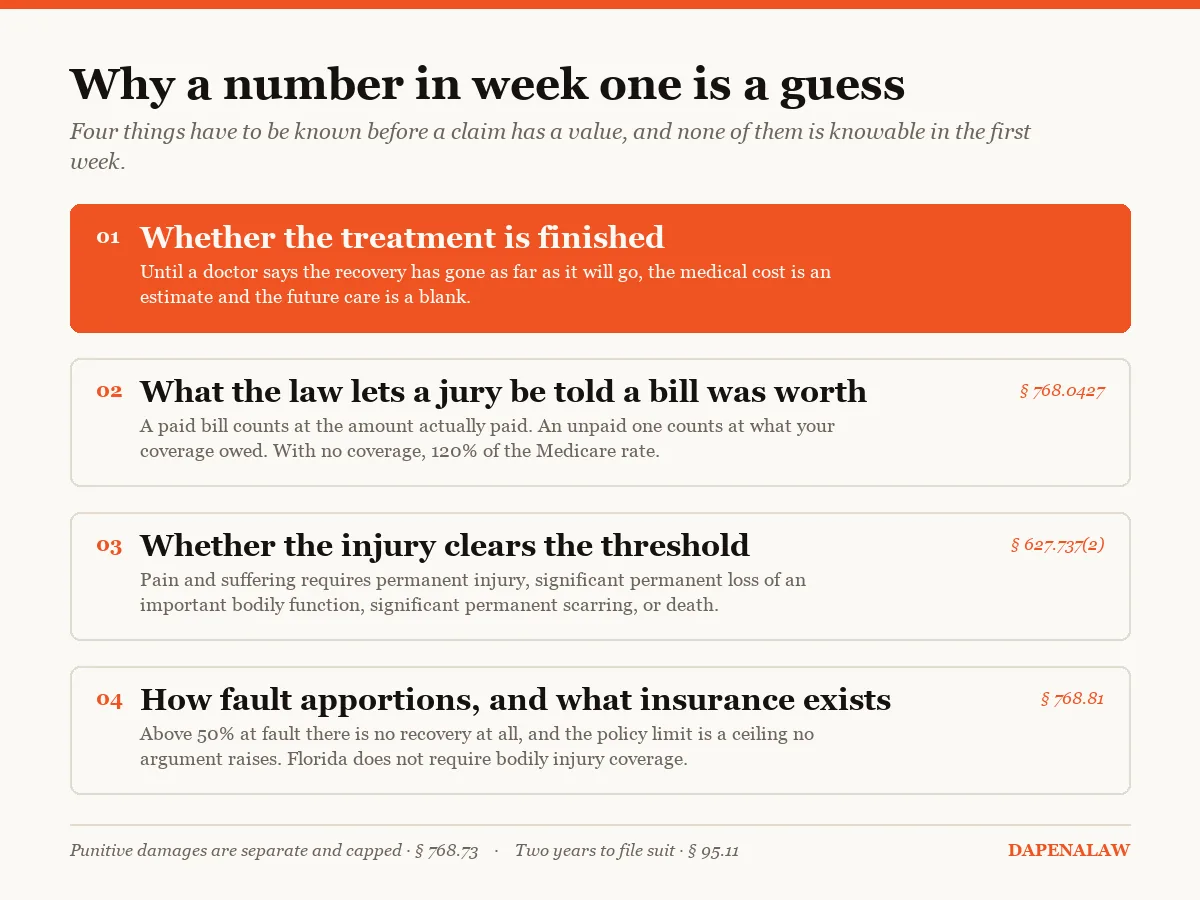
Nobody can tell you yet, and the ones who do are competing for the signature rather than valuing the claim. Four things decide it: whether your treatment is finished, what the law lets a jury be told your medical bills were worth, whether the injury clears Florida’s threshold for pain and suffering, and how fault apportions against how much insurance exists. The last one is a ceiling no argument raises. What can be said in week one is which of the four is going to matter most in your case.
01 The multiplier is a myth
There is no formula, and the one people quote was never real
The "three times your medical bills" rule does not exist in Florida law, in any insurer’s manual that anyone will show you, or in any courtroom. It persists because it is the only number anybody can give a stranger in sixty seconds.
What exists instead is a set of categories, each proved separately: medical expenses already incurred, medical care reasonably expected in the future, lost earnings, lost earning capacity, and the non-economic harm the law calls pain, suffering, mental anguish, disability and loss of the capacity to enjoy life. Each one is proved with different evidence, and three of them cannot even be estimated until treatment ends.
A claim is not a number waiting to be discovered. It is a set of facts that becomes a number once enough of them are known, and the order in which they become known is not negotiable.
A firm that gives you a figure on the first call is not valuing the claim. It is competing for the signature.
02 The four things
What the number will actually depend on
Whether the treatment is finished. Until a physician says you have reached maximum medical improvement, the medical cost is an estimate and future care is a blank line. A permanency opinion — whether anything about this injury is permanent — is also what the threshold turns on, and it does not exist until the treating doctor can give it.
What a jury may be told the bills were worth. This changed in 2023 and most people have not caught up. A bill already paid comes in at the amount actually paid, whoever paid it. A bill still unpaid, where you had coverage, comes in at what the coverage was obligated to pay plus your share. With no coverage at all, or on Medicare or Medicaid, the measure is 120% of the Medicare rate (§ 768.0427). The large number printed on a hospital statement is rarely the number the claim is built on.
Whether the injury clears the threshold. Pain and suffering is recoverable from the at-fault driver only where the injury consists in whole or in part of a significant and permanent loss of an important bodily function, a permanent injury within a reasonable degree of medical probability, significant and permanent scarring or disfigurement, or death (§ 627.737(2)). Below it, the claim is the economic loss and nothing else, and that single question routinely moves a case by an order of magnitude.
How fault apportions, against how much insurance exists. A claimant found more than 50% at fault recovers nothing at all (§ 768.81). And Florida does not require a driver to carry bodily injury liability coverage, so the available policy is frequently the real ceiling — a $2 million case against a $25,000 policy and no other defendant is a $25,000 case, and no amount of litigation changes that.
03 What stays uncertain
The parts that do not resolve, and should be described honestly
Non-economic damages have no formula and no cap in an ordinary negligence case. What they are worth depends on the injury, the evidence of how life changed, and ultimately on people in a jury box. Anybody quoting a range for that this early is describing a hope.
Future medical care is an opinion, not an invoice. It is proved with a physician’s testimony about what is reasonably expected, and it is argued over.
Punitive damages are a separate question and they are capped. Generally at the greater of three times compensatory damages or $500,000; at four times or $2 million where the conduct was motivated solely by unreasonable financial gain and a policymaker knew of the danger; and uncapped only where the defendant had a specific intent to harm (§ 768.73). They are not part of an ordinary crash claim and should not be dangled as though they were.
04 What can be said early
What an honest first conversation actually produces
Which of the four is going to decide your case. That is answerable on day one and it is more useful than a number. For many claims it is the insurance: if the available coverage is small and there is no second defendant, everything else is detail.
Whether anything has already gone wrong. A missed fourteen-day window, a gap in treatment, a recorded statement, a signed authorization that opened the whole medical history.
Whether there is a second place to look for coverage. Your own uninsured or underinsured motorist coverage, a resident relative’s policy, an employer’s vehicle, a commercial policy behind the other driver. This is the question that changes cases, and it is answerable in week one.
And how long it is likely to take, which is usually the question underneath the question. Two years is the deadline to file suit (§ 95.11), not a prediction of when a case resolves.
05 An example
Two claims with identical bills and very different values
Two people are rear-ended in similar collisions. Each finishes treatment with about $18,000 in medical bills. On the "three times" rule both are worth roughly $54,000, which is why the rule is popular.
The first has a soft tissue injury that resolved, no permanency opinion, and health insurance that paid most of the bills at contracted rates. The threshold is not met, so there is no pain and suffering claim at all, and the medical damages come in at what was actually paid rather than what was billed. The real value is a fraction of the figure the rule produced.
The second has a disc herniation with a permanency opinion, ongoing symptoms, and a job they can no longer do the same way. The threshold is met, future care is in evidence, and lost earning capacity is on the table. The ceiling is now the at-fault driver’s policy limit and whatever underinsured motorist coverage exists — which is why that coverage, not the bills, is the number worth finding out first.
A constructed example, written to show how the rule works. It is not a case this firm handled and it is not a promised result.
06 What to do now
- Finish the treatment before asking the question seriouslyNot because the question is premature to ask, but because the answer does not exist until a physician can say whether anything is permanent.
- Pull your own declarations pageUninsured and underinsured motorist coverage, and whether it stacks across vehicles. Most people have never read theirs, and it frequently sets the real ceiling.
- Ask what the at-fault driver actually carries, in writingNot described on a call. Florida does not require bodily injury coverage at all, so this is the single fact most likely to decide the case.
- Keep the evidence of how life changedNot just bills. What you cannot do now, what you stopped doing, what somebody else does for you. That is what non-economic damages are proved with, and it is not reconstructible later.
- Use your health insurance and keep every explanation of benefitsWhat was paid, and by whom, is the document that establishes the amount the statute lets into evidence.
- Ask what the number depends on, not what the number isAn honest answer early identifies which of the four factors decides your case. An early figure tells you only that somebody wants the case.
07 What an attorney would look into
- Whether a permanency opinion exists or is expected, since the threshold turns on it
- What was actually paid on each bill and by whom, because that is the measure the statute allows
- Whether health coverage existed throughout, and whether any treatment went on a letter of protection instead
- The at-fault driver’s bodily injury limits, confirmed in writing rather than described
- Whether uninsured or underinsured motorist coverage exists, and whether it stacks
- Whether a second defendant exists — an employer, a vehicle owner, a commercial policy, a road condition
- How fault is apportioned in the report and whether the physical evidence supports it, because above 50% the claim recovers nothing
08 The sources
- Fla. Stat. § 768.0427 Evidence of medical damagesWhat a jury may be told a medical bill was worth: amounts actually paid, amounts coverage owed, or 120% of the Medicare rate where there is no coverage.
- Fla. Stat. § 627.737 The injury thresholdPain and suffering requires permanent injury, significant permanent loss of an important bodily function, significant permanent scarring, or death.
- Fla. Stat. § 768.81 Comparative faultMore than 50% at fault and the claim recovers nothing; below that, the award is reduced by the percentage of fault.
- Fla. Stat. § 768.73 Punitive damagesGenerally capped at three times compensatory damages or $500,000, four times or $2 million for conduct motivated solely by unreasonable financial gain, and uncapped only for a specific intent to harm.
- Fla. Stat. § 95.11 Time limitsTwo years to file suit for most negligence claims accruing on or after March 24, 2023.
More questions
Is there really no formula?
No. The "three times medical bills" rule is not in any Florida statute, any published insurer manual, or any jury instruction. It survives because it is the only thing that fits in a sentence.
What adjusters do use are internal evaluation programs that weigh the diagnosis codes, the treatment pattern, the gaps, the venue and the attorney. None of that is a multiplier, and none of it is published.
Another firm gave me a number. Should I go with them?
Ask them which of the four factors they based it on and what they already know about your policy limits. If the answer is thin, the number was marketing.
A number given before a permanency opinion exists and before anyone has confirmed the available coverage is not a valuation. It is a bid.
Does it increase the value if I keep treating?
Treating because treatment is needed is what builds a claim. Treating to build a claim is visible in the records and it damages one, and since 2023 the amount claimable for that treatment is tied to what coverage would have paid anyway.
Follow the referrals, attend the appointments, and stop when the doctor says to stop.
What if the other driver has almost no insurance?
Then that limit is usually the ceiling, and the real question moves to your own uninsured or underinsured motorist coverage, a resident relative’s policy, or whether a second defendant exists.
This is the single most valuable thing to establish early, and it is often answerable in a day.
How long will it take?
Longer than you want and usually less time than the deadline allows. The honest shape of it is: treatment first, then the demand, then negotiation, then suit only if that fails. Two years is the deadline to file, not an estimate of resolution.
The thing that lengthens cases most is not the lawyer — it is treatment that has not finished, because nothing can be valued before it does.
What does it cost to ask?
The consultation on an injury matter is free, and the representation is on a contingency fee, generally payable only on recovery, with case expenses governed by the written agreement.
If the honest answer is that the available coverage caps this at a figure you could reach yourself, that is what you will be told.
Ask what your case depends on, not what it is worth
The first conversation can identify which of the four factors decides your claim and whether there is coverage nobody has found yet. It is free, and it does not require your treatment to be finished.