
Personal injury
Who pays my medical bills while the case runs?
Somebody pays at the time of treatment and somebody is repaid at the end, and they are almost never the same.
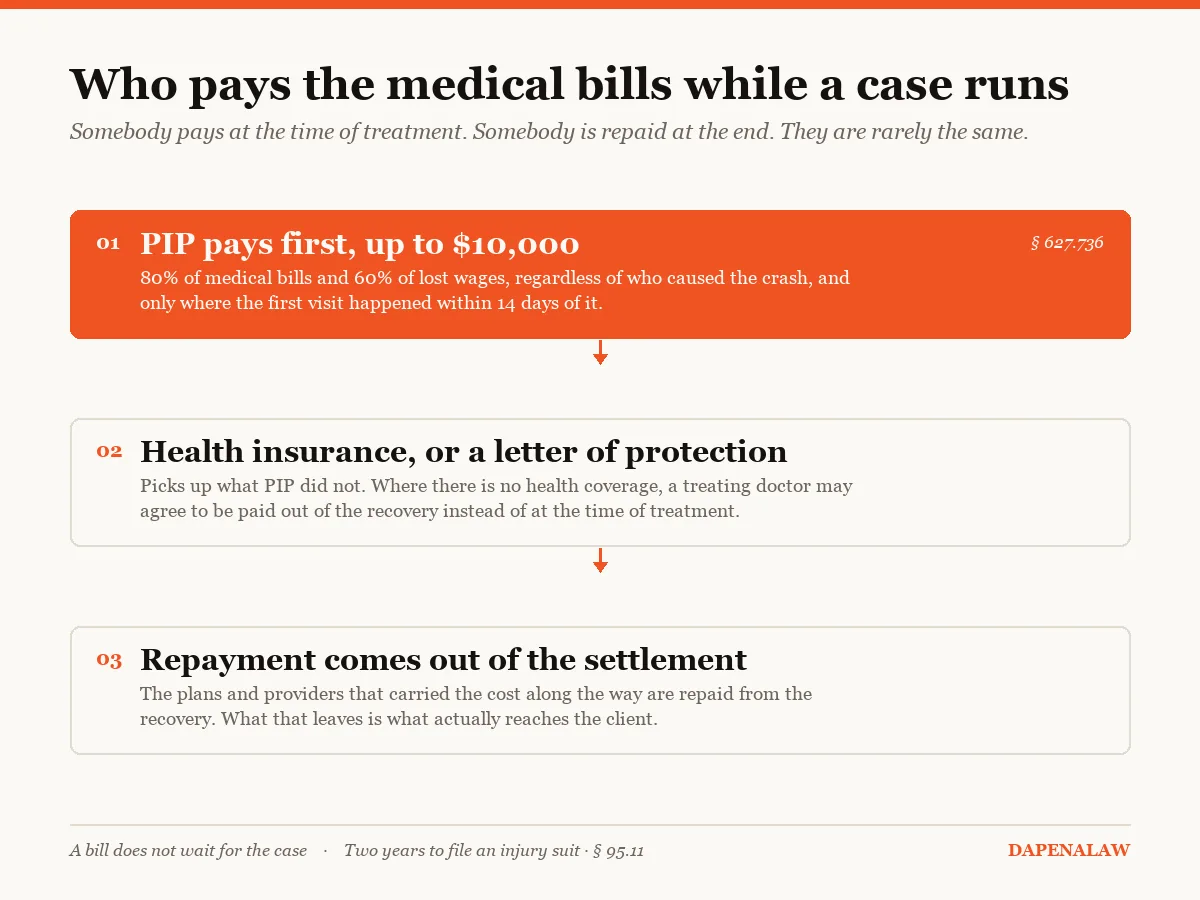
Your own PIP pays first — 80% of the bills, up to $10,000, and only if you were seen within fourteen days. Health insurance or a letter of protection covers what PIP did not. The at-fault driver’s insurer pays nothing along the way: it pays once, at the end, in a single sum against a release, and whoever carried the cost in the meantime is repaid out of that. Nobody sends the bill to the driver who caused it.
01 Why the bills come to you
Liability insurance does not pay as you go
There is no account that medical bills are charged to while a claim is open. The at-fault driver’s liability coverage pays once, at the end, in one sum, in exchange for a release. Until that happens the hospital, the imaging center and the orthopedist are looking at the person who received the care, which is you.
That single fact explains most of what feels wrong about the first two months. The crash was not your fault, the bills are arriving anyway, and the company that will eventually pay is the one company nobody can send an invoice to.
It also explains collections letters during a perfectly healthy case. A collections notice is not a judgment on the claim. It is usually a billing department that does not know a claim exists, because nobody told it. That is fixable in a phone call, and it is worth fixing early — a bill that goes to collections is harder to resolve out of the settlement than one that was flagged as accident-related from the first visit.
A collections letter during an open claim is not a verdict on the case. It is a billing department that does not know the case exists.
02 What PIP actually covers
PIP pays first, and the $10,000 is not automatic
Florida requires every driver to carry $10,000 of Personal Injury Protection, and it pays regardless of who caused the crash. It covers 80% of reasonable and necessary medical expenses and 60% of lost gross income, and it pays nothing at all unless initial care is received within fourteen days of the crash (§ 627.736).
The $10,000 figure depends on something most people have never heard of. PIP reimburses up to $10,000 only where a physician, dentist, physician assistant or advanced practice registered nurse determines that the injury was an emergency medical condition. Where a provider instead determines that it was not, reimbursement is limited to $2,500. The determination that it was an emergency medical condition can only come from that short list of providers; the determination that it was not can come from a wider group, chiropractic physicians among them.
So a claim can be handled competently, treated promptly, and still stop at $2,500 — not because anything went wrong, but because nobody on the narrow list ever wrote the determination down.
And 80% is not 100%. Even inside PIP, a fifth of every covered bill is left over. That balance does not disappear. It sits with the provider until something resolves it, which is the settlement, a health plan, or you.
03 Health insurance
Use the health insurance, even when it feels like helping the wrong side
The instinct is that using your own health plan lets the at-fault driver’s insurer off cheaply. Since 2023, Florida law makes close to the opposite true, and this is the single most expensive misunderstanding in an injury case.
§ 768.0427, enacted by chapter 2023-15, Laws of Florida, controls what a jury is allowed to be told a medical bill was worth. For a bill that has already been paid, the admissible evidence is the amount actually paid, whoever paid it. For a bill that is unpaid and you had coverage, it is what the coverage is obligated to pay the provider, plus your own share.
Here is the part that matters. Where you had health coverage but treated under a letter of protection instead of using it, the measure is still what that coverage would have paid. Declining to use the card does not raise the number a jury may hear. It only changes who is owed at the end, and leaves you owing a provider on terms that were never negotiated.
Where there is no coverage at all, or where Medicare or Medicaid applies, the admissible amount is 120% of the Medicare rate — or 170% of the state Medicaid rate where no Medicare rate exists. The large number printed on a hospital statement is, in nearly every case, not the number the claim can be built on.
04 Letters of protection
What a letter of protection does, and what it now has to disclose
A letter of protection is an agreement that a provider treats now and is paid out of the recovery rather than at the time of care. For someone with no health insurance and a specialist referral they cannot otherwise act on, it is often the only way the treatment happens at all, and treatment that happens is what a claim is made of.
What changed in 2023 is the paperwork. Under § 768.0427(3), disclosure is a condition precedent to claiming those medical expenses at all. That means a copy of the letter itself; itemized billing coded the way the statute requires; if the provider sold the receivable to a factoring company, the buyer’s name and what it paid, discount included; whether you had health coverage at the time; and whether an attorney referred you to that provider — a referral the statute makes disclosable notwithstanding the lawyer-client privilege in § 90.502.
None of that is a reason to avoid a letter of protection. It is a reason the paperwork has to be right from the first visit rather than reconstructed two years later, and a reason to say plainly who sent you where.
05 Who gets repaid
At the end, whoever carried the cost is repaid out of the recovery
A settlement is not all yours. Before anything reaches you, the people who paid along the way are repaid from it — the health plan under its own subrogation terms, the providers holding letters of protection, and any government program that paid.
Medicare pays conditionally when another payer is responsible and recovers those conditional payments from the settlement under the Medicare Secondary Payer statute, 42 U.S.C. § 1395y(b)(2). Ignoring it does not make it go away; it makes it expensive.
Medicaid is the one with a deadline. Florida’s agency holds an automatic lien on any third-party recovery, perfected from the moment treatment is first received (§ 409.910). Its default share is set by formula: after attorney’s fees and taxable costs, half of what remains goes to the agency up to what Medicaid actually paid, with the fee treated as 25% — which comes to 37.5% of the gross recovery unless somebody challenges it.
It can be challenged, and the window is short. A recipient may show by clear and convincing evidence that a smaller portion of the recovery represents medical expenses, but only by petition to the Division of Administrative Hearings within twenty-one days, and the clock starts when the agency is paid or the money is placed in trust for it — not when somebody notices. That is the whole remedy, and it is the single most commonly missed deadline in this part of a case.
Twenty-one days to challenge the Medicaid number, counted from when the agency is paid — not from when somebody notices.
06 An example
A clinic that said not to bother with the insurance card
Someone with a marketplace health plan is rear-ended and referred to a clinic for therapy and injections. The clinic says not to worry about insurance — they will treat on a letter of protection and collect at the end. Over four months the billed charges reach about $38,000.
At the end of the case, because health coverage existed the whole time, the measure that can be put in front of a jury is what that plan would have paid for the same care, which is a fraction of $38,000. The claim is not larger for the larger number. The clinic, meanwhile, is still holding a letter of protection for the full amount, on terms nobody negotiated.
The treatment was real and it was necessary. What went wrong was the billing route, decided in the first five minutes of the first visit by someone who was not thinking about a statute passed in 2023.
A constructed example, written to show how the rule works. It is not a case this firm handled and it is not a promised result.
07 What to do now
- Be seen within fourteen days, and say it was a crashMiss that window and PIP pays nothing, however serious the injury turns out to be. Saying the visit is crash-related is also what gets the bill coded in a way that can be found later.
- Ask whether an emergency medical condition determination was madeAnd by whom. Without one from a physician, dentist, physician assistant or advanced practice registered nurse, PIP stops at $2,500 instead of $10,000.
- Give the clinic your health insurance cardEven when you are told not to bother. Using the coverage you have does not shrink the claim, and declining to use it does not grow it.
- Keep every explanation of benefitsNot just the bills — the statements showing what the plan paid and what it refused. That is the document that establishes the amount the law lets into evidence.
- Say out loud whether Medicare, Medicaid, TRICARE or VA coverage is involvedEach has its own repayment rules and one of them has a twenty-one-day deadline. This is the question most people answer late, and late is where it costs money.
- Answer the collections letter instead of filing itTell the provider a claim is pending and give them the claim number and the adjuster. A bill flagged as accident-related is straightforward to resolve at the end. One sitting in collections is not.
08 What an attorney would look into
- Whether an emergency medical condition determination exists, and whether it came from a provider whose determination can reach the full $10,000
- Whether PIP was exhausted, capped at $2,500, or never billed at all
- Whether health coverage existed at the time of each course of treatment, and whether it was used
- Whether any letter of protection exists, and whether the receivable behind it has been sold to a factoring company
- Whether Medicare or Medicaid paid anything, and what the agency’s number is actually built from
- Whether the bills as submitted match the measure the statute allows into evidence, rather than the charge printed on the statement
- Whether a provider is balance billing beyond what the claim is permitted to include
09 The sources
- Fla. Stat. § 627.736 Personal Injury Protection80% of medical expenses and 60% of lost income to $10,000, the fourteen-day deadline, and the $2,500 limit where no emergency medical condition is determined.
- Fla. Stat. § 768.0427 Evidence of medical damagesWhat a jury may be told a bill was worth, and what a letter of protection must disclose before those expenses can be claimed. Enacted by ch. 2023-15, Laws of Florida.
- Fla. Stat. § 409.910 Medicaid third-party liabilityThe automatic lien on a recovery, the default repayment formula, and the twenty-one-day window to contest it.
- 42 U.S.C. § 1395y(b)(2) Medicare Secondary PayerMedicare pays conditionally when another payer is responsible, and recovers those payments from the settlement.
- Fla. Stat. § 95.11 Time limitsTwo years for most negligence claims accruing on or after March 24, 2023.
More questions
The hospital sent me to collections. Is the case in trouble?
Almost certainly not. A billing department and a claims file are not connected to each other, and a bill goes to collections on its own schedule whether or not a claim is going well.
Call the provider, tell them a claim is pending, and give them the claim number and the adjuster’s details. Most billing departments will hold an account that is documented as accident-related. The ones that will not are a separate problem, and a smaller one than it feels like.
Should I use my health insurance, or does that help the other side?
Use it. Since 2023 the amount that can be put in front of a jury for an unpaid bill is tied to what your coverage was obligated to pay — and if you had coverage but treated under a letter of protection instead, the measure is still what the coverage would have paid.
Declining to use the card does not make the claim bigger. It changes who you owe at the end, and usually not in your favor.
PIP only paid $2,500. Why?
Because PIP reaches $10,000 only where a physician, dentist, physician assistant or advanced practice registered nurse determines that the injury was an emergency medical condition. Where that determination says it was not — and a wider group of providers can make that one — reimbursement is capped at $2,500.
It is worth finding out which of those two happened, and whether the determination was ever made at all.
Is a letter of protection a bad idea?
Not at all, and for someone with no health coverage it is often the only way a specialist referral turns into actual treatment.
What it is not is a way to make the claim larger, and since 2023 it carries real disclosure requirements — the letter itself, itemized coded billing, whether the receivable was sold and for how much, whether you had coverage, and who referred you. Those are straightforward when they are handled from the first visit.
Will Medicaid take the whole settlement?
No, but its default share is larger than most people expect: after attorney’s fees and taxable costs, half of the remainder up to what Medicaid actually paid, with the fee treated as 25% — about 37.5% of the gross recovery.
That default can be contested by showing that a smaller portion of the recovery represents medical expenses, but only by petition to the Division of Administrative Hearings within twenty-one days of the agency being paid. Miss it and the formula stands.
Does it cost anything to ask about the bills?
The consultation on an injury matter is free, and the representation is on a contingency fee, generally payable only on recovery. Case expenses are governed by the written agreement.
Bills are worth raising early rather than at the end. Most of what goes wrong here is decided in the first visit, not in the last month.
Bring the bills, not just the crash
How the treatment was billed decides what the claim can include, and most of it is settled in the first two weeks. It is worth an hour before the next appointment, and it costs nothing.