
Personal injury
I missed the 14-day deadline. Is my claim over?
No. It ends one source of payment, and the one it ends is not the one that pays for the injury.
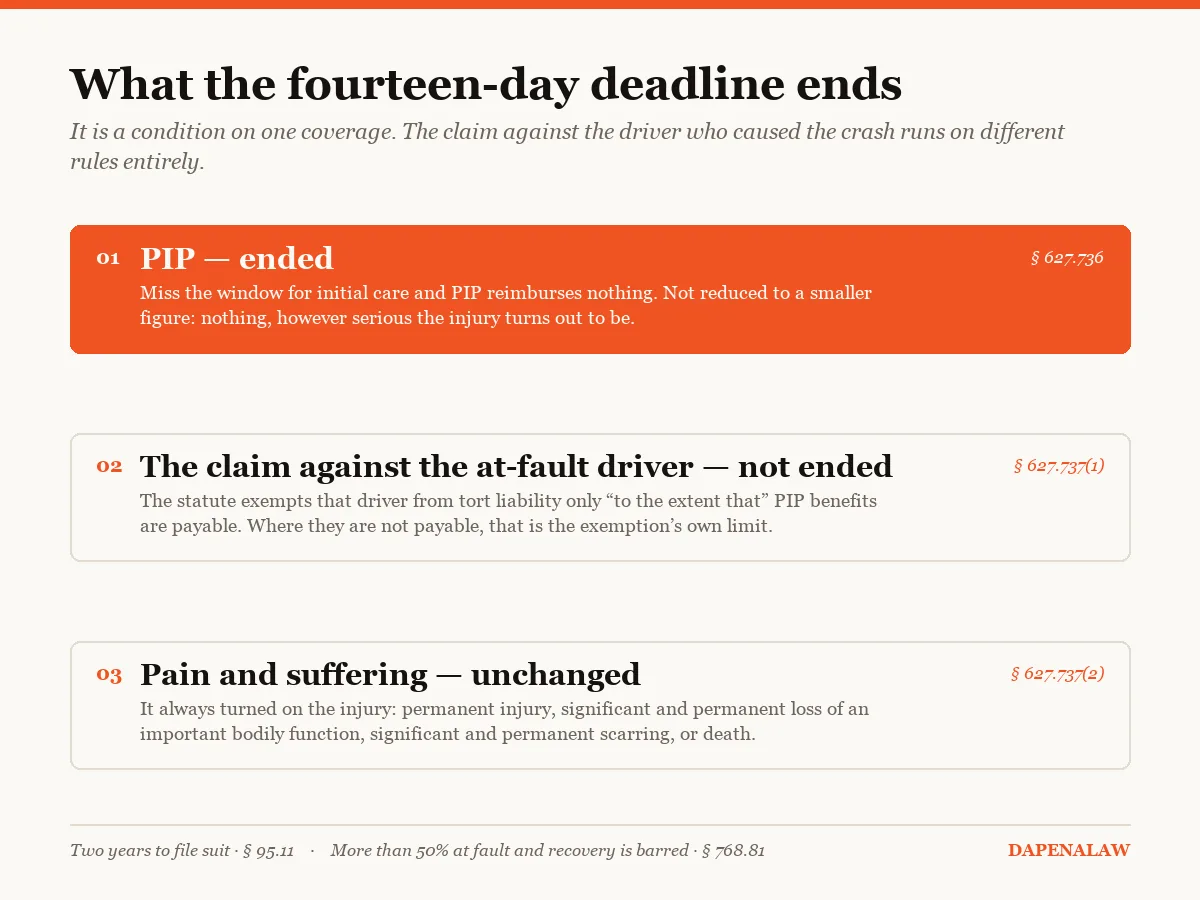
No. The fourteen-day rule is a condition on Personal Injury Protection — your own no-fault coverage — and missing it means PIP reimburses nothing. It is not a condition on the claim against the driver who caused the crash. That claim runs on a different deadline, two years, and turns on a different question entirely: whether the injury meets Florida’s threshold. What you lost is real. What is left is usually the larger half.
01 What actually ended
The fourteen-day rule is a PIP rule, and nothing else
Florida’s no-fault statute conditions the whole $10,000 on one thing: that the injured person receives initial services and care within fourteen days of the crash (§ 627.736). Miss it and PIP is not reduced to a smaller figure. It pays nothing, however serious the injury turns out to be.
What counts as initial care is wider than people assume. The statute looks for services lawfully provided, supervised, ordered or prescribed by a physician, osteopath, dentist or chiropractic physician, or rendered at a hospital, in a facility that owns or is wholly owned by a hospital, or by ambulance or emergency services. An urgent care visit on day nine counts. A conversation with a relative who is a nurse does not.
And the reasons people miss it are the ordinary ones. Nothing hurt on the day. There was no visible injury, so a hospital seemed excessive. There was no health insurance and no way to pay for a visit nobody thought was necessary. There was a shift the next morning. Nobody mentioned that a clock had started, because nobody usually does.
Miss the window and PIP is not reduced to a smaller figure. It pays nothing, however serious the injury turns out to be.
02 What did not end
The claim against the driver who caused it is a separate thing
These are two different claims against two different parties under two different rules, and the fourteen-day condition sits on only one of them. PIP is a claim against your own insurer. The claim for the injury is against the driver who caused the crash, and nothing in § 627.736 conditions it.
The no-fault bargain itself has a limit written into it. Florida exempts an insured driver from tort liability for bodily injury — but only to the extent that the benefits described in § 627.736(1) are payable for that injury (§ 627.737(1)). The exemption is measured by what PIP pays. That is the statute’s own wording, and how it applies to a particular set of bills is an argument to be made on the facts rather than a result to be promised in advance.
Pain and suffering never depended on PIP at all. It depends on the injury clearing the threshold in § 627.737(2): a significant and permanent loss of an important bodily function, a permanent injury within a reasonable degree of medical probability, significant and permanent scarring or disfigurement, or death. A herniated disc that meets that test meets it whether or not anyone was seen on day three.
03 What changes
Three things that get harder, and are worth knowing early
The bills have to go somewhere else. Health insurance, or a letter of protection where there is none. That is its own subject and the rules changed in 2023 — who actually pays while the case runs is the companion to this one.
The gap gets argued. An adjuster will read a first visit on day nineteen as evidence that the injury came from something else, or that it was minor until it was not. That argument is answerable, but it is answered with specifics: what the symptoms were in those days, what you did instead, whether you tried to work, who you told.
The wage benefit is gone. PIP’s 60% of lost gross income went with the rest of it. Lost earnings remain part of the claim against the at-fault driver, but there is no longer anything paying them while the case runs, which changes what the next few months look like in practice.
04 What to do now
The window is closed. The record is not.
Get seen anyway, today. Late treatment still documents the injury, and the record from here forward is the record the claim is built on. A first visit on day twenty is better than a first visit on day forty by exactly the amount of argument it saves.
Write down the days you lost. When the symptoms started, when they got worse, what you tried, whether you went to work and what that was like. Written now it is a contemporaneous account. Reconstructed in a deposition eighteen months from now it is a memory being tested.
Do not move the date. This has to be said plainly, because the temptation is real and somebody will suggest it. A clinic that offers to write the visit up as having happened earlier is offering to end the case permanently and to create a problem far worse than a denied PIP claim. A late first visit is a fact to be explained. A falsified record is fraud, and it is the one thing here that cannot be repaired.
A late first visit is a fact to be explained. A falsified record is the one thing here that cannot be repaired.
05 When it really is over
The deadlines that do end a Florida claim
Two years. For negligence accruing on or after March 24, 2023, a lawsuit must be filed within two years (§ 95.11). Most articles still online say four, because that is what it was. This is the deadline that ends a claim outright.
More than half the fault. A claimant found more than 50% responsible recovers nothing at all (§ 768.81). That is a change from how Florida worked before 2023 and it is the other thing that ends a case rather than reducing it.
A signed release. It is final, and it covers what has not been diagnosed yet.
And honestly: sometimes the practical answer is that very little is left. Where the injury resolved, the bills were modest, there is no permanent injury and PIP is gone, what remains may not be worth a case. That is a real outcome and it is worth being told rather than discovering it after months. It is also a judgment nobody can make from the fourteen-day miss alone.
06 An example
Day nineteen, and a claim that was not over
Someone is hit at an intersection, declines the ambulance because nothing hurts, and goes to work the next morning. The neck stiffens over the following week and they assume it will pass. By day nineteen they cannot turn their head to check a blind spot, and they finally see a doctor. An MRI two weeks later shows a disc herniation.
PIP is denied, correctly, because initial care came after the fourteenth day. The $10,000 is gone and so is the 60% wage benefit. What is not gone is the claim against the driver who ran the light, because that claim turns on whether the injury meets the statutory threshold, and a herniation with ongoing symptoms and a permanency opinion is the kind of injury that does.
The case was harder than it needed to be. The insurer argued the nineteen days meant the injury came from somewhere else, and answering that took the employer’s records, a coworker’s account of the week, and the treating doctor’s explanation of why a disc injury commonly presents late. It was not over. It was more work.
A constructed example, written to show how the rule works. It is not a case this firm handled and it is not a promised result.
07 What to do now
- Be seen today, not when it is convenientThe fourteen-day window is closed and nothing reopens it, but every day that passes before the first visit is another day an adjuster can point at. The record starts whenever you start it.
- Write the gap down while you still remember itDay by day: what hurt, what you tried, whether you worked, who you told, what you took for it. A contemporaneous note is evidence. A reconstruction eighteen months later is cross-examination material.
- Find out what coverage still respondsHealth insurance first. Your own uninsured or underinsured motorist coverage, which is unaffected by the PIP deadline. The at-fault driver’s bodily injury limits, if they carry any.
- Tell the truth about the date, to everybodyTo the doctor, to the adjuster, to the lawyer. Nobody competent will be put off by a late first visit. Everybody will be put off by a record that does not match the facts.
- Gather what the gap can be explained withEmployer records showing you worked or did not, messages where you mentioned the pain, the pharmacy record for whatever you took, the names of people who saw you that week.
- Get the threshold question looked at earlyWhether the injury meets § 627.737(2) is the question the whole remaining claim turns on, and it is answered from the medical record rather than from how the crash felt.
08 What an attorney would look into
- Whether any visit at all fell inside the fourteen days — an emergency room, an ambulance, an urgent care, a walk-in, even one that found nothing
- Whether the care that was received qualifies under § 627.736 as initial services and care, which is wider than most people assume
- Whether the injury meets the threshold in § 627.737(2), which is what the remaining claim turns on
- Whether uninsured or underinsured motorist coverage exists, since the PIP deadline does not touch it
- What the at-fault driver actually carries in bodily injury coverage, which Florida does not require at all
- What the record shows about the days between the crash and the first visit, and what independently corroborates it
- Whether anything has already been signed, and whether a recorded statement described the delay in a way that needs addressing
09 The sources
- Fla. Stat. § 627.736 Personal Injury ProtectionThe fourteen-day requirement for initial services and care, and what counts as that care.
- Fla. Stat. § 627.737 Tort exemption and the injury thresholdThe exemption applies only to the extent PIP benefits are payable, and pain and suffering requires permanent injury, significant permanent loss of function, significant permanent scarring, or death.
- Fla. Stat. § 768.0427 Evidence of medical damagesWhat a jury may be told a bill was worth, which matters more once PIP is not paying any of it.
- Fla. Stat. § 95.11 Time limitsTwo years for most negligence claims accruing on or after March 24, 2023 — the deadline that does end a claim.
- Fla. Stat. § 768.81 Comparative faultMore than 50% at fault and the claim recovers nothing.
More questions
Can the fourteen days be extended?
No. There is no good-cause exception written into the statute and no form that reopens it. What can change the answer is finding care that already happened and nobody counted — an ambulance that attended the scene, an emergency room visit that found nothing, a walk-in clinic the week of the crash.
That is worth checking properly before accepting that the window was missed, because people routinely forget a visit that produced no diagnosis.
Does missing it mean the crash was my fault?
No, and the two have nothing to do with each other. PIP pays regardless of fault, which is the point of it, and the deadline is a condition of that coverage rather than a judgment about the collision.
Fault is decided separately, and under § 768.81 it matters enormously — above 50% there is no recovery — but it is not affected one way or the other by when you were first seen.
Who pays the medical bills now?
Health insurance, if there is any, and it should be used — since 2023 the amount that can be claimed for an unpaid bill is tied to what coverage was obligated to pay. Where there is no coverage, a letter of protection is the usual route.
That subject has a piece of its own on this site, on who actually pays the medical bills while a case runs, and it is linked from this article.
The adjuster said my claim is closed. Is it?
Your PIP claim may well be, and correctly. That is not the same as the claim against the driver who caused the crash, which is against a different company under different rules and is not theirs to close.
It is worth being precise about which claim a letter is talking about, because the wording often is not.
What if my own insurer never told me about the deadline?
It is in the policy and in the statute, and not being told is unfortunately not a defense to it. Chasing that is rarely worth the time it costs.
What is worth the time is the claim that is still open, and the question of whether the injury meets the threshold.
Is it worth asking at this point?
Yes, and the consultation on an injury matter is free. Representation is on a contingency fee, generally payable only on recovery, with case expenses governed by the written agreement.
If the honest answer is that too little is left to be worth a case, that is what you will be told, and knowing it now is better than finding out in eight months.
The PIP window closed. Find out what is still open.
It takes one conversation to separate what ended from what did not, and the second part is usually the bigger one. It is free and there is no obligation.