
Homestead construction accident lawyer
The claim against everyone on the site who is not your employer
This office does not handle workers’ compensation. What it handles is the third-party claim — the case against everybody else on the job site who caused the injury, which runs alongside a comp claim rather than instead of it. Fla. Stat. § 440.11 makes comp the exclusive remedy against your own employer, with narrow exceptions, and it says nothing at all about a general contractor who is not your employer, another trade on the site, an equipment owner, a property owner or a driver. One sentence opens most of these cases: under § 440.10(1)(e) a subcontractor is protected from suit by another sub’s injured worker only if comp was secured and that subcontractor’s own gross negligence was not the major contributing cause of the injury. In South Dade the sites are low buildings on open ground — subdivisions, packing houses, greenhouse ranges and road work — with a different set of companies on them than a downtown tower. The exclusivity rule is explained in full on the Florida construction accident page. What follows is the South Dade part.
- Miami-Dade County crashes, 2024
- 60,000Florida Department of Highway Safety and Motor Vehicles
- People injured
- 29,359In Miami-Dade County alone, in one year
- People killed
- 272Down from 325 the year before
- Third-party claims only
- Not compThis firm handles the claim against everyone who is not your employer.
Quick answers about Homestead construction accident claims
- Does this office handle my workers’ comp claim?
- No. Workers’ compensation — the claim against your own employer — is not part of this practice. The third-party claim against everybody else on the site is.
- Can I bring both at once?
- Yes, and usually you should. They are separate claims with separate deadlines, and the comp carrier will assert a lien against anything recovered from a third party — so the order they are handled in matters.
- Who can I actually sue?
- A general contractor who is not your employer, another subcontractor on the site, an equipment owner or manufacturer, a property owner, a delivery driver, a crane or lift operator. Section 440.11 protects only your employer.
- What about another subcontractor?
- Section 440.10(1)(e) protects them only if comp was secured and their own gross negligence was not the major contributing cause of the injury. Where it was, that protection is gone.
- I am undocumented. Does that matter to the claim?
- The right to bring an injury claim in Florida does not depend on immigration status, and status is not an element of the case.
- What are the South Dade sites?
- Residential subdivisions, packing houses and cold storage, greenhouse and nursery ranges, road widening on US-1 and Krome, and work at and around Homestead Air Reserve Base.
- How long do I have?
- Two years on the third-party claim for an injury on or after March 24, 2023, under § 95.11. The comp claim runs on its own, shorter notice requirements.
01 The law, once
02 Who else was on the site
Where construction accident claims arise in Miami-Dade County
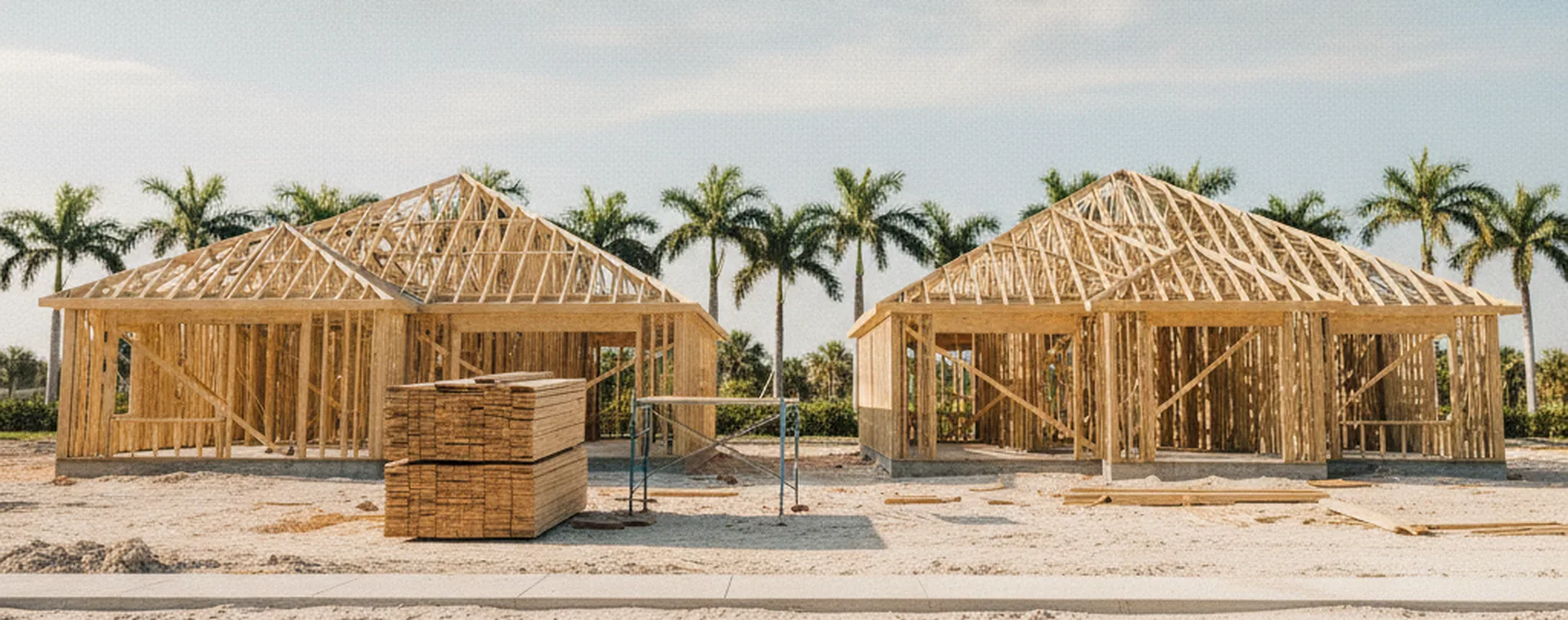
A South Dade job site is not a high-rise. It is a subdivision going up on graded sand, a packing house being rebuilt, a greenhouse range, a road widening. Low buildings and open ground, which changes the hazards and changes who the companies on the site are — but not the rule that only one of them is your employer.
- Your own employerWorkers’ compensation only, under § 440.11, and not part of this practice. The other tracks are.
- The general contractor, if not your employerResponsible for site conditions and coordination. Section 440.11 does not protect a company that does not employ you.
- Another subcontractor on the siteProtected under § 440.10(1)(e) only if comp was secured and its own gross negligence was not the major contributing cause.
- Equipment owners and manufacturersA rented lift, a borrowed saw, a defective guard. Maintenance records and inspection logs matter, and they are not kept forever.
- The property ownerA grower, a packing company, a developer. Ordinary premises duties apply to a party that is not your employer.
- Delivery and hauling driversConcrete, lumber, fill, equipment. A vehicle claim inside a construction case, with a commercial policy behind it.
- A staffing or labor contractorWho actually employed you is a legal question rather than an obvious one, and it decides which track each defendant falls on.
- A public project ownerRoad work for the county, the state or the city brings § 768.28 into it, with a notice requirement and caps.
03 Two tracks
04 The gross negligence sentence
05 A South Dade site
06 Who employed you
07 The first week
08 Examples of situations
Situations this office sees in Miami-Dade County
The following are examples of the kinds of situations that arise in this county. They are illustrations of how the rules apply, not descriptions of past cases, and they do not predict any outcome. Every claim turns on its own facts, its own coverage and its own medical record.
The unshored trench
A worker in an excavation on a subdivision when the wall gives way. The trench was dug by a different sub. Section 440.10(1)(e) protects that sub only if its own gross negligence was not the major contributing cause.
The rented lift
A fall from a lift that was rented, not owned, and whose last inspection is a question. The rental company and the equipment manufacturer are not your employer, and the maintenance record is the case.
The packing house rebuild
A worker hurt during a renovation at a working packing house. There is a general contractor, the operating company, and a grower who owns the land — three defendants and three policies, none of them your employer.
The crew van on US-1
A van carrying workers to a site is struck on the way in. A vehicle claim, a possible employer claim and a comp question at once, and who owned and operated the van decides how they fit together.
09 The evidence
Evidence that exists here and often goes uncollected
Almost every camera that saw the crash overwrites itself within days or weeks. The difference between a disputed liability case and a straightforward one is usually whether someone asked for the footage while it still existed.
Photographs of the site, within hours
The equipment, the condition and the protection that was or was not there. A trench is backfilled and a scaffold comes down the same day.
Every company name on the site
On trucks, trailers, hard hats and posted notices. The list of other companies on that site is the third-party case.
The permit file
A public record naming the owner, the general contractor and the licensed subs. City of Homestead for a city address, Miami-Dade County for an unincorporated one.
Proof of who employed you
The pay stub, the badge, the sign-in sheet, the text telling you where to report. Who your employer was decides which companies are protected.
The OSHA file, if there was an inspection
Citations, interviews and findings. Frequently the strongest independent account of what went wrong.
Written notice to your employer
Keep a copy. It starts the comp track and fixes the date the third-party claim also depends on.
10 The report
11 The office
Homestead construction accident questions, answered
Do I need a lawyer for a construction accident in Homestead?
For the workers’ compensation claim, that is a separate practice and not this one.
For the third-party claim, the difficulty is that the recovery depends on identifying companies you may never have been told the names of, and on site records that stop existing. That is the part that is hard to do alone, and it is also where the money usually is.
Who can I bring a claim against?
Anyone on that site who caused the injury and is not your employer: a general contractor who does not employ you, another subcontractor, an equipment owner or manufacturer, the property owner, a delivery driver.
Section 440.11 makes comp the exclusive remedy against your employer, with narrow exceptions. It says nothing about anybody else.
Can another subcontractor be sued?
Section 440.10(1)(e) gives a sub protection from a claim by another sub’s injured worker on two conditions: that comp was secured, and that the sub’s own gross negligence was not the major contributing cause of the injury.
Where its gross negligence was the major contributing cause, that protection does not apply. An unshored trench, a removed guard or a scaffold built wrong by another trade is where these cases open.
I do not have papers. Can I still make a claim?
The right to bring an injury claim in Florida does not depend on immigration status, and status is not an element of the case.
If you have questions about your own situation, that is exactly what the consultation is for.
What does a South Dade job site look like in one of these cases?
Usually a residential subdivision on graded lots, a packing house or cold storage building, a greenhouse or shade-house range, road widening on US-1 or Krome Avenue, or work around Homestead Air Reserve Base.
Low buildings and open ground, which means fewer falls from a structure and more trenching, ladder and scaffold injuries, more equipment moving across open lots, and heat as a real factor on an open site in summer.
What does it cost to ask?
The consultation is free and the representation is on a contingency fee, generally payable only on recovery. Case expenses are governed by the written agreement.
The conversation is with Jose A. Dapena, not an intake department.
12 Keep reading
- Florida construction accident lawThe statutes, the deadlines and the defenses, in full
- The Homestead officeEverything the office handles, and the area it covers
- Personal injury in FloridaThe whole practice, and the other 22 kinds of claim
This page is general information about Florida law, not legal advice about your case. Published by Jose A. Dapena, P.A. Last updated October 2026.
Free case review with a Homestead construction accident lawyer
No fee to talk and no obligation. You deal with your attorney directly, at every stage.