
Homestead negligent security lawyer
What the 2023 statute requires of an apartment owner, and where it does not apply
A negligent security claim says a property owner should have foreseen a crime and failed to take reasonable measures against it. Since 2023, Fla. Stat. § 768.0706 gives the owner of a multifamily residential property of five or more dwelling units a presumption against liability — but only if the owner proves it substantially implemented nine specific security measures, and § 768.0706(3) places that burden squarely on the owner. The statute reaches nothing else: a store parking lot on US-1, a gas station, a bar, a hotel or a packing house yard is governed by ordinary premises liability with no presumption at all. That distinction matters a great deal in Homestead, Naranja and Leisure City, where most of the rental housing is garden apartments in blocks of five or more units. The nine requirements and how foreseeability is proved are explained in full on the Florida negligent security page. What follows is the South Dade part.
- Miami-Dade County crashes, 2024
- 60,000Florida Department of Highway Safety and Motor Vehicles
- People injured
- 29,359In Miami-Dade County alone, in one year
- People killed
- 272Down from 325 the year before
- Where the statute applies
- 5+ unitsThe 2023 presumption covers multifamily residential only. § 768.0706(1)(b)
Quick answers about Homestead negligent security claims
- Where does the 2023 statute apply?
- Only to a multifamily residential property of five or more dwelling units. § 768.0706(1)(b). A store, a bar, a hotel, a garage or a parking lot is not covered by it at all.
- Does the presumption mean the owner wins?
- No. Section 768.0706(3) puts the burden on the owner to prove it substantially implemented the nine measures. Until it does, there is no presumption to apply.
- What are the nine things?
- They include lighting to a stated standard in common areas, parking lots and walkways; a one-inch deadbolt on each unit door; locking devices on windows and sliding doors; a peephole or viewer; and a documented crime-prevention assessment.
- What if it happened at a store or a gas station?
- Then ordinary premises liability applies, with no presumption and no statutory checklist. Foreseeability is proved with the crime history of that location and its surroundings.
- Does an arrest have to happen first?
- No. The claim is against the property owner for failing to take reasonable measures, not against the person who committed the crime, and it does not depend on a prosecution.
- What evidence disappears fastest?
- Camera footage, which overwrites within days, and the lighting as it actually was. A bulb gets replaced and a gate gets repaired within a week of a serious incident.
- How long do I have?
- Two years for a claim arising on or after March 24, 2023, under § 95.11. The footage and the lighting evidence are gone long before that.
01 The law, once
02 The places
Where negligent security claims arise in Miami-Dade County
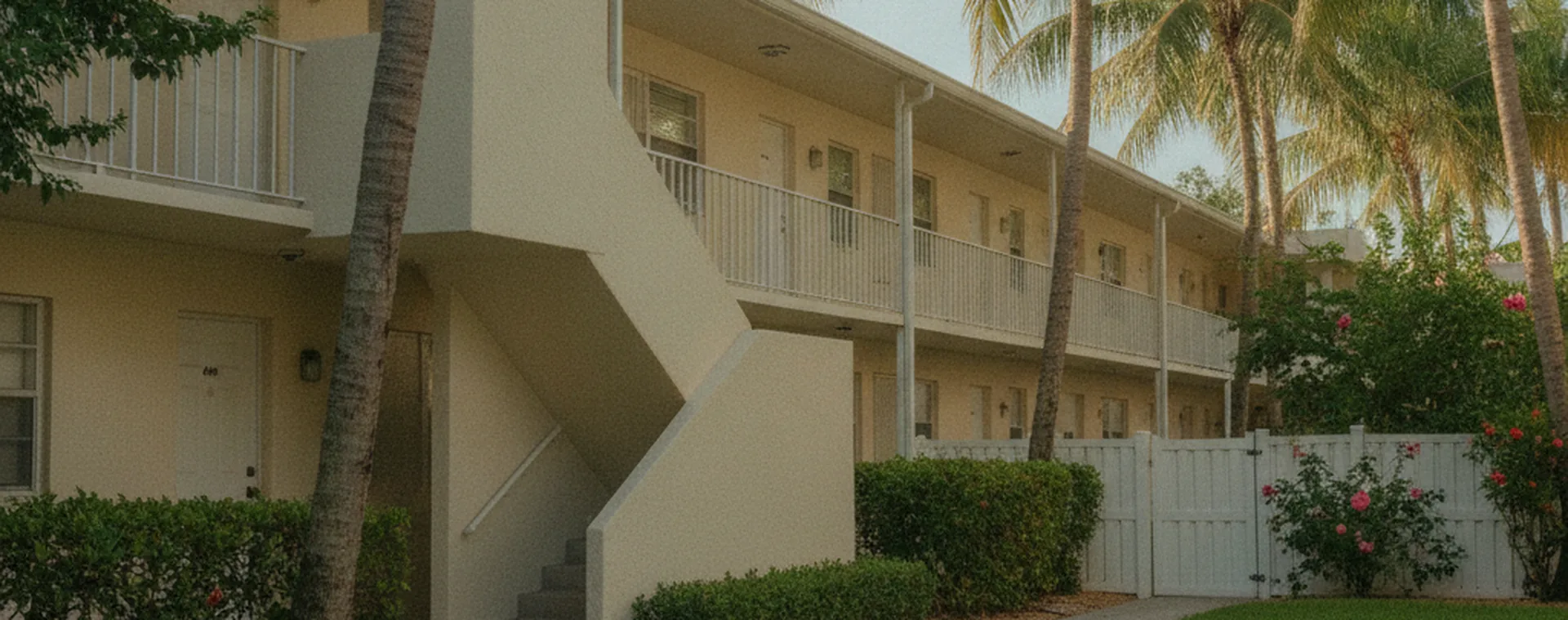
The rental housing in Homestead, Naranja and Leisure City is mostly two-story garden apartments built in blocks — which means the 2023 statute applies to a great deal of it, and the first question in the case is not what the owner did but whether the owner can prove it did nine specific things.
- Garden apartments of five or more unitsMost of the rental stock in Homestead, Naranja and Leisure City. The 2023 presumption is in play, and the burden to earn it is the owner’s.
- Duplexes and single-family rentalsFewer than five dwelling units, so § 768.0706 does not apply. Ordinary premises liability instead, with no checklist.
- The US-1 retail parking lotsNot multifamily residential, so no presumption at all. Foreseeability is proved from the crime history of that lot.
- Gas stations and convenience storesOpen late, cash on site, and the recurring setting for these claims. Ordinary premises liability.
- Bars and nightlifeIncluding event nights. No presumption, and the question is what the operator knew about prior incidents on its own property.
- Hotels and motels along US-1Commercial lodging rather than multifamily residential. The 2023 statute does not reach them.
- Packing houses, nurseries and labor housingBusiness property. Whether housing on it is multifamily residential of five or more units is a question of fact worth establishing early.
- Public housing and county-managed propertyA governmental owner adds § 768.28: a written notice requirement first, and caps on recovery.
03 The nine measures
04 Where it does not apply
05 The South Dade housing stock
06 Foreseeability
07 The first week
08 Examples of situations
Situations this office sees in Miami-Dade County
The following are examples of the kinds of situations that arise in this county. They are illustrations of how the rules apply, not descriptions of past cases, and they do not predict any outcome. Every claim turns on its own facts, its own coverage and its own medical record.
The dark walkway in Naranja
An assault on an open second-floor walkway where two fixtures had been out for weeks and tenants had complained. The complaint record and the night photographs are the case; the statute names the lighting standard directly.
The propped gate
A pedestrian gate in a perimeter fence that had not latched in months. The statute requires locked gates at a pool fence specifically, and a perimeter gate that never worked is ordinary negligence on top of that.
The convenience store lot on US-1
Not multifamily residential, so no presumption and no checklist. Foreseeability comes from the calls for service to that address and from what the operator had already been told.
The four-unit building
A property with fewer than five dwelling units falls outside § 768.0706 entirely. Ordinary premises liability applies, and establishing the unit count is the first thing to do rather than the last.
09 The evidence
Evidence that exists here and often goes uncollected
Almost every camera that saw the crash overwrites itself within days or weeks. The difference between a disputed liability case and a straightforward one is usually whether someone asked for the footage while it still existed.
A written preservation demand
To the management company and the registered agent, within days, naming the cameras and the window. This is the earliest deadline in the case.
Night photographs of the lighting
At the same hour the incident happened. What could actually be seen, and which fixtures were dark. A replaced bulb erases this permanently.
Calls for service to the address
From the agency that serves the property. The crime history of that specific address is the foundation of foreseeability.
Tenant complaints, in any form
A text, a resident portal message, an email about a broken gate or a dark walkway. Direct evidence the owner knew, and the easiest thing to lose.
The locks, gates and fence as they are
Photographed before repair. The statute is specific about deadbolt throw, window locks and gate locking, which makes the physical detail decisive.
Who owns and who manages
The Property Appraiser for the parcel owner, the Division of Corporations for the management company and its registered agent. Usually not the same entity.
10 The report
11 The office
Homestead negligent security questions, answered
Do I need a lawyer for a negligent security claim in Homestead?
This is not a case to attempt alone. The evidence that decides it — camera footage, the lighting as it was, the complaint history and the owner’s own records — is held by the other side and most of it is gone within a week.
It is also the one area of premises law where a 2023 statute sets out nine specific requirements, and knowing which of them the owner can actually document is the difference between a claim and a letter.
Does the 2023 statute mean the apartment owner is protected?
Only if the owner earns it. Section 768.0706(1) gives a presumption against liability to the owner of a multifamily residential property of five or more dwelling units, but only where it substantially implemented nine specific measures.
And § 768.0706(3) puts the burden of proving that on the owner. Until the owner produces the records, there is no presumption in the case.
What if it happened at a store or a parking lot?
Then § 768.0706 does not apply at all. It reaches only multifamily residential property of five or more dwelling units.
Ordinary premises liability applies instead: whether the crime was reasonably foreseeable, and whether the owner took reasonable measures. Foreseeability is proved from the crime history of that address and from what the operator had already been told.
Why does this come up so much in South Dade?
Because of the housing type. Rental housing in Homestead, Naranja, Leisure City and Goulds is predominantly two-story garden apartments in blocks of five or more units, with open walkways, exterior stairs, surface parking and a perimeter fence.
That is exactly the property the statute describes, and exactly the kind of property where its nine measures — walkway lighting, exterior deadbolts, sliding-door locks, a locked pool gate — are physical facts rather than abstractions.
Does someone have to be arrested first?
No. The claim is against the property owner for failing to take reasonable security measures, not against the person who committed the crime.
A prosecution may never happen and the claim does not wait for one. What matters is what the owner knew and what the owner did.
What does it cost to ask?
The consultation is free and the representation is on a contingency fee, generally payable only on recovery. Case expenses are governed by the written agreement.
The conversation is with Jose A. Dapena, not an intake department.
12 Keep reading
- Florida negligent security lawThe statutes, the deadlines and the defenses, in full
- The Homestead officeEverything the office handles, and the area it covers
- Personal injury in FloridaThe whole practice, and the other 22 kinds of claim
This page is general information about Florida law, not legal advice about your case. Published by Jose A. Dapena, P.A. Last updated October 2026.
Free case review with a Homestead negligent security lawyer
No fee to talk and no obligation. You deal with your attorney directly, at every stage.