
Homestead dog bite lawyer
Why where you were standing decides the case, and what the statute actually says
Florida does not give a dog one free bite. Fla. Stat. § 767.04 makes the owner liable for a bite that happens in a public place, or where the bitten person was lawfully in a private place including the owner’s own property — regardless of the dog’s former viciousness or whether the owner knew about it. So the first question is not whether the dog had bitten anybody before. It is where the bitten person was standing and whether they were entitled to be there, and in South Dade that answer is frequently complicated: unfenced acreage in the Redland, a gate that is the only boundary for five acres, working dogs at a nursery or packing house, and rural delivery routes where a carrier is on the property under a legal duty rather than an invitation. Every bite should also be reported to Miami-Dade Animal Services and to the Florida Department of Health in Miami-Dade. The statute and its exceptions are explained in full on the Florida dog bite page. What follows is the South Dade part.
- Miami-Dade County crashes, 2024
- 60,000Florida Department of Highway Safety and Motor Vehicles
- People injured
- 29,359In Miami-Dade County alone, in one year
- People killed
- 272Down from 325 the year before
- Prior bites required
- NoneLiability applies regardless of the dog’s former viciousness. § 767.04
Quick answers about Homestead dog bite claims
- Does the dog have to have bitten someone before?
- No. Section 767.04 imposes liability regardless of the dog’s former viciousness or the owner’s knowledge of it. Florida has no one-free-bite rule.
- I was on the owner’s property.
- That does not defeat the claim. The statute covers a bite on the owner’s own property as long as you were lawfully there — by invitation, express or implied, or performing a duty imposed by law or by postal regulations.
- There was a "Bad Dog" sign.
- An easily readable sign including those words, displayed in a prominent place, is a defense — except against a person under 6, and except where the owner’s own negligence proximately caused the damages.
- Who do I report the bite to?
- Miami-Dade Animal Services through its online Animal Bite Report, and the Florida Department of Health in Miami-Dade County at 305-324-2400. Both, and both promptly.
- What about rabies?
- That is the reason the health department is involved and why the dog has to be identified and its vaccination status established. It is a medical question before it is a legal one.
- The dog belongs to a business.
- Then there is usually a commercial policy rather than a homeowner’s one, and the analysis of who owned or kept the dog becomes part of the case.
- How long do I have?
- Two years for a claim arising on or after March 24, 2023, under § 95.11. The photographs of the injury and the scene are needed far sooner than that.
01 The law, once
02 Where it happened
Where dog bite claims arise in Miami-Dade County
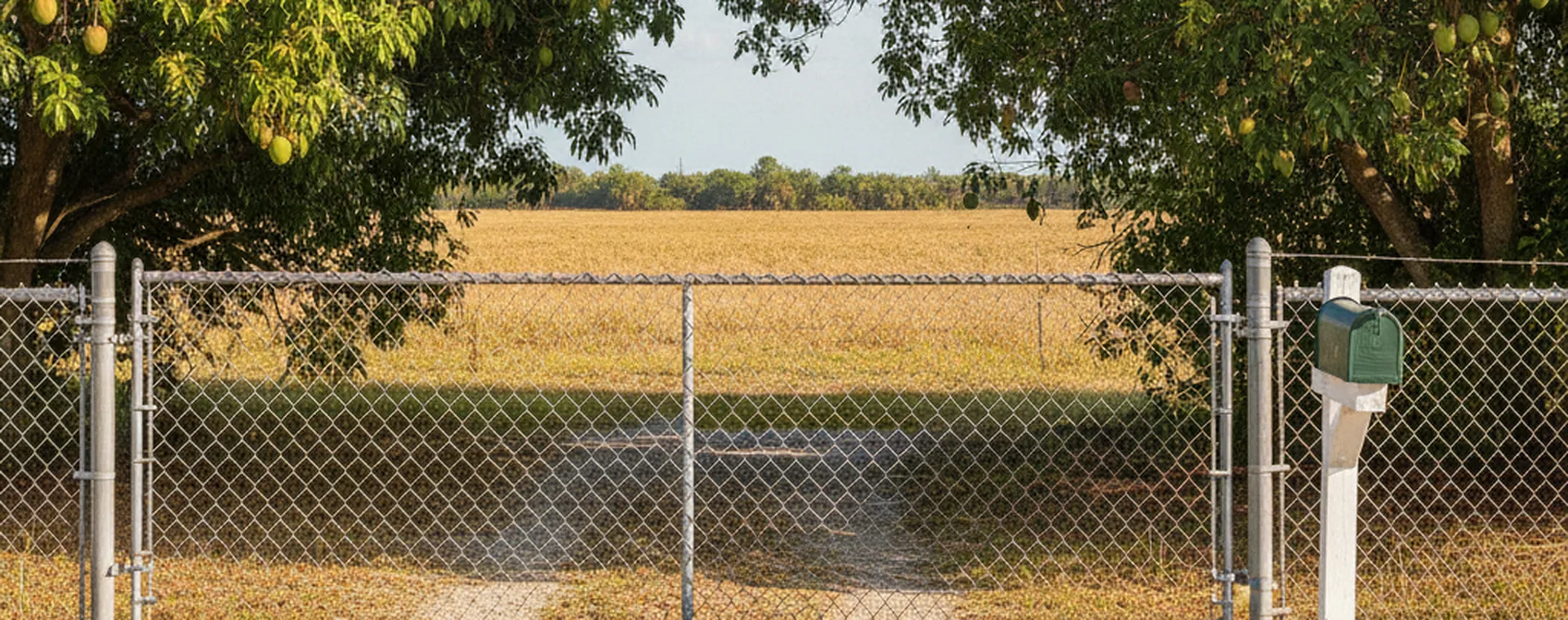
Where the bitten person was standing is the first question in every one of these cases, and in South Dade the answer is unusual more often than not. Acreage with no fence anybody can see, a gate that is the only boundary for five acres, a packing house yard, and a rural delivery route where somebody is lawfully on the property by law rather than by invitation.
- A public placeA street, a sidewalk, a park. The statute applies directly and the question of whether you were entitled to be there does not arise.
- On the owner’s property by invitationExpress or implied. A visitor, a guest, a contractor, somebody delivering something. The statute covers this expressly.
- Performing a duty imposed by lawA mail carrier under postal regulations, a meter reader, an inspector. Lawfully present without any invitation at all.
- Unfenced Redland acreageWhere a property line is a row of trees and nobody can tell where it is. The boundary itself becomes a question of fact.
- A nursery, grove or packing house yardWorking dogs on a business property, which usually means a commercial policy and a question about who kept the dog.
- A rented house or apartmentThe owner of the dog is liable under § 767.04. A landlord’s separate responsibility is a different and narrower question.
- Where a "Bad Dog" sign was postedA defense under § 767.04 — except against a child under 6, and except where the owner’s own negligence caused the damages.
- A county or city parkGovernmental property, which adds the § 768.28 notice requirement if the claim is against the public body rather than the dog’s owner.
03 No free bite
04 The boundary problem
05 The Bad Dog sign
06 Reporting it
07 The injury
08 Examples of situations
Situations this office sees in Miami-Dade County
The following are examples of the kinds of situations that arise in this county. They are illustrations of how the rules apply, not descriptions of past cases, and they do not predict any outcome. Every claim turns on its own facts, its own coverage and its own medical record.
The rural delivery route
A carrier walking up an unmarked Redland driveway is bitten at the door. They were lawfully present performing a duty under postal regulations, which the statute covers expressly, and no invitation was needed.
The loose dog on the road
A dog off its own property bites a person walking on the street. This is a public-place bite, and whether the person was entitled to be anywhere does not arise.
The nursery yard
A customer at a plant nursery is bitten by a dog kept on the premises. There is usually a commercial policy, and the question of who owned or kept the dog becomes part of the case.
The child at a family gathering
A bite to a young child on a property that has a Bad Dog sign. The sign defense does not apply to a person under 6, and the claim proceeds on the statute as written.
09 The evidence
Evidence that exists here and often goes uncollected
Almost every camera that saw the crash overwrites itself within days or weeks. The difference between a disputed liability case and a straightforward one is usually whether someone asked for the footage while it still existed.
Photographs of the wound, at every stage
Before closure, during healing, and after. A bite claim is largely a scarring claim, and only the early photographs show what it was.
Photographs of the property as it was
What was fenced, gated and posted, and what a person approaching could see. Fences get built and signs appear after a bite.
The sign, exactly as it was
Its wording, its size, its position and whether it was readable. The defense depends on those details and they are easy to change later.
The Animal Services report
The official record of the dog, its owner and its vaccination status. Without it, an insurer’s first position is that nothing is verified.
The owner and the parcel
A name and an address, confirmed against the Property Appraiser. The person at the gate is frequently not the person on the deed.
Witnesses and any prior complaints
Neighbors who knew the dog, and any earlier Animal Services complaint. Not required to prove liability, but it changes how a claim is valued.
10 The report
11 The office
Homestead dog bite questions, answered
Do I need a lawyer for a dog bite in Homestead?
Where a bite broke no skin and healed in a week, there is nothing to build a case around.
Where there is scarring, a hand or face injury, a child, or an owner disputing where you were standing, the case turns on evidence that changes within days — the wound, the property, and the sign if there was one.
Does Florida give a dog one free bite?
No. Section 767.04 imposes liability on the owner regardless of the dog’s former viciousness and regardless of whether the owner knew about it.
That is the opposite of what most people assume, and it means the owner’s knowledge is not something you have to prove.
I was on the owner’s property when it happened.
The statute covers a bite on the owner’s own property as long as you were lawfully there. Lawfully there includes being on the premises by invitation, express or implied, and being there performing a duty imposed by state law, by federal law or postal regulations, or by a municipal ordinance.
In the Redland, where a driveway may run a hundred yards and nothing marks the sides of a parcel, that question deserves photographs of the property as it actually was.
There was a Bad Dog sign on the gate.
That is a real defense under § 767.04, but it is narrow. The sign has to be easily readable, displayed in a prominent place, and include the words "Bad Dog".
And it has two exceptions. It does not apply at all to a person under 6 years of age, and it does not apply where the damages were proximately caused by the owner’s own negligent act or omission — a gate left open, for instance.
Who do I report the bite to?
Miami-Dade Animal Services, through the county’s Animal Bite Report. The Pet Adoption and Protection Center is at 3599 NW 79th Avenue in Doral.
And the Florida Department of Health in Miami-Dade County, at 305-324-2400, which handles the rabies-exposure side. Report to both, and do it promptly — the report is what establishes the dog and its vaccination status.
What does it cost to ask?
The consultation is free and the representation is on a contingency fee, generally payable only on recovery. Case expenses are governed by the written agreement.
The conversation is with Jose A. Dapena, not an intake department.
12 Keep reading
- Florida dog bite lawThe statutes, the deadlines and the defenses, in full
- The Homestead officeEverything the office handles, and the area it covers
- Personal injury in FloridaThe whole practice, and the other 22 kinds of claim
This page is general information about Florida law, not legal advice about your case. Published by Jose A. Dapena, P.A. Last updated October 2026.
Free case review with a Homestead dog bite lawyer
No fee to talk and no obligation. You deal with your attorney directly, at every stage.