
Personal injury
Who pays if I am hit while delivering for DoorDash or Uber Eats?
A delivery crash has two sides: the delivery driver who was hurt, and the person hurt by a delivery driver. Florida’s rideshare insurance law is about passenger rides and does not mention deliveries.
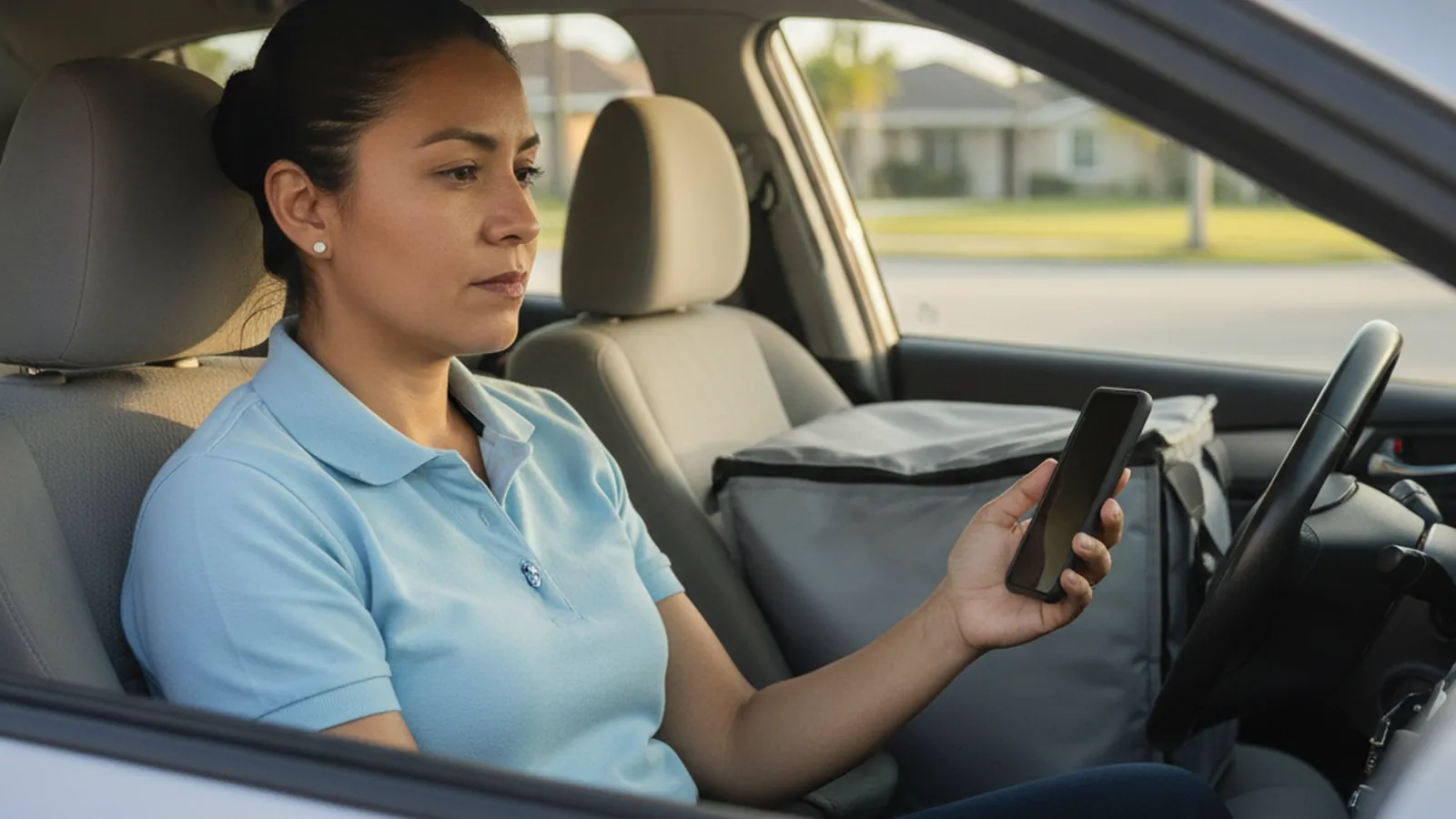
Your own Personal Injury Protection pays first, up to $10,000, whoever caused the crash, if your policy covers the trip. After that it depends on which side you were on. If you were the delivery driver, the claim runs against the driver who hit you, and against your own uninsured motorist coverage if that driver has too little insurance. DoorDash says it provides occupational accident coverage that may pay a driver’s medical bills; Uber says what it maintains does not pay a driver’s injuries. If a delivery driver hit you, the claim runs against that driver’s policy and, while an order was active, whatever liability coverage the app says it maintains. Section 627.748, Florida’s rideshare insurance statute, covers prearranged rides with a rider and does not mention deliveries.

01 The statute
Does Florida’s Uber and Lyft insurance law cover food delivery?
No. Section 627.748 is written for passenger rides. It defines a prearranged ride as transportation of a rider by a driver, beginning when the driver accepts a ride requested through the company’s digital network and ending when the last rider leaves the vehicle, and it defines a rider as a person who uses the network to obtain that ride (§ 627.748(1)(b), (c)). The words delivery and food do not appear anywhere in the statute, and its history ends with a 2020 law.
A food order has no rider, so the statute’s tiers do not describe it. The $50,000, $100,000 and $25,000 liability tiers apply while a driver is logged on to a ride network, and the $1 million tier applies during a prearranged ride (§ 627.748(7)(b), (c)). The statute does not say whether logging on to a delivery app counts as logging on to a ride network. That turns on the company’s terms and the policy, which a lawyer can read for a particular company.
The statute also leaves room for personal policies to exclude commercial use. It does not invalidate or limit a policy exclusion for vehicles used to carry persons or property for a charge or available for hire by the public (§ 627.748(8)(c)1). DoorDash’s own page says that many personal policies are written for personal driving and that an insurer that treats delivery as business use can affect whether claims are covered.
Florida’s rideshare insurance statute is about passengers. A delivery is not a ride.
02 Your own PIP
Does my own PIP pay if I am hit while making a delivery?
PIP is the first layer for a person hurt in a motor vehicle crash, and it does not ask who was at fault. A policy that meets Florida’s security requirements must provide PIP to the named insured, to relatives living in the household, to people operating the insured car, to passengers, and to “other persons struck by the motor vehicle and suffering bodily injury while not an occupant of a self-propelled vehicle,” up to $10,000 in medical and disability benefits (§ 627.736(1)). Medical benefits are 80 percent of reasonable expenses, and only if you receive initial services and care within 14 days of the crash (what the 14 days require).
Without an emergency medical condition finding, the limit is $2,500. The full $10,000 is available when a physician, dentist, physician assistant or advanced practice registered nurse determines that you had an emergency medical condition; if the provider determines you did not, reimbursement is limited to $2,500 (§ 627.736(1)(a)).
Whether your policy applies during a delivery is a question about its wording. The PIP statute sets the minimum a compliant policy must provide, and § 627.748(8)(b) lets an insurer exclude coverage while a driver is logged on to a ride network or giving a ride. Neither says anything about deliveries. Get the policy, read the exclusions and the definition of business use, and do not assume the answer either way. A denial letter is not the end of the claim, because other layers may still apply.
If workers’ compensation applies, it is credited against PIP. The statute says benefits received under any workers’ compensation law are credited against the PIP benefits (§ 627.736(4)).
03 The other driver
If another driver hit me during a delivery, who pays beyond PIP?
The claim reaches the driver who caused the crash and the insurance behind that driver. Florida’s no-fault law exempts drivers from tort liability to the extent PIP benefits are payable, and allows a claim for pain and suffering only when the injury is a significant and permanent loss of an important bodily function, a permanent injury within a reasonable degree of medical probability, significant and permanent scarring or disfigurement, or death (§ 627.737(1), (2)). The claim also reaches the expenses PIP does not pay.
Fault is shared by percentage, and above 50 percent you recover nothing. A party found more than 50 percent at fault for his or her own harm may not recover damages (§ 768.81(6)). That is why both “the delivery driver was rushing” and “the other driver ran the light” matter (what a partial-fault claim does).
When the delivery driver is the one who caused the crash, there may be three layers of coverage. They are the driver’s personal policy, which may exclude delivery use; the liability coverage the app says it maintains while an order is active; and any other policy that covers the car if the driver does not own it. DoorDash’s help page lists Boston, North Dakota, Indiana, Kentucky and West Virginia separately and puts every other U.S. state under one entry, so Florida is not listed on its own. For that entry it says DoorDash provides third-party auto liability insurance from the moment a Dasher accepts a request until the order is delivered, unassigned or canceled, and that a Dasher who is online but has not accepted a request is covered by their own insurance as the primary policy. It states no limit for that entry. Uber’s page says its coverage depends on the state and on whether the driver was offline, online, en route or on a trip, and it does not state limits; it sends drivers to the Driver app.
Whether the app itself can be held responsible is a different question. DoorDash’s page says drivers work under an Independent Contractor Agreement. Whether a company that calls its drivers contractors can be held liable for a driver’s negligence turns on the facts and on case law that a lawyer has to read.
If those layers all fail, there may be little behind the claim. Florida does not require most drivers to carry bodily injury liability coverage (when the driver who hit you has no insurance), and your own uninsured motorist coverage then becomes the next place to look.
04 The delivery driver
Do DoorDash or Uber Eats pay my medical bills if I was the driver who got hurt?
DoorDash says it provides occupational accident coverage automatically. Its Dasher insurance page, read November 13, 2026, says that if you are injured during an active delivery, coverage may include medical expenses up to $1,000,000 and disability payments of 50 percent of your average weekly earnings, up to $500 a week, with no enrollment, premium, deductible or co-pay. It adds that coverage is subject to policy terms, conditions, limitations, exclusions and local law, and may vary by state. It says coverage maintained by DoorDash does not pay for repairs to your own vehicle.
Uber says what it maintains does not pay for your injuries. Uber’s delivery insurance page, read the same day, says coverage maintained by Uber does not pay for the driver’s injuries or for repairs to the driver’s car in any period of a delivery, that in most states a driver may buy optional injury protection, and that Uber maintains no coverage when the driver is offline.
Those are the companies’ descriptions, not the policies. Both pages say coverage varies by state and by what you were doing when the crash happened. Ask for the policy and the claim form. The definition of an active delivery, the exclusions and any rule about which coverage pays first decide what a driver actually receives, and a lawyer has to read them.
Your own coverages and the at-fault driver are still in play. Uninsured motorist coverage protects insured persons who are legally entitled to recover from the owner or operator of an uninsured vehicle, unless the named insured rejected it in writing (§ 627.727(1)). DoorDash’s page says UM and UIM coverage on a personal policy may help if you are hit by a driver with no insurance or too little, and to confirm with your insurer whether it applies during deliveries.
05 Workers’ compensation
Is a DoorDash or Uber Eats driver covered by workers’ compensation?
Only if the driver is an employee under chapter 440, and the label in the contract does not decide it. The statute defines an employee as a person who receives remuneration from an employer for work under a contract for hire, and it excludes an independent contractor who is not in the construction industry (§ 440.02(18)(a), (d)1.). To qualify as an independent contractor a person must meet at least four of six listed criteria, such as a separate business with its own equipment, pay received by a business rather than an individual, or the ability to work for others without an application; a person who does not meet four may still be presumed one after full consideration of the situation. A person claiming to be an independent contractor has the burden of proving it.
The statute that treats rideshare drivers as contractors is limited to rides. Section 627.748(9) says a TNC driver is an independent contractor if four conditions are met. It speaks of TNC drivers, who provide prearranged rides, and does not mention deliveries.
If workers’ compensation does apply, the deadlines are short. An employee must tell the employer of the injury within 30 days, with exceptions (§ 440.185(1)), and a petition for benefits must be filed within two years after the employee knew or should have known the injury arose from work (§ 440.19(1)).
Workers’ compensation does not end the claim against the other driver. An injured employee may accept compensation and also pursue the third party who caused the injury, and the employer or its insurer is subrogated to the employee’s rights to the extent of the benefits paid (§ 440.39(1), (2)). If the employee does not sue within one year after the cause of action accrues, the employer or carrier may, after 30 days’ notice, bring the action itself (§ 440.39(4)(a)).
The words “independent contractor” in a contract are where the question starts, not where it ends.
06 Deadlines
How long do I have to make a claim after a delivery crash?
PIP needs care within 14 days. Medical benefits are payable only if initial services and care are received within 14 days after the crash (§ 627.736(1)(a)).
A negligence lawsuit must be filed within two years. An action founded on negligence has a two-year limit (§ 95.11(5)(a)), and the other clocks that can apply to a crash are in the article on filing deadlines.
A workers’ compensation claim has its own two clocks. Notice to the employer within 30 days and a petition within two years. Whether the clock for a delivery driver is the compensation clock, the negligence clock or both depends on the facts, so treat the shortest one as the one that matters first.
Report the crash to the app, but do not wait on that process. Both companies’ pages ask drivers to report an accident through the app. A report to the app is not a substitute for seeing a doctor within 14 days.
07 Evidence
What evidence matters after a crash with a delivery driver?
The crash report and what it says about the delivery. When a crash results in injury or any complaint of pain, the officer completes a long-form report (§ 316.066(1)(a)). Tell the officer that a delivery was underway, and say which company, so the report can be read later with that in view.
The app’s own records are not automatically available. For rides, the statute requires a TNC to give a directly involved party or an insurer the precise log-on and log-off times for the 12 hours before and after the crash on request (§ 627.748(8)(d)). The statute says nothing like that about deliveries, so the records for a delivery come through the claim, a written request to preserve them, or a lawsuit.
Screenshot the app before it refreshes. The order status, the pickup and drop-off times and the account name show whether an order was active, and the active period is what both companies’ pages use to decide what they maintain.
08 Miami-Dade and Hillsborough
Where do the report and the case go in Miami-Dade, Homestead and Hillsborough?
The report comes from the state portal or from the agency that wrote it. The portal is the quickest route, and the agency keeps its own copy. How each works is in the guide for Miami-Dade and Homestead and the one for Tampa and Hillsborough County. In Homestead the city’s own police department keeps reports for crashes it handled.
A suit is filed in the county where the defendant lives, where the crash happened, or where a company has an office or agent. Florida’s venue statutes set those options (§ 47.011, § 47.051), and where a car accident lawsuit is filed explains the Miami-Dade and Hillsborough courts. A delivery company that does business in both counties does not change that.
09 Jose A. Dapena
Who handles a delivery crash claim in Miami, Homestead and Tampa?
A call is about which side of the crash you were on. Jose A. Dapena starts with the questions that decide these claims: whether an order was active, which policies could apply, whether the injured driver might be an employee, and which clock is running. He handles the workers’ compensation claim if the driver turns out to be an employee and the injury claim against the other driver, and the two can run together.
Where Jose A. Dapena appears. His injury work is in Miami, Homestead and Tampa, and the first conversation covers the app involved, the other driver and what coverage may be in play.
10 An example
Two people, one kind of crash, two sets of insurance
A driver on an active delivery, with the order accepted, is hit by a car that runs a red light. She sees a doctor the next day, so the 14 days are met. Her own PIP pays first if her policy covers the trip. The driver who ran the light is the at-fault party, and the company says it may pay her medical bills through an occupational accident policy. She asks for that policy rather than assuming it pays, and she keeps the clocks in view.
A man crossing at a crosswalk is hit by a delivery driver who was looking at the app. PIP can reach a person struck by a motor vehicle while not in one (§ 627.736(1)); which policy pays first is a question about the policies. The delivery driver’s personal policy is the first liability question, and then whatever liability coverage the app says it maintains while the order was active. This is an illustration of how the pieces fit together, not a real case.
A constructed example, written to show how the rule works. It is not a case this firm handled and it is not a promised result.
11 What to do now
- Call 911 and say it was a deliveryA crash with an injury or any complaint of pain gets a long-form report, and the report is the first record of who was driving and why.
- See a doctor within 14 daysPIP medical benefits depend on initial services and care within 14 days, however the crash happened.
- Screenshot the app before it refreshesThe order status, the pickup and drop-off times and the account name show whether an order was active.
- Report the crash to the app and to your insurer, and say only what happenedA short factual account is enough. Do not sign a release or accept a payment until you know what else you may claim.
- Ask for the policies, not the summariesThe companies’ pages describe coverage in general terms and say it varies by state and is subject to exclusions.
- Keep every bill and every record of what you earnedPIP’s disability benefit and any lost-income claim depend on proof of what you were earning.
12 What an attorney would look into
- Whether an order was accepted and active when the crash happened, from the app’s records and the drivers’ accounts
- Whether the delivery driver’s personal policy excludes delivery use, and what the app says it maintains for that period
- Whether the injured driver is an employee or an independent contractor under § 440.02, and whether notice to an employer is still possible
- Which PIP policy responds, whether care came within 14 days, and whether an emergency medical condition was found
- Whether uninsured or underinsured motorist coverage exists or was rejected in writing, and by whom
- Who owns the vehicle, and what else covers it
13 The sources
- Fla. Stat. § 627.748 Transportation network companiesDefines prearranged rides and riders, sets the insurance tiers for TNC drivers, allows exclusions while a driver is logged on, and does not mention deliveries.
- Fla. Stat. § 627.736 Personal Injury ProtectionPIP of $10,000, 80 percent of medical bills if care comes within 14 days, a $2,500 limit without an emergency medical condition, and a credit for workers’ compensation.
- Fla. Stat. § 627.737 Tort exemption and permanency thresholdLimits a claim for pain and suffering to a significant and permanent loss of a bodily function, permanent injury, significant scarring or death.
- Fla. Stat. § 627.727 Uninsured and underinsured vehicle coverageUninsured motorist coverage is part of a policy unless the named insured rejects it in writing.
- Fla. Stat. § 768.81 Comparative faultA party found more than 50 percent at fault for his or her own harm may not recover damages.
- Fla. Stat. § 95.11(5)(a) Two-year limit for negligenceAn action founded on negligence must be filed within two years.
- Fla. Stat. § 440.02 Employee and independent contractorDefines an employee, excludes an independent contractor outside construction, and sets the four-of-six criteria and the burden of proof.
- Fla. Stat. §§ 440.185, 440.19 Notice and petition deadlinesNotice to the employer within 30 days and a petition within two years after the employee knew or should have known the injury arose from work.
- Fla. Stat. § 440.39 Claims against a third partyAn injured employee may accept compensation and sue the third party; the carrier is subrogated; after one year and notice the carrier may bring the action.
- Fla. Stat. § 316.066 Written crash reportsA long-form report is completed for a crash with an injury or any complaint of pain.
- DoorDash Insurance Basics for DashersDescribes occupational accident coverage, third-party liability in most states and what is not covered. Read November 13, 2026.
- DoorDash Help Center Understanding Auto Insurance Maintained by DoorDashState entries for liability coverage and the delivery service period. Florida falls under the entry for all other states. Read November 13, 2026.
- Uber Insurance for delivery tripsDescribes third-party liability by period, says Uber’s coverage does not pay a driver’s injuries or vehicle repairs, and points to the Driver app for limits. Read November 13, 2026.
More questions
Does DoorDash or Uber Eats insurance cover me if I am hit while delivering?
DoorDash says it provides occupational accident coverage automatically, with medical benefits that may reach $1,000,000 and disability payments of 50 percent of average weekly earnings up to $500 a week, subject to its terms and exclusions. Uber says what it maintains does not pay a driver’s own injuries and that optional injury protection is sold in most states.
Both pages describe the coverage in general terms. The policy decides what is actually paid.
Does the app’s insurance pay the other person if a delivery driver hits them?
DoorDash says it provides third-party auto liability insurance from the time a Dasher accepts a request until the order is delivered, unassigned or canceled, in the states its page lumps together, which includes Florida. It states no limit for that entry. Uber says its liability coverage depends on the state and the driver’s status in the app and points to the Driver app for limits.
The driver’s personal policy is also in play, and it may exclude delivery use.
Does Florida’s rideshare insurance law apply to DoorDash and Uber Eats?
Section 627.748 is written for prearranged rides with a rider, and the statute does not mention deliveries. It does not say whether logging on to a delivery app counts as logging on to a ride network.
Which coverage applies to a delivery therefore comes from the policies and the companies’ own terms.
Is a DoorDash or Uber Eats driver an employee?
It depends on the facts. Under § 440.02, an independent contractor outside construction must meet at least four of six criteria or be presumed one after full consideration of the situation, and the person claiming to be an independent contractor has the burden of proving it. The label in a contract does not decide it.
The statute that treats rideshare drivers as contractors, § 627.748(9), speaks of rides and does not mention deliveries.
What if I was online but had not accepted an order?
DoorDash’s page says that for the states it lists together, a Dasher who is online but has not accepted a request is covered by their own auto insurance as the primary policy. Uber’s page describes separate periods for offline, online and available, and en route or on a trip, and sends drivers to the Driver app for the limits.
Your personal policy, and whether it excludes delivery use, matters most in that period.
Can I still claim if my own insurer says it does not cover delivery?
Yes, other layers may still apply: the at-fault driver’s liability coverage, your uninsured or underinsured motorist coverage if you have it, and any coverage the app maintains.
The statute allows policies to exclude vehicles carrying persons or property for a charge, so read the exclusion rather than relying on a phone call.
I was hit by a delivery driver as a pedestrian. Whose insurance pays?
PIP can reach a person struck by a motor vehicle while not in a self-propelled vehicle (§ 627.736(1)). Which policy pays first depends on your household’s coverage and the vehicle that hit you.
Beyond PIP, the claim runs against the driver who caused the crash, then any liability coverage the app says it maintains while an order was active.
How long do I have to sue?
A negligence action has a two-year limit (§ 95.11(5)(a)). PIP medical benefits depend on care within 14 days, and a workers’ compensation claim has a 30-day notice and a two-year petition deadline.
Treat the shortest clock as the first one.
Should I give the app’s insurer a recorded statement?
A recorded statement is for the company’s file. Giving the basic facts is fine. Guessing about speeds, distances or injuries is where statements go wrong.
A lawyer can handle the contact with the app and its insurer for you.
Can I sue DoorDash or Uber Eats directly?
Whether a company can be held responsible for a delivery driver turns on the facts and on case law that a lawyer has to read. DoorDash’s page says drivers work under an Independent Contractor Agreement.
A lawyer reads the contract, the policy and what happened.
What if the delivery was by bicycle, e-bike or scooter?
These rules are written for cars. PIP and the permanency threshold are written for motor vehicles, and a crash with a bicycle, e-bike or scooter turns on different facts.
DoorDash’s page lists separate limits for some states for electric and motorized bicycles.
What does it cost to talk to Jose A. Dapena about a delivery crash?
The first consultation on an injury matter is free. Representation is on a contingency fee, generally payable only on recovery, with case expenses governed by the written agreement.
He will tell you honestly whether a claim is worth bringing.
Hit while delivering, or hit by a delivery driver?
Tell Jose A. Dapena which side of the crash you were on and which app was involved. He will tell you which policies to ask for, which clocks are running and whether a claim is worth bringing. The call is free and there is no obligation.